
RoboTTT: Context Scaling for Robot Policies
Yunfan Jiang, Yevgen Chebotar, Ruijie Zheng, Fengyuan Hu, Yunhao Ge, Jimmy Wu, Tianyuan Dai, Scott Reed, Li Fei-Fei, Yuke Zhu, Linxi "Jim" Fan · N/A · 2026
Framework
N/A
License
N/A
Stars
N/A
Summary
Recent robot foundation models operate with single-step or short-history visuomotor context. We introduce Test-Time-Training Robot Policies (RoboTTT), a robot model and training recipe that scale visuomotor context to 8K timesteps, three orders of magnitude beyond state-of-the-art policies, witho...
Abstract Summary
Key Points
- Recent robot foundation models operate with single-step or short-history visuomotor context
- We introduce Test-Time-Training Robot Policies (RoboTTT), a robot model and training recipe that ...
- At this context length, we unlock new robot capabilities: one-shot in-context imitation from huma...
- We also observe, for the first time, steady gains in closed-loop performance as pretraining conte...
- At its core, RoboTTT integrates Test-Time Training into robot foundation models such as Vision-La...
RoboTTT: Context Scaling for Robot Policies
|Authors: Yunfan Jiang, Yevgen Chebotar, Ruijie Zheng, Fengyuan Hu, Yunhao Ge, Jimmy Wu, Tianyuan Dai, Scott Reed, Li Fei-Fei, Yuke Zhu, Linxi “Jim” Fan
|Venue: arXiv preprint | Year: 2026
|arXiv: 2607.15275v1
Abstract
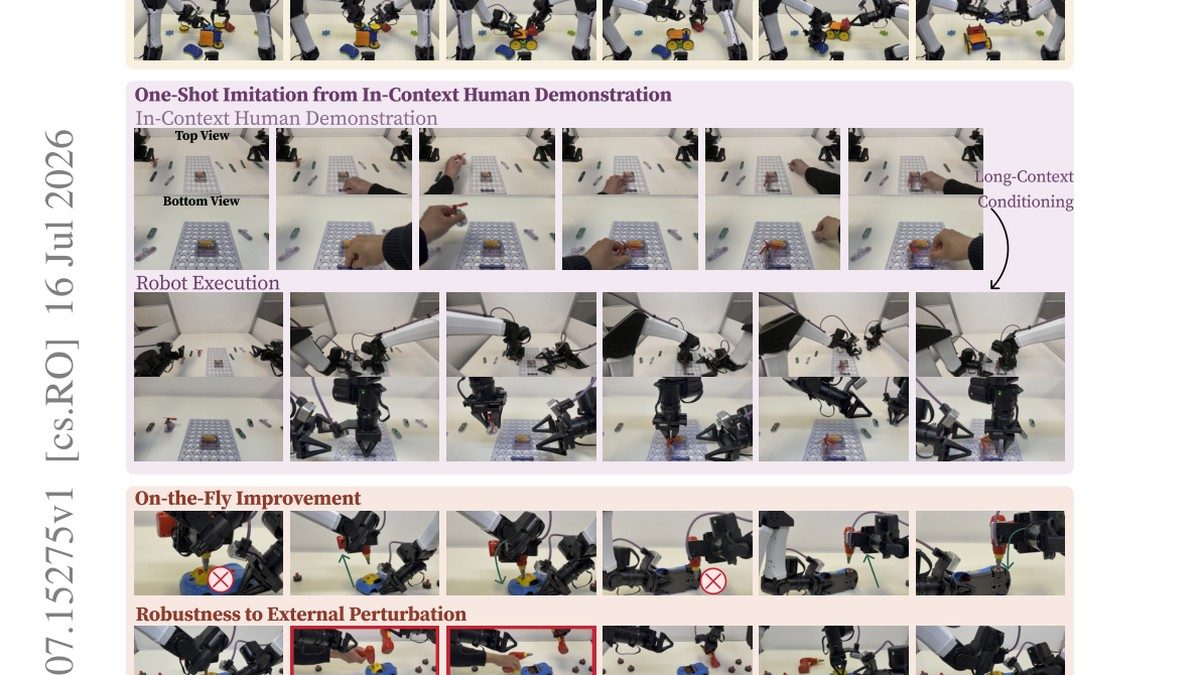
Recent robot foundation models operate with single-step or short-history visuomotor context. We introduce Test-Time-Training Robot Policies (RoboTTT), a robot model and training recipe that scale visuomotor context to 8K timesteps, three orders of magnitude beyond state-of-the-art policies, without growing inference latency. At this context length, we unlock new robot capabilities: one-shot in-context imitation from human video demonstrations, on-the-fly policy improvement, robustness to perturbations, and stronger performance on multi-stage, long-horizon tasks. We also observe, for the first time, steady gains in closed-loop performance as pretraining context length scales. At its core, RoboTTT integrates Test-Time Training into robot foundation models such as Vision-Language-Action policies, yielding a sequence model whose recurrent state consists of fast weights, parameters updated by gradient descent during both training and inference, compressing histories into weight space and retrieving contextual information for long-context conditioning. To scale training context length, the recipe combines sequence action forcing with truncated backpropagation through time. On challenging real-robot manipulation tasks, RoboTTT improves overall performance by 87% over the single-step context baseline and fully completes a five-minute, ten-stage assembly task, which no baseline ever does. RoboTTT trained with 8K-timestep context outperforms the same model pretrained with 1K timesteps by 62%, suggesting context length as a new scaling axis for robot foundation models. Videos are available at https://research.nvidia.com/labs/gear/robottt/
Key Contributions
- Recent robot foundation models operate with single-step or short-history visuomotor context
- We introduce Test-Time-Training Robot Policies (RoboTTT), a robot model and training recipe that …
- At this context length, we unlock new robot capabilities: one-shot in-context imitation from huma…
- We also observe, for the first time, steady gains in closed-loop performance as pretraining conte…
- At its core, RoboTTT integrates Test-Time Training into robot foundation models such as Vision-La…
Topics
- manipulation
- vision
- vla
- reinforcement-learning
- learning-from-demonstration
Code & Data
- GitHub repository: https://github.com/fla-org/flash-linear-attention
BibTeX
@article{Jiang2026_260715275v1,
  title     = {RoboTTT: Context Scaling for Robot Policies},
  author    = {Yunfan Jiang and Yevgen Chebotar and Ruijie Zheng and Fengyuan Hu and Yunhao Ge and Jimmy Wu and Tianyuan Dai and Scott Reed and Li Fei-Fei and Yuke Zhu and Linxi "Jim" Fan},
  year      = {2026},
  eprint    = {2607.15275v1},
  archivePrefix = {arXiv},
  primaryClass  = {cs.RO},
  url       = {https://arxiv.org/abs/2607.15275v1}
}
Related Papers
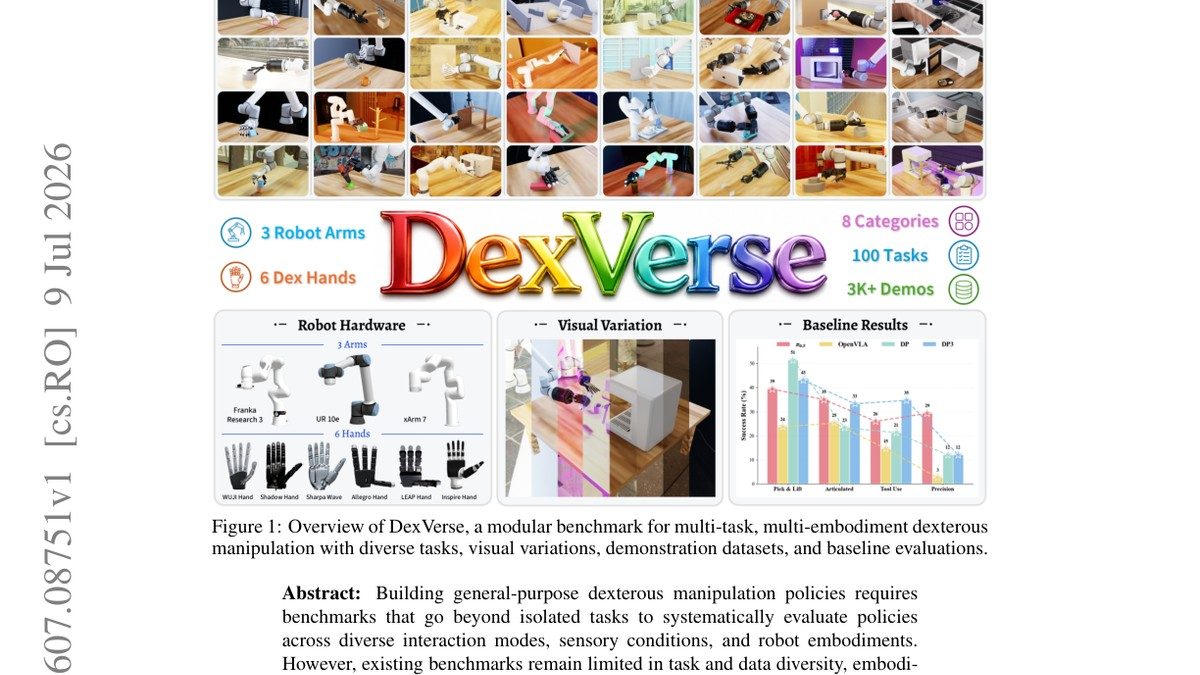
DexVerse: A Modular Benchmark for Multi-Task, Multi-Embodiment Dexterous Manipulation
Yunchao Yao, Zhuxiu Xu, Tianqi Zhang et al. · arXiv preprint · Jul 2026
Building general-purpose dexterous manipulation policies requires benchmarks that go beyond isolated tasks to systematically evaluate policies across diverse interaction modes, sensory conditions, and robot embodiments. However, existing benchmarks remain limited in task and data diversity, embod...
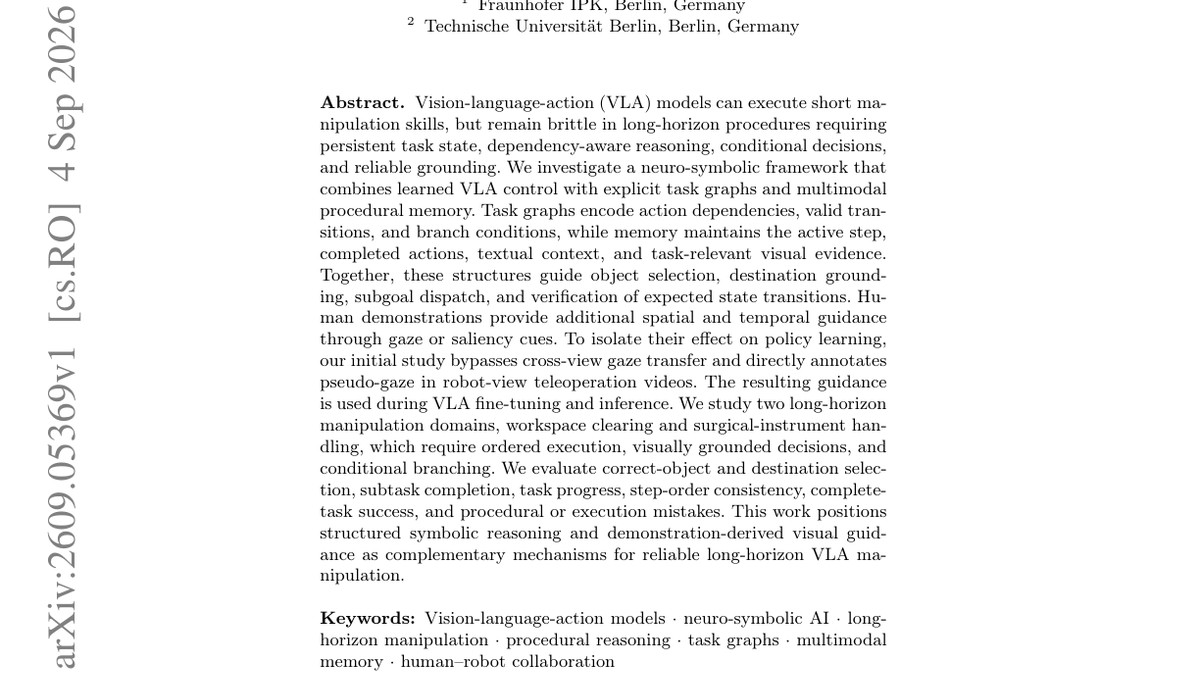
Towards Neuro-Symbolic Procedural Reasoning for Long-Horizon Vision-Language-Action Manipulation
Vivek Chavan, Yahuan Shi, Oliver Heimann et al. · arXiv preprint · Sep 2026
Vision-language-action (VLA) models can execute short manipulation skills, but remain brittle in long-horizon procedures requiring persistent task state, dependency-aware reasoning, conditional decisions, and reliable grounding. We investigate a neuro-symbolic framework that combines learned VLA ...
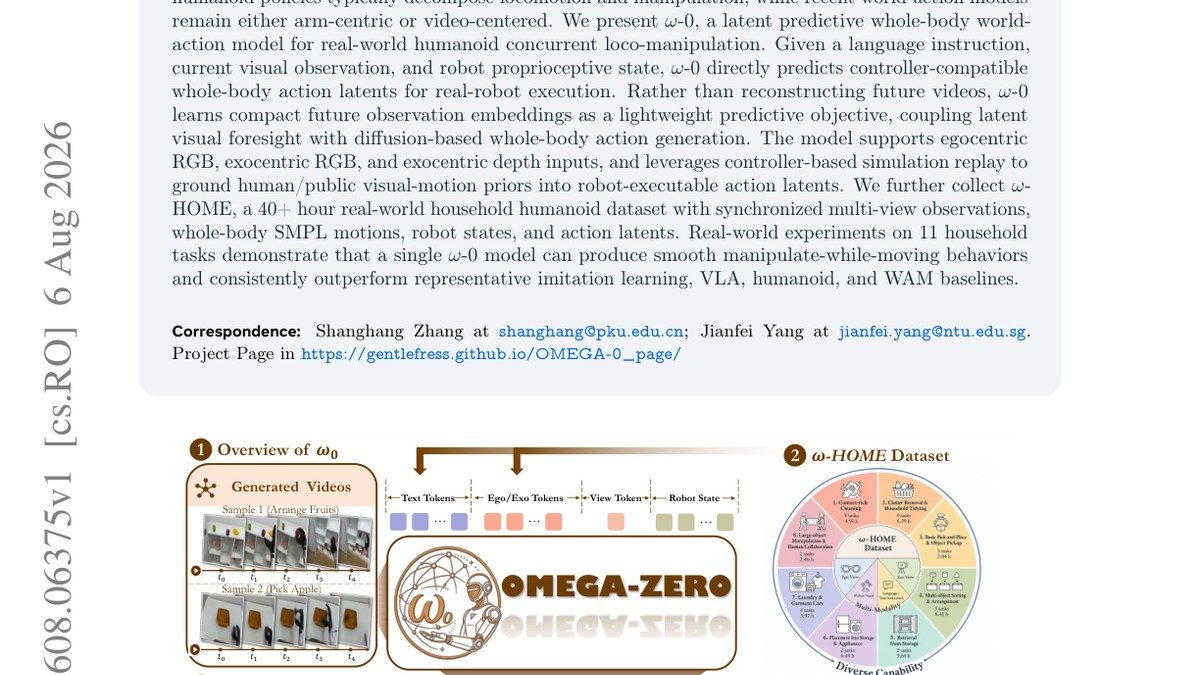
$ω$-0: A Latent Predictive World Action Model for Concurrent Humanoid Loco-Manipulation
Zhe Li, Zhenzhe Zhang, Yangyang Wei et al. · arXiv preprint · Aug 2026
Humanoid household tasks often require concurrent loco-manipulation, where the robot must move, adjust posture, maintain balance, and manipulate objects as a single coordinated behavior. Yet existing humanoid policies typically decompose locomotion and manipulation, while recent world-action mode...
GR00T N1: An Open Foundation Model for Generalist Humanoid Robots
NVIDIA, :, Johan Bjorck et al. · arXiv preprint · Mar 2025
General-purpose robots need a versatile body and an intelligent mind. Recent advancements in humanoid robots have shown great promise as a hardware platform for building generalist autonomy in the human world. A robot foundation model, trained on massive and diverse data sources, is essential for...