
Scout-Assisted Planning for Heterogeneous Robot Teams under Partially Known Environments
Hoang-Dung Bui, Abhish Khanal, Raihan Islam Arnob, Gregory J. Stein · George Mason University · 2026
Summary
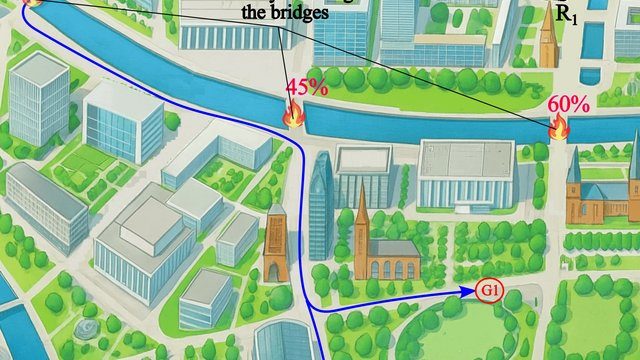
SAP pairs aerial scouts with ground robots to gather environmental information ahead of time, reducing mission time by 40% through information-theoretic POMDP planning.
Abstract Summary
Key Points
- Formalizes heterogeneous team planning as a belief-space POMDP.
- Aerial scouts gather information ahead of ground robot traversal.
- Dynamic mission allocation based on information gain and cost reduction.
- Validated on quadcopter and Clearpath Husky in forest and urban scenarios.
- Reduces total mission time by 40% compared to baseline replanning.
Additional Notes
Overview
- Paper (PDF): 2605.22693
- arXiv: 2605.22693
Related Papers
- What Limits Vision-and-Language Navigation?
- SafeManip: A Property-Driven Benchmark for Temporal Safety Evaluation
- Fast-LIO 2: Fast Direct LiDAR-Inertial Odometry
Related Papers

Superhuman Safe and Agile Racing through Multi-Agent Reinforcement Learning
Ismail Geles, Leonard Bauersfeld, Markus Wulfmeier et al. · arXiv preprint · May 2026
The first demonstration of superhuman, safe, multi-agent drone racing using a MARL framework trained in simulation and transferred to real Crazyflie nano-drones.

Learning Agile Flight in the Wild
Elia Kaufmann, Mathias Gehrig, Philipp Foehn et al. · Science Robotics · Feb 2023
An end-to-end neural drone controller trained entirely in simulation flies acrobatic maneuvers in the real world with zero real-world fine-tuning, enabled by domain randomization and reinforcement learning.
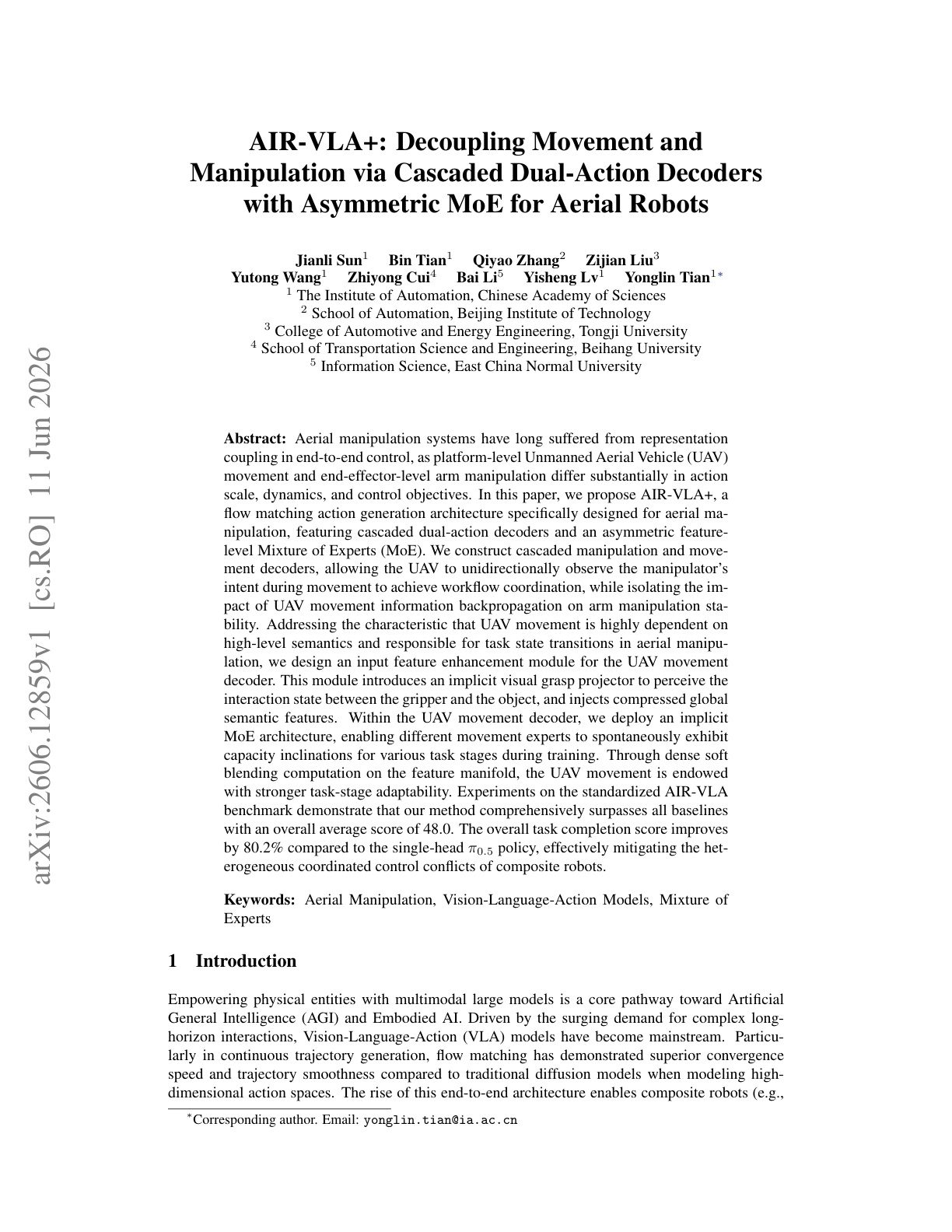
AIR-VLA+: Decoupling Movement and Manipulation via Cascaded Dual-Action Decoders with Asymmetric MoE for Aerial Robots
Jianli Sun, Bin Tian, Qiyao Zhang et al. · arXiv preprint · Jun 2026
Aerial manipulation systems have long suffered from representation coupling in end-to-end control, as platform-level Unmanned Aerial Vehicle (UAV) movement and end-effector-level arm manipulation differ substantially in action scale, dynamics, and control objectives. In this paper, we propose AIR-VL...
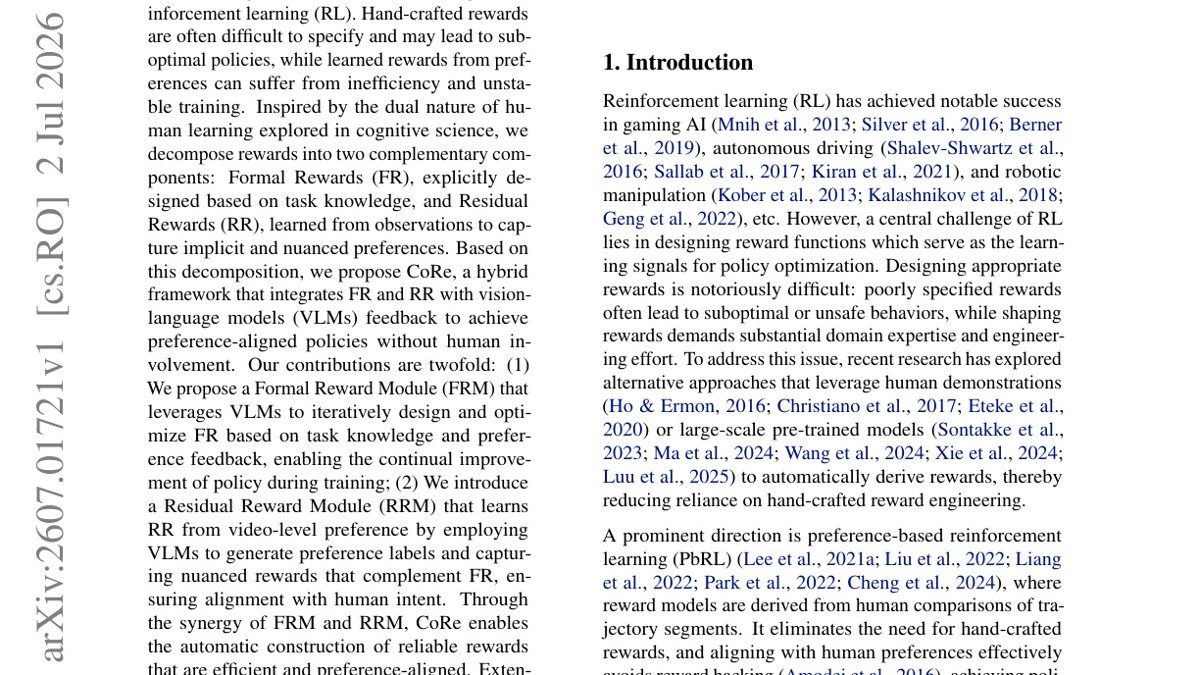
CoRe: Combined Rewards with Vision-Language Model Feedback for Preference-Aligned Reinforcement Learning
Hexian Ni, Tao Lu, Yinghao Cai · ICML 2026 · Jul 2026
Reward design remains a central challenge in reinforcement learning (RL). Hand-crafted rewards are often difficult to specify and may lead to suboptimal policies, while learned rew...