

Learning Agile Flight in the Wild
FeaturedElia Kaufmann, Mathias Gehrig, Philipp Foehn, Rene Ranftl, Alexey Dosovitskiy, Vladlen Koltun, Davide Scaramuzza · ZH, Intel Labs · 2023
Framework
PyTorch
License
MIT
Stars
189
Summary
An end-to-end neural drone controller trained entirely in simulation flies acrobatic maneuvers in the real world with zero real-world fine-tuning, enabled by domain randomization and reinforcement learning.
Abstract Summary
Key Points
- End-to-end neural policy trained 100% in simulation; zero real-world fine-tuning.
- Extreme domain randomization over 50+ visual, dynamics, and noise parameters.
- ResNet-18 + LSTM policy runs at 20 Hz on NVIDIA Jetson for onboard inference.
- Achieves professional-level lap times and acrobatic sequences on real drones.
- Open-source training pipeline and Flightmare simulator integration.
Related Papers
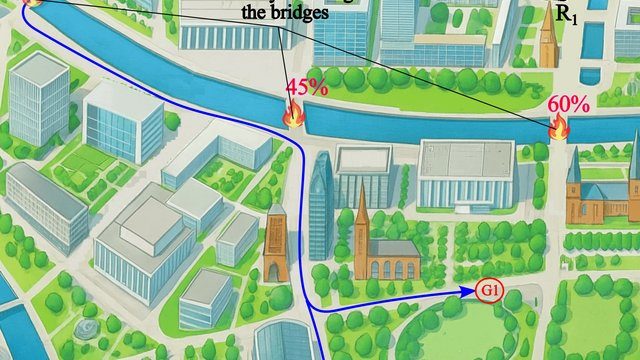
Scout-Assisted Planning for Heterogeneous Robot Teams under Partially Known Environments
Hoang-Dung Bui, Abhish Khanal, Raihan Islam Arnob et al. · arXiv preprint · May 2026
SAP pairs aerial scouts with ground robots to gather environmental information ahead of time, reducing mission time by 40% through information-theoretic POMDP planning.

Superhuman Safe and Agile Racing through Multi-Agent Reinforcement Learning
Ismail Geles, Leonard Bauersfeld, Markus Wulfmeier et al. · arXiv preprint · May 2026
The first demonstration of superhuman, safe, multi-agent drone racing using a MARL framework trained in simulation and transferred to real Crazyflie nano-drones.
AIR-VLA+: Decoupling Movement and Manipulation via Cascaded Dual-Action Decoders with Asymmetric MoE for Aerial Robots
Jianli Sun, Bin Tian, Qiyao Zhang et al. · arXiv preprint · Jun 2026
Aerial manipulation systems have long suffered from representation coupling in end-to-end control, as platform-level Unmanned Aerial Vehicle (UAV) movement and end-effector-level arm manipulation differ substantially in action scale, dynamics, and control objectives. In this paper, we propose AIR-VL...
CoRe: Combined Rewards with Vision-Language Model Feedback for Preference-Aligned Reinforcement Learning
Hexian Ni, Tao Lu, Yinghao Cai · ICML 2026 · Jul 2026
Reward design remains a central challenge in reinforcement learning (RL). Hand-crafted rewards are often difficult to specify and may lead to suboptimal policies, while learned rew...