
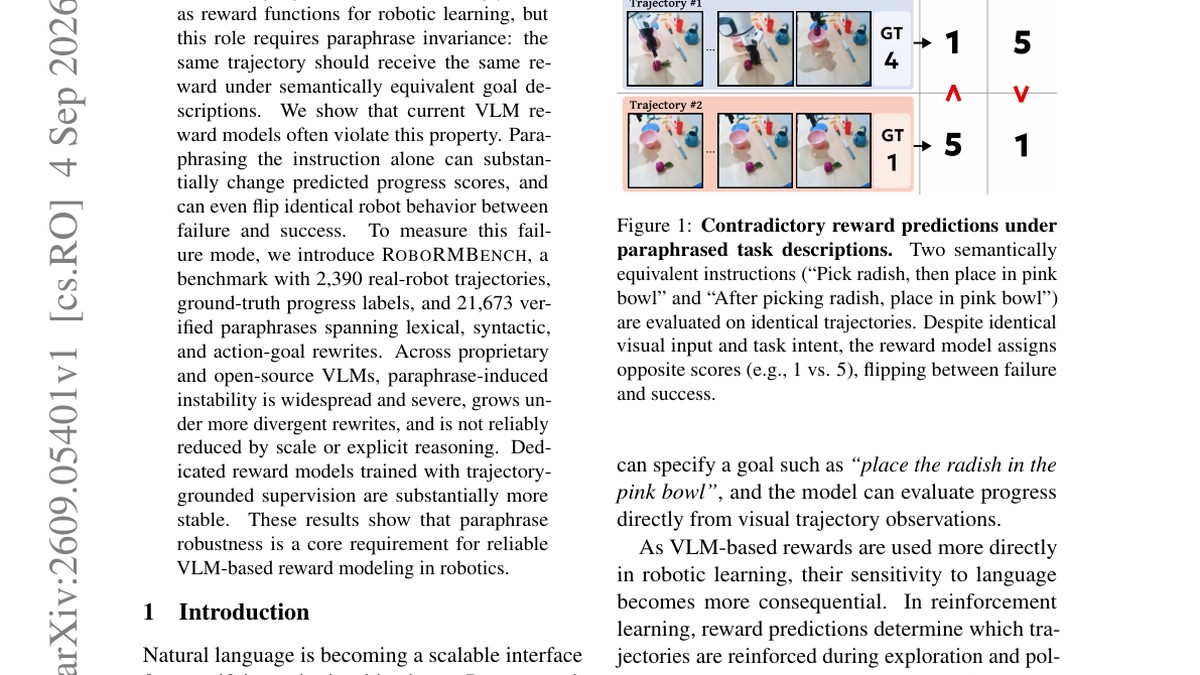
Same Trajectory, Contradictory Rewards (ROBORMBENCH): Paraphrase Fragility in Vision Language Reward Models
Wonje Jeung, Sangyeon Yoon, Hyesoo Hong, Yoonjun Cho, Dongjae Jeon, Bumjun Kim, Jean Oh, Youngjae Yu, Albert No · N/A · 2026
Framework
N/A
License
N/A
Stars
N/A
Summary
Vision-language models are increasingly used as reward functions for robotic learning, but this role requires paraphrase invariance: the same trajectory should receive the same reward under semantically equivalent goal descriptions. We show that current VLM reward models often violate this proper...
Abstract Summary
Key Points
- Vision-language models are increasingly used as reward functions for robotic learning, but this r...
- We show that current VLM reward models often violate this property
- Paraphrasing the instruction alone can substantially change predicted progress scores, and can ev...
- To measure this failure mode, we introduce ROBORMBENCH, a benchmark with 2,390 real-robot traject...
- Across proprietary and open-source VLMs, paraphrase-induced instability is widespread and severe,...
Same Trajectory, Contradictory Rewards (ROBORMBENCH): Paraphrase Fragility in Vision Language Reward Models
|Authors: Wonje Jeung, Sangyeon Yoon, Hyesoo Hong, Yoonjun Cho, Dongjae Jeon, Bumjun Kim, Jean Oh, Youngjae Yu, Albert No
|Venue: arXiv preprint | Year: 2026
|arXiv: 2609.05401v1
Abstract
Vision-language models are increasingly used as reward functions for robotic learning, but this role requires paraphrase invariance: the same trajectory should receive the same reward under semantically equivalent goal descriptions. We show that current VLM reward models often violate this property. Paraphrasing the instruction alone can substantially change predicted progress scores, and can even flip identical robot behavior between failure and success. To measure this failure mode, we introduce ROBORMBENCH, a benchmark with 2,390 real-robot trajectories, ground-truth progress labels, and 21,673 verified paraphrases spanning lexical, syntactic, and action-goal rewrites. Across proprietary and open-source VLMs, paraphrase-induced instability is widespread and severe, grows under more divergent rewrites, and is not reliably reduced by scale or explicit reasoning. Dedicated reward models trained with trajectory-grounded supervision are substantially more stable. These results show that paraphrase robustness is a core requirement for reliable VLM-based reward modeling in robotics.
Key Contributions
- Vision-language models are increasingly used as reward functions for robotic learning, but this r…
- We show that current VLM reward models often violate this property
- Paraphrasing the instruction alone can substantially change predicted progress scores, and can ev…
- To measure this failure mode, we introduce ROBORMBENCH, a benchmark with 2,390 real-robot traject…
- Across proprietary and open-source VLMs, paraphrase-induced instability is widespread and severe,…
Topics
- vision
- vla
- benchmark
Code & Data
No code repository linked in paper metadata.
BibTeX
@article{Jeung2026_260905401v1,
  title     = {Same Trajectory, Contradictory Rewards (ROBORMBENCH): Paraphrase Fragility in Vision Language Reward Models},
  author    = {Wonje Jeung and Sangyeon Yoon and Hyesoo Hong and Yoonjun Cho and Dongjae Jeon and Bumjun Kim and Jean Oh and Youngjae Yu and Albert No},
  year      = {2026},
  eprint    = {2609.05401v1},
  archivePrefix = {arXiv},
  primaryClass  = {cs.RO},
  url       = {https://arxiv.org/abs/2609.05401v1}
}
Related Papers

AXIS: A Growable Community-Driven Data Engine for Scalable Robot Manipulation
Mengfei Zhao, Dihong Huang, Yikai Tang et al. · arXiv preprint · Jul 2026
Learning effective robot manipulation policies requires diverse, high-quality demonstrations, yet existing data pipelines are often difficult to scale because they rely on specialized hardware, centralized operators, or fixed task suites. We present AXIS, a growable community-driven data engine a...
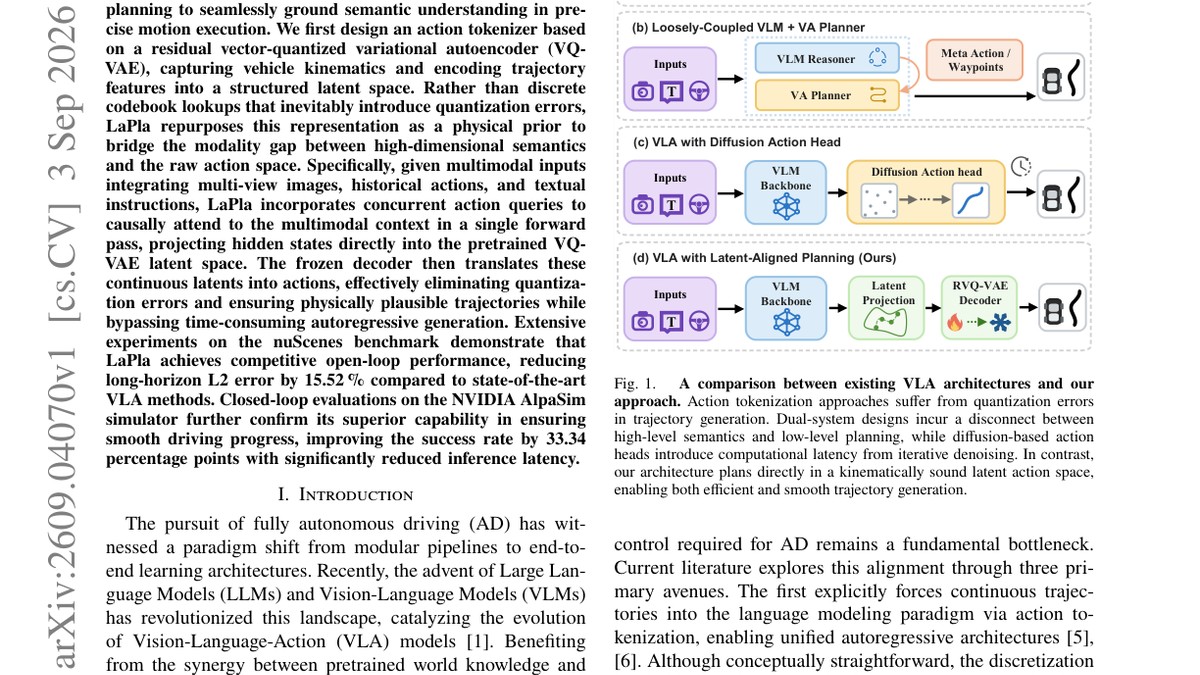
Continuous Actions from Discrete Minds: Latent-Aligned Planning for End-to-End Autonomous Driving
Ruoyu Yao, Yusen Xie, Qingzhao Liu et al. · arXiv preprint · Sep 2026
Bridging the gap between the discrete reasoning of Vision-Language Models and the continuous, physics-constrained nature of autonomous driving remains a significant challenge. In this work, we introduce LaPla, a unified Vision-Language-Action (VLA) framework featuring latent-aligned planning to s...
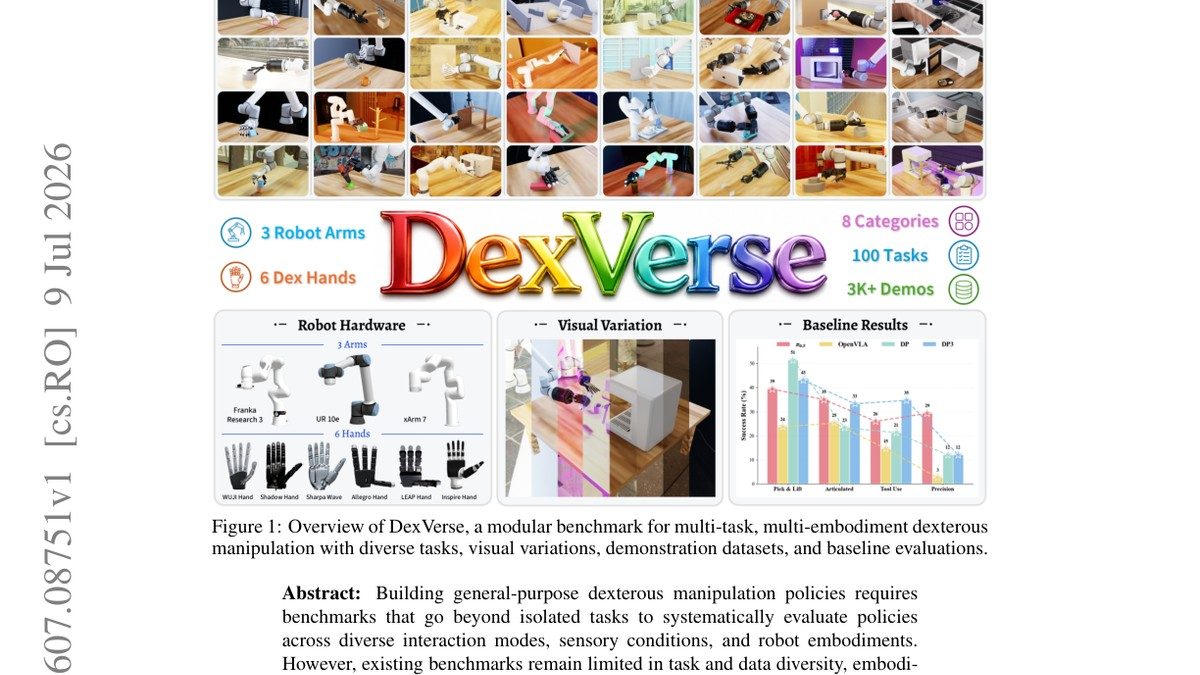
DexVerse: A Modular Benchmark for Multi-Task, Multi-Embodiment Dexterous Manipulation
Yunchao Yao, Zhuxiu Xu, Tianqi Zhang et al. · arXiv preprint · Jul 2026
Building general-purpose dexterous manipulation policies requires benchmarks that go beyond isolated tasks to systematically evaluate policies across diverse interaction modes, sensory conditions, and robot embodiments. However, existing benchmarks remain limited in task and data diversity, embod...
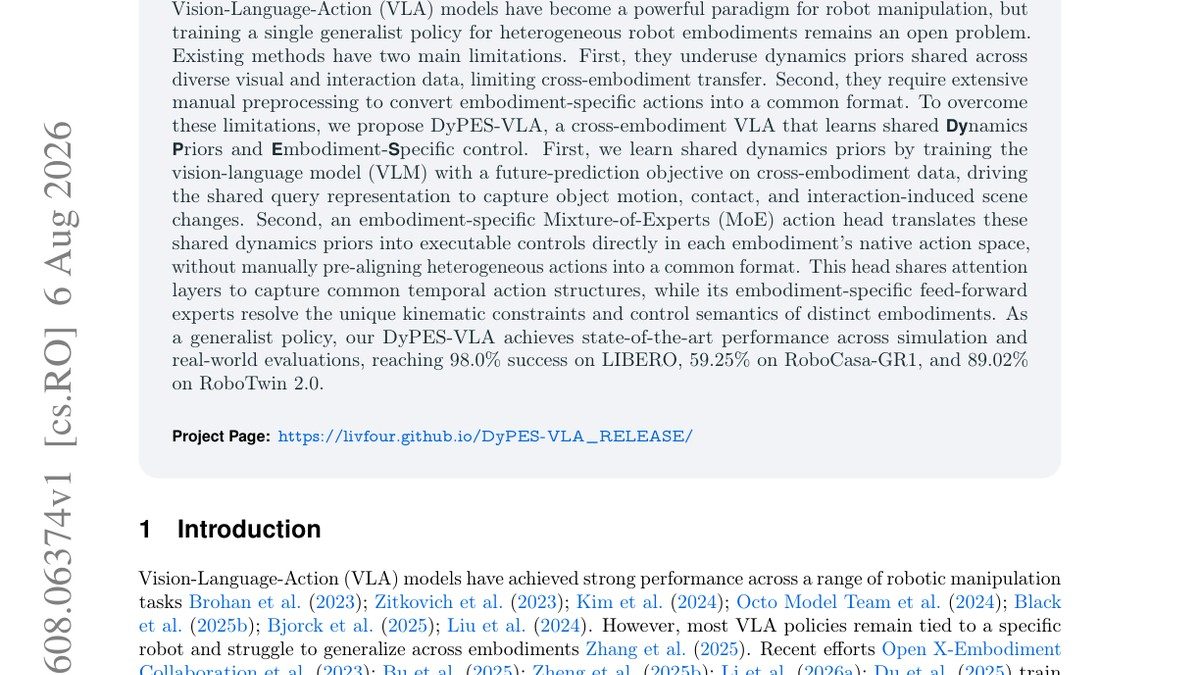
DyPES-VLA: Learning Shared Dynamics Priors and Embodiment-Specific Control for Cross-Embodiment Manipulation
Junfeng Li, Junjie He, Zhide Zhong et al. · arXiv preprint · Aug 2026
Vision-Language-Action (VLA) models have become a powerful paradigm for robot manipulation, but training a single generalist policy for heterogeneous robot embodiments remains an open problem. Existing methods have two main limitations. First, they underuse dynamics priors shared across diverse v...