

RT-2: Vision-Language-Action Models That Generalize to Novel Tasks
FeaturedAnthony Brohan, Noah Brown, Justice Carbajal, Yevgen Chebotar, Xi Chen, Krzysztof Choromanski, Tianli Ding, Danny Driess, Avinava Dubey, Pete Florence, Chuyuan Fu, Montse Gonzalez Arenas, Keerthana Gopalakrishnan, Kehang Han, Karol Hausman, Alexander Herzog, Jasmine Hsu, Brian Ichter, Alex Irpan, Nikhil Joshi, Ryan Julian, Dmitry Kalashnikov · Google DeepMind, Google Research · 2024
Framework
JAX / TensorFlow
License
Apache-2.0
Stars
1,853
Summary
Google DeepMind's VLA model combining a vision-language foundation model with robot action outputs, showing emergent generalization to novel objects, backgrounds, and semantic instructions far beyond training data.
Abstract Summary
Key Points
- First large VLM fine-tuned to output robot action tokens (PaLI-X → actions).
- Co-training on VQA, captioning, and robot data preserves world knowledge.
- 2–3x improvement on novel objects compared to specialist imitation policies.
- Handles abstract semantic instructions never seen during robot training.
- Established the VLA paradigm underlying OpenVLA, Octo, and π₀.
Related Papers
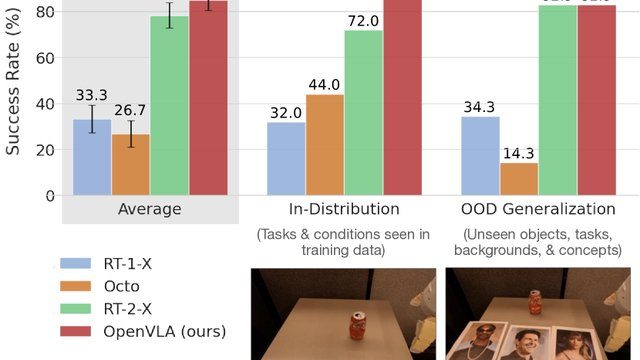
OpenVLA: An Open-Source Vision-Language-Action Model
Moo Jin Kim, Karl Pertsch, Siddharth Karamcheti et al. · arXiv · Jun 2024
A 7B-parameter open-source Vision-Language-Action model pre-trained on 970k real-world robot demonstrations, achieving strong generalization across robots and tasks.
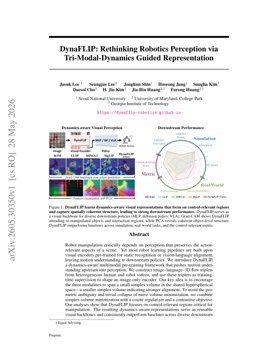
DynaFLIP: Rethinking Robotics Perception via Tri-Modal-Dynamics Guided Representation
Jusuk Lee, Seungjae Lee, Jonghun Shin et al. · arXiv preprint · May 2026
Robot manipulation critically depends on perception that preserves the action-relevant aspects of a scene. Yet most robot learning pipelines are built upon visual encoders pre-trained for static recog
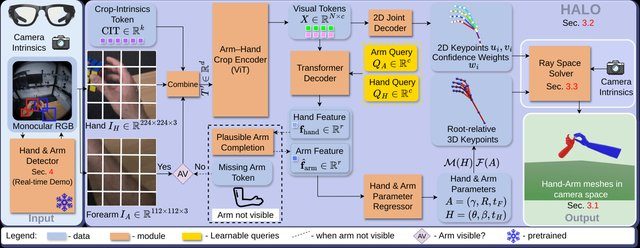
EgoForce: Forearm-Guided Camera-Space 3D Hand Pose from a Monocular Egocentric Camera
Christen Millerdurai, Shaoxiang Wang, Yaxu Xie et al. · SIGGRAPH 2026 · May 2026
Reconstructing the absolute 3D pose and shape of the hands from the user's viewpoint using a single head-mounted camera is crucial for practical egocentric interaction in AR/VR, telepresence, and hand-centric manipulation tasks, where sensing must...
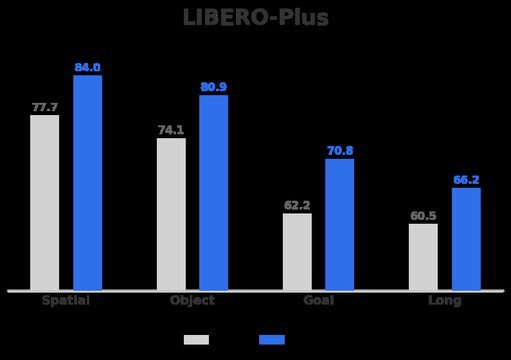
GuidedVLA: Specifying Task-Relevant Factors via Plug-and-Play Action Attention Specialization
Xiaosong Jia, Bowen Yang, Zuhao Ge et al. · RSS 2026 · May 2026
Vision-Language-Action (VLA) models aim for general robot learning by aligning action as a modality within powerful Vision-Language Models (VLMs). Existing VLAs rely on end-to-end supervision to implicitly enable the action decoding process to learn...