
OpenVLA: An Open-Source Vision-Language-Action Model
FeaturedMoo Jin Kim, Karl Pertsch, Siddharth Karamcheti, Ted Xiao, Ashwin Balakrishna, Suraj Nair, Rafael Rafailov, Erin Foster, Grace Lam, Pannag Sanketi, Quan Vuong, Thomas Kollar, Benjamin Burchfiel, Russ Tedrake, Dorsa Sadigh, Sergey Levine, Peng Xu, Chelsea Finn · Stanford, UC Berkeley, Toyota Research Institute, Google DeepMind, MIT · 2024
Framework
PyTorch
License
Apache-2.0
Stars
6,260
Summary
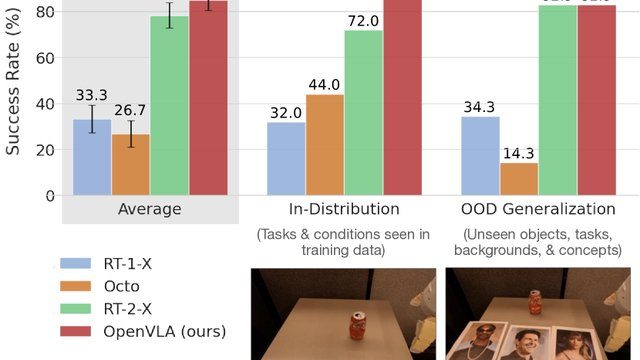
A 7B-parameter open-source Vision-Language-Action model pre-trained on 970k real-world robot demonstrations, achieving strong generalization across robots and tasks.
Abstract Summary
Key Points
- First fully open-source 7B VLA model with publicly available weights and training code.
- Pre-trained on 970k real robot trajectories from the Open X-Embodiment dataset (22 robots).
- Uses Llama 2 + DINOv2/SigLIP vision encoder; actions quantized into discrete tokens.
- Strong few-shot transfer: fine-tune on ~10-100 demos with LoRA for a new robot.
- Supports natural language task specification and multi-step long-horizon tasks.
Additional Notes
Fine-tuning Tips
- Use the official LoRA config for fast adaptation; full fine-tuning requires significant compute.
- Action quantization bin count is a key hyperparameter when transferring to robots with different action spaces.
- The model expects image resolution of 224x224; preprocessing should match the training pipeline exactly.
Related Papers
- RT-2 (Brohan et al., 2023)
- Octo (Team et al., 2024)
- Open X-Embodiment (Padalkar et al., 2023)
Related Papers
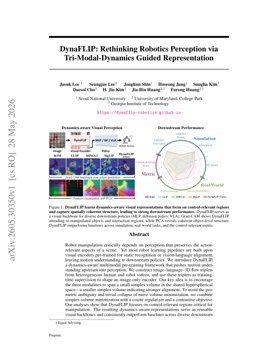
DynaFLIP: Rethinking Robotics Perception via Tri-Modal-Dynamics Guided Representation
Jusuk Lee, Seungjae Lee, Jonghun Shin et al. · arXiv preprint · May 2026
Robot manipulation critically depends on perception that preserves the action-relevant aspects of a scene. Yet most robot learning pipelines are built upon visual encoders pre-trained for static recog
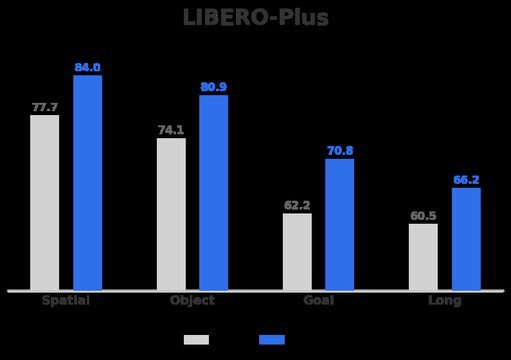
GuidedVLA: Specifying Task-Relevant Factors via Plug-and-Play Action Attention Specialization
Xiaosong Jia, Bowen Yang, Zuhao Ge et al. · RSS 2026 · May 2026
Vision-Language-Action (VLA) models aim for general robot learning by aligning action as a modality within powerful Vision-Language Models (VLMs). Existing VLAs rely on end-to-end supervision to implicitly enable the action decoding process to learn...
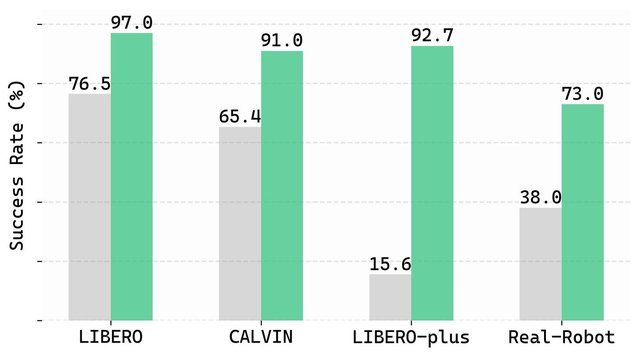
From Imagined Futures to Executable Actions: Mixture of Latent Actions for Robot Manipulation
Yajie Li, Bozhou Zhang, Chun Gu et al. · ICML 2026 · May 2026
Video foundation-models models offer a promising imagination mechanism for robot manipulation by predicting long-horizon future observations, but effectively exploiting these imagined futures for action execution remains challenging. Existing approaches...
Qwen-VLA: Unifying Vision-Language-Action Modeling across Tasks, Environments, and Robot Embodiments
Qiuyue Wang, Mingsheng Li, Jian Guan et al. · arXiv preprint · May 2026
Embodied intelligence is often studied through specialized models for individual tasks such as manipulation or navigation, resulting in fragmented capabilities and limited generalization across tasks,