
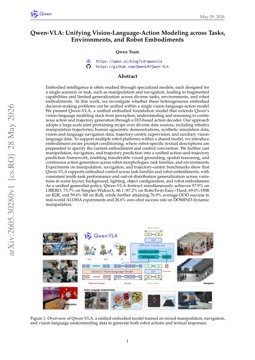
Qwen-VLA: Unifying Vision-Language-Action Modeling across Tasks, Environments, and Robot Embodiments
FeaturedQiuyue Wang, Mingsheng Li, Jian Guan, Jinhui Ye, Sicheng Xie, Yitao Liu, Junhao Chen, Zhixuan Liang, Jie Zhang, Xintong Hu, Xuhong Huang, Pei Lin, Junyang Lin, Dayiheng Liu, Shuai Bai · · 2026
Framework
N/A
License
N/A
Stars
0
Summary
Embodied intelligence is often studied through specialized models for individual tasks such as manipulation or navigation, resulting in fragmented capabilities and limited generalization across tasks,
Abstract Summary
Key Points
- Unified VLA foundation model across manipulation, navigation, and trajectory prediction.
- DiT-based action decoder extending Qwen VL stack to continuous action generation.
- Embodiment-aware prompt conditioning supports multiple robot platforms.
- Trained on diverse data including human egocentric, synthetic, and navigation data.
- Achieves strong results across LIBERO, Simpler, RoboTwin, R2R, RxR, and real-world ALOHA.
Related Papers
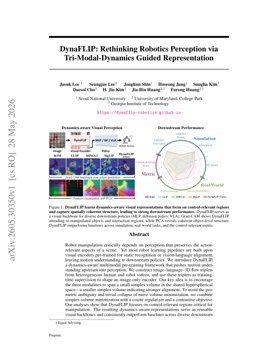
DynaFLIP: Rethinking Robotics Perception via Tri-Modal-Dynamics Guided Representation
Jusuk Lee, Seungjae Lee, Jonghun Shin et al. · arXiv preprint · May 2026
Robot manipulation critically depends on perception that preserves the action-relevant aspects of a scene. Yet most robot learning pipelines are built upon visual encoders pre-trained for static recog
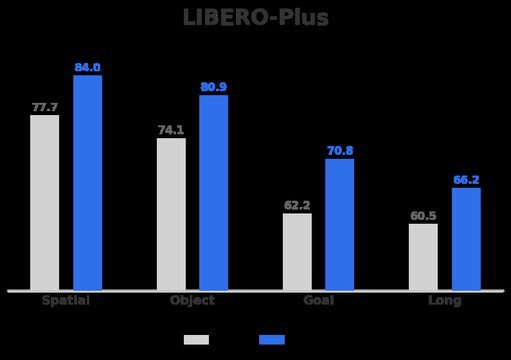
GuidedVLA: Specifying Task-Relevant Factors via Plug-and-Play Action Attention Specialization
Xiaosong Jia, Bowen Yang, Zuhao Ge et al. · RSS 2026 · May 2026
Vision-Language-Action (VLA) models aim for general robot learning by aligning action as a modality within powerful Vision-Language Models (VLMs). Existing VLAs rely on end-to-end supervision to implicitly enable the action decoding process to learn...
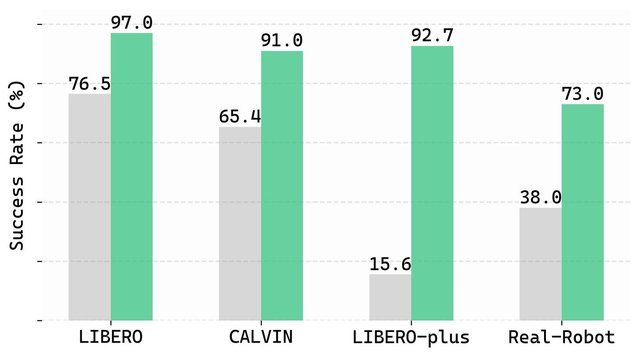
From Imagined Futures to Executable Actions: Mixture of Latent Actions for Robot Manipulation
Yajie Li, Bozhou Zhang, Chun Gu et al. · ICML 2026 · May 2026
Video foundation-models models offer a promising imagination mechanism for robot manipulation by predicting long-horizon future observations, but effectively exploiting these imagined futures for action execution remains challenging. Existing approaches...
Spatial Memory for Out-of-Vision Manipulation in Vision-Language-Action
Pengteng Li, Weiyu Guo, He Zhang et al. · arXiv preprint · May 2026
SOMA introduces an explicit spatial memory framework that enables VLA models to track and manipulate objects even after they leave the camera's field of view.