
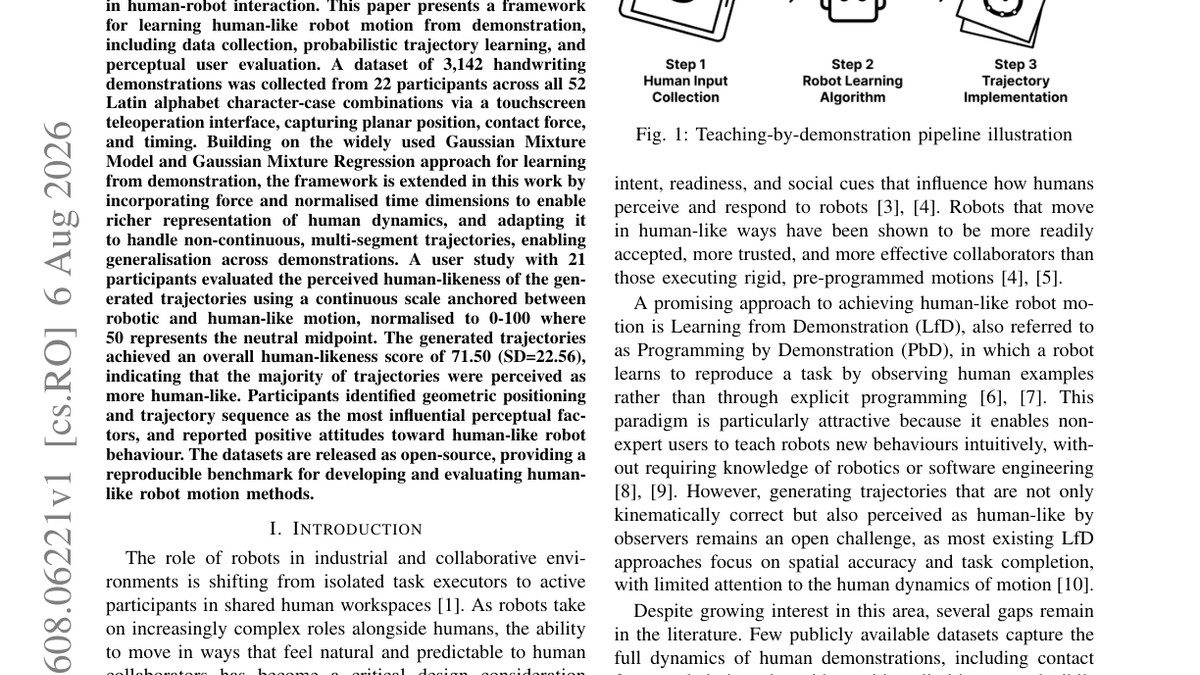
Robot Learning from Human Demonstrations: Handwritten Alphabet Trajectories and Human-Likeness Evaluation
Alperen Kenan, Paul Bremner, Manuel Giuliani · N/A · 2026
Framework
N/A
License
N/A
Stars
N/A
Summary
Learning from demonstration (LfD) provides a developmental framework through which robots can develop motor skills by observing and imitating human dynamics, reducing reliance on explicit programming to teach a skill to a robot. The resulting human-like robot motion is recognised as a key factor ...
Abstract Summary
Key Points
- Learning from demonstration (LfD) provides a developmental framework through which robots can dev...
- The resulting human-like robot motion is recognised as a key factor in building trust and enablin...
- This paper presents a framework for learning human-like robot motion from demonstration, includin...
- A dataset of 3,142 handwriting demonstrations was collected from 22 participants across all 52 La...
- Building on the widely used Gaussian Mixture Model and Gaussian Mixture Regression approach for l...
Robot Learning from Human Demonstrations: Handwritten Alphabet Trajectories and Human-Likeness Evaluation
|Authors: Alperen Kenan, Paul Bremner, Manuel Giuliani
|Venue: arXiv preprint | Year: 2026
|arXiv: 2608.06221v1
Abstract
Learning from demonstration (LfD) provides a developmental framework through which robots can develop motor skills by observing and imitating human dynamics, reducing reliance on explicit programming to teach a skill to a robot. The resulting human-like robot motion is recognised as a key factor in building trust and enabling natural collaboration in human-robot interaction. This paper presents a framework for learning human-like robot motion from demonstration, including data collection, probabilistic trajectory learning, and perceptual user evaluation. A dataset of 3,142 handwriting demonstrations was collected from 22 participants across all 52 Latin alphabet character-case combinations via a touchscreen teleoperation interface, capturing planar position, contact force, and timing. Building on the widely used Gaussian Mixture Model and Gaussian Mixture Regression approach for learning from demonstration, the framework is extended in this work by incorporating force and normalised time dimensions to enable richer representation of human dynamics, and adapting it to handle non-continuous, multi-segment trajectories, enabling generalisation across demonstrations. A user study with 21 participants evaluated the perceived human-likeness of the generated trajectories using a continuous scale anchored between robotic and human-like motion, normalised to 0-100 where 50 represents the neutral midpoint. The generated trajectories achieved an overall human-likeness score of 71.50 (SD=22.56), indicating that the majority of trajectories were perceived as more human-like. Participants identified geometric positioning and trajectory sequence as the most influential perceptual factors, and reported positive attitudes toward human-like robot behaviour. The datasets are released as open-source, providing a reproducible benchmark for developing and evaluating human-like robot motion methods.
Key Contributions
- Learning from demonstration (LfD) provides a developmental framework through which robots can dev…
- The resulting human-like robot motion is recognised as a key factor in building trust and enablin…
- This paper presents a framework for learning human-like robot motion from demonstration, includin…
- A dataset of 3,142 handwriting demonstrations was collected from 22 participants across all 52 La…
- Building on the widely used Gaussian Mixture Model and Gaussian Mixture Regression approach for l…
Topics
- human-robot-interaction
- learning-from-demonstration
- tactile
- benchmark
Code & Data
- GitHub repository: https://github.com/Preliy/Flange
BibTeX
@article{Kenan2026_260806221v1,
  title     = {Robot Learning from Human Demonstrations: Handwritten Alphabet Trajectories and Human-Likeness Evaluation},
  author    = {Alperen Kenan and Paul Bremner and Manuel Giuliani},
  year      = {2026},
  eprint    = {2608.06221v1},
  archivePrefix = {arXiv},
  primaryClass  = {cs.RO},
  url       = {https://arxiv.org/abs/2608.06221v1}
}
Related Papers
Design and Evaluation of a Touchscreen-Based Teleoperation Interface for Robotic Manipulators
Juan José García Cárdenas, Alperen Kenan, Hamidreza Raei et al. · arXiv preprint · Aug 2026
Intuitive teleoperation interfaces are crucial for the safe and effective operation of robotic manipulators in challenging environments. In the nuclear industry, surface contact tasks such as swab sampling require precise path and force tracking, obstacle avoidance, and sustained operator attenti...
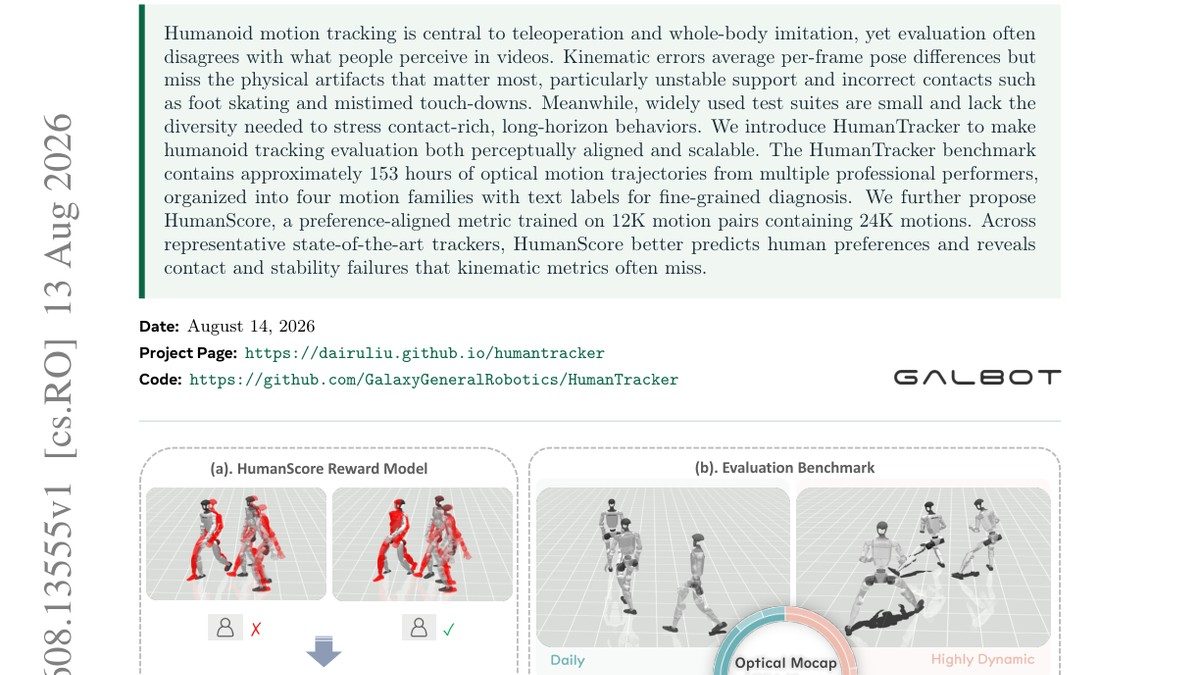
HumanTracker: Towards Comprehensive and Human-Aligned Motion Tracking Benchmark
Dairu Liu, Zekun Qi, Jiayu Zeng et al. · arXiv preprint · Aug 2026
Humanoid motion tracking is central to teleoperation and whole-body imitation, yet evaluation often disagrees with what people perceive in videos. Kinematic errors average per-frame pose differences but miss the physical artifacts that matter most, particularly unstable support and incorrect cont...
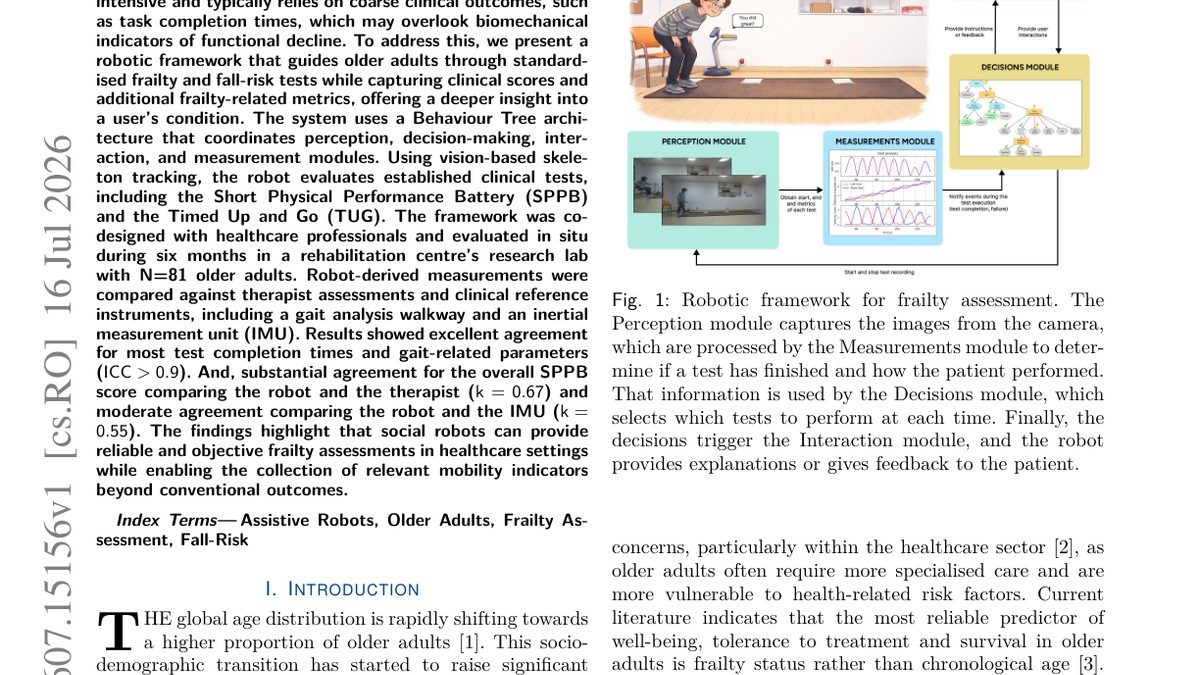
Assessing Physical Frailty and Fall-Risk Indicators with Social Robots: An in situ Evaluation with Older Adults
Aniol Civit, Antonio Andriella, Alba Martínez et al. · arXiv preprint · Jul 2026
Frailty assessments are crucial to evaluate the risk of adverse events and the health and social care needs of older adults, yet their administration remains resource-intensive and typically relies on coarse clinical outcomes, such as task completion times, which may overlook biomechanical indica...

AXIS: A Growable Community-Driven Data Engine for Scalable Robot Manipulation
Mengfei Zhao, Dihong Huang, Yikai Tang et al. · arXiv preprint · Jul 2026
Learning effective robot manipulation policies requires diverse, high-quality demonstrations, yet existing data pipelines are often difficult to scale because they rely on specialized hardware, centralized operators, or fixed task suites. We present AXIS, a growable community-driven data engine a...