
HumanTracker: Towards Comprehensive and Human-Aligned Motion Tracking Benchmark
Dairu Liu, Zekun Qi, Jiayu Zeng, Ruixi Yu, Yu Guan, Yintianrun Zhang, Xuchuan Chen, Sikai Liang, Zekai Li, Chenghuai Lin, Xinqiang Yu, Wenyao Zhang, He Wang, Li Yi · N/A · 2026
Framework
N/A
License
N/A
Stars
N/A
Summary
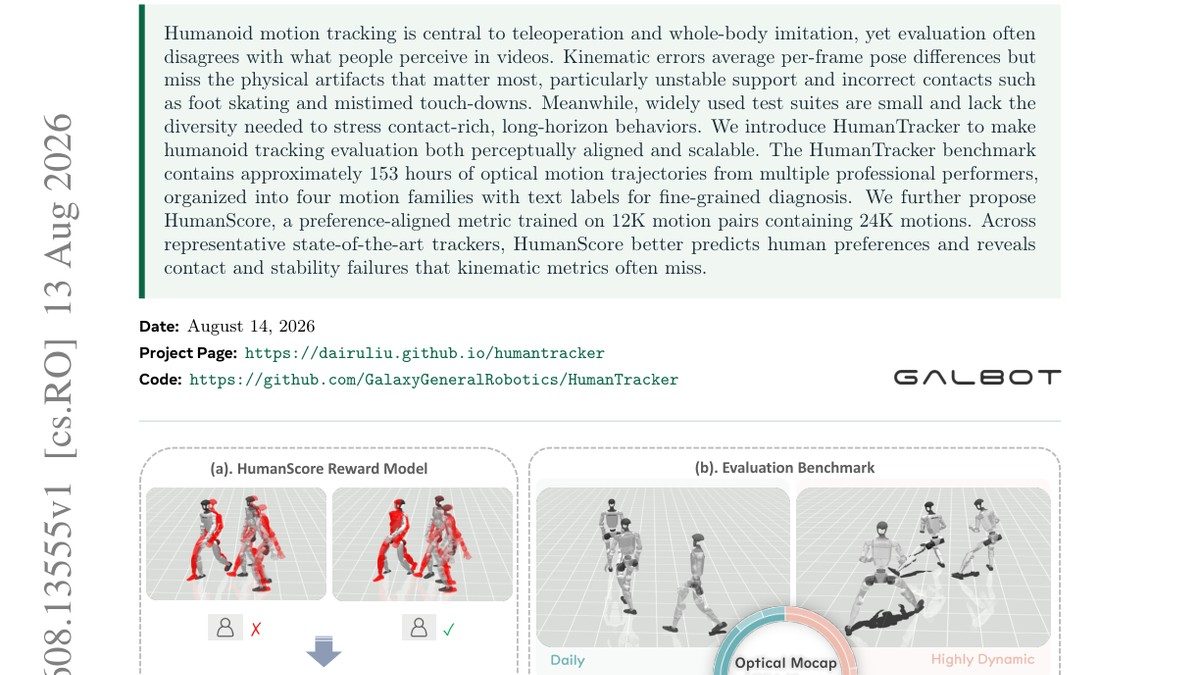
Humanoid motion tracking is central to teleoperation and whole-body imitation, yet evaluation often disagrees with what people perceive in videos. Kinematic errors average per-frame pose differences but miss the physical artifacts that matter most, particularly unstable support and incorrect cont...
Abstract Summary
Key Points
- Humanoid motion tracking is central to teleoperation and whole-body imitation, yet evaluation oft...
- Kinematic errors average per-frame pose differences but miss the physical artifacts that matter m...
- Meanwhile, widely used test suites are small and lack the diversity needed to stress contact-rich...
- We introduce HumanTracker to make humanoid tracking evaluation both perceptually aligned and scal...
- The HumanTracker benchmark contains approximately 153 hours of optical motion trajectories from m...
HumanTracker: Towards Comprehensive and Human-Aligned Motion Tracking Benchmark
|Authors: Dairu Liu, Zekun Qi, Jiayu Zeng, Ruixi Yu, Yu Guan, Yintianrun Zhang, Xuchuan Chen, Sikai Liang, Zekai Li, Chenghuai Lin, Xinqiang Yu, Wenyao Zhang, He Wang, Li Yi
|Venue: arXiv preprint | Year: 2026
|arXiv: 2608.13555v1
Abstract
Humanoid motion tracking is central to teleoperation and whole-body imitation, yet evaluation often disagrees with what people perceive in videos. Kinematic errors average per-frame pose differences but miss the physical artifacts that matter most, particularly unstable support and incorrect contacts such as foot skating and mistimed touch-downs. Meanwhile, widely used test suites are small and lack the diversity needed to stress contact-rich, long-horizon behaviors. We introduce HumanTracker to make humanoid tracking evaluation both perceptually aligned and scalable. The HumanTracker benchmark contains approximately 153 hours of optical motion trajectories from multiple professional performers, organized into four motion families with text labels for fine-grained diagnosis. We further propose HumanScore, a preference-aligned metric trained on 12K motion pairs containing 24K motions. Across representative state-of-the-art trackers, HumanScore better predicts human preferences and reveals contact and stability failures that kinematic metrics often miss.
Key Contributions
- Humanoid motion tracking is central to teleoperation and whole-body imitation, yet evaluation oft…
- Kinematic errors average per-frame pose differences but miss the physical artifacts that matter m…
- Meanwhile, widely used test suites are small and lack the diversity needed to stress contact-rich…
- We introduce HumanTracker to make humanoid tracking evaluation both perceptually aligned and scal…
- The HumanTracker benchmark contains approximately 153 hours of optical motion trajectories from m…
Topics
- reinforcement-learning
- learning-from-demonstration
- tactile
- benchmark
Code & Data
- GitHub repository: https://github.com/GalaxyGeneralRobotics/HumanTracker
BibTeX
@article{Liu2026_260813555v1,
  title     = {HumanTracker: Towards Comprehensive and Human-Aligned Motion Tracking Benchmark},
  author    = {Dairu Liu and Zekun Qi and Jiayu Zeng and Ruixi Yu and Yu Guan and Yintianrun Zhang and Xuchuan Chen and Sikai Liang and Zekai Li and Chenghuai Lin and Xinqiang Yu and Wenyao Zhang and He Wang and Li Yi},
  year      = {2026},
  eprint    = {2608.13555v1},
  archivePrefix = {arXiv},
  primaryClass  = {cs.RO},
  url       = {https://arxiv.org/abs/2608.13555v1}
}
Related Papers
Design and Evaluation of a Touchscreen-Based Teleoperation Interface for Robotic Manipulators
Juan José García Cárdenas, Alperen Kenan, Hamidreza Raei et al. · arXiv preprint · Aug 2026
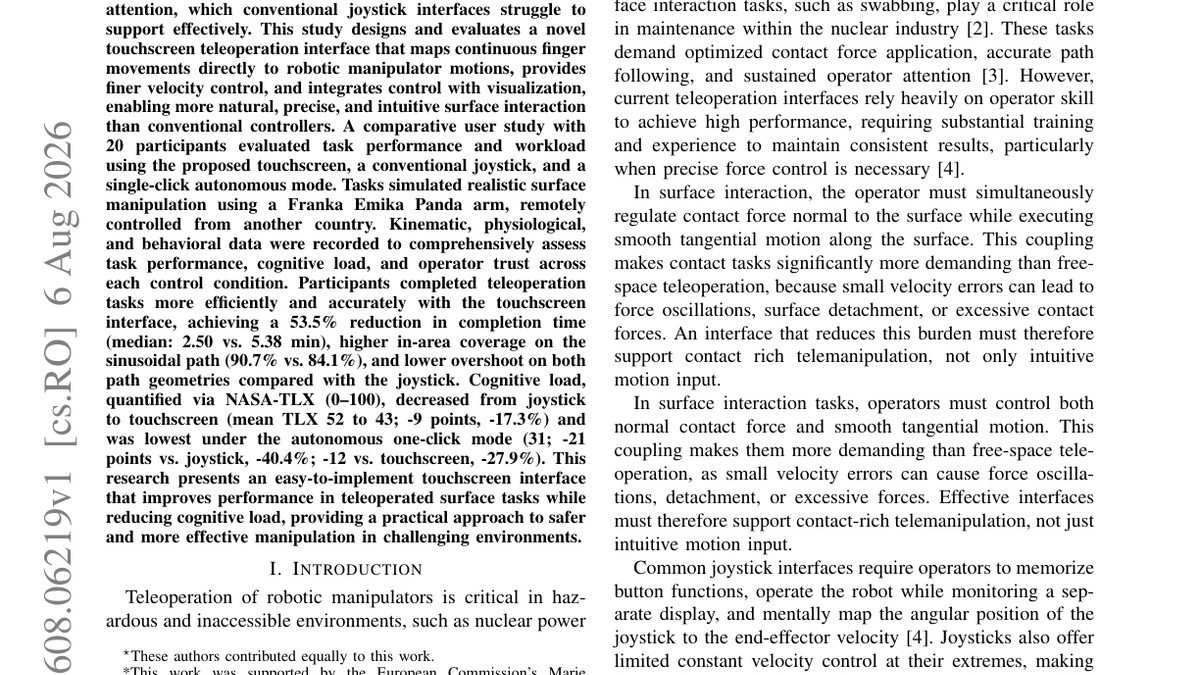
Intuitive teleoperation interfaces are crucial for the safe and effective operation of robotic manipulators in challenging environments. In the nuclear industry, surface contact tasks such as swab sampling require precise path and force tracking, obstacle avoidance, and sustained operator attenti...
DexVerse: A Modular Benchmark for Multi-Task, Multi-Embodiment Dexterous Manipulation
Yunchao Yao, Zhuxiu Xu, Tianqi Zhang et al. · arXiv preprint · Jul 2026
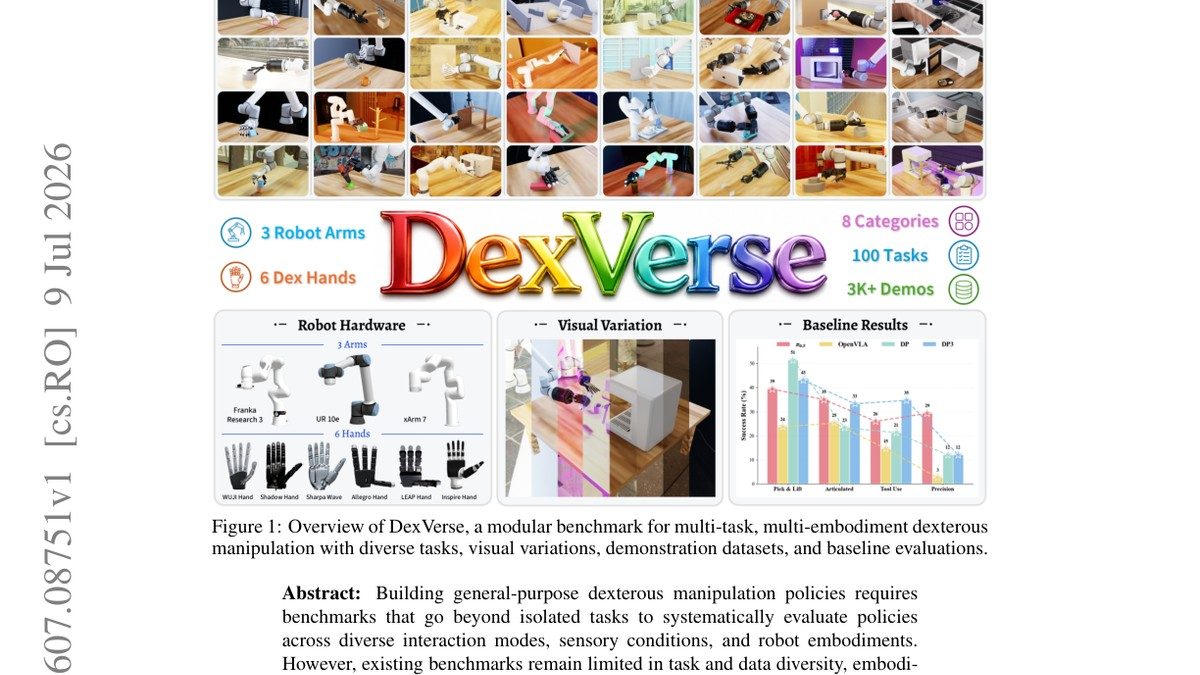
Building general-purpose dexterous manipulation policies requires benchmarks that go beyond isolated tasks to systematically evaluate policies across diverse interaction modes, sensory conditions, and robot embodiments. However, existing benchmarks remain limited in task and data diversity, embod...
GeniWorld: A Generalizable Interactive World Model for Robotic Manipulation via Visual Actions
Chenghao Gu, Hanyang Yu, Jingbo Zhang et al. · arXiv preprint · Aug 2026
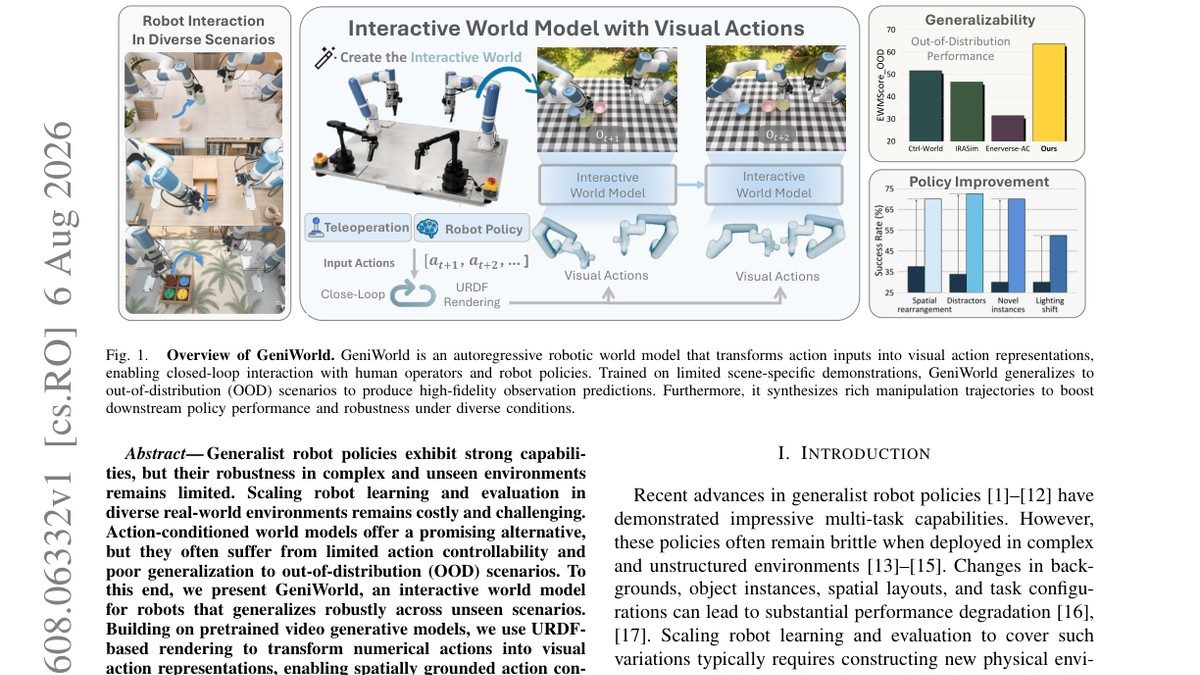
Generalist robot policies exhibit strong capabilities, but their robustness in complex and unseen environments remains limited. Scaling robot learning and evaluation in diverse real-world environments remains costly and challenging. Action-conditioned world models offer a promising alternative, b...
Planning-Oriented End-to-End Autonomous Driving: Architectures, Evaluation, and Emerging Paradigms
Yanchen Guan, Xingcheng Liu, Bin Rao et al. · arXiv preprint · Aug 2026
End-to-end autonomous driving has evolved from camera-to-control regression toward planning-oriented systems that use structured representations, trajectory-level outputs, and increasingly realistic evaluation protocols. This survey reviews this transition across behavior cloning, conditional imi...