
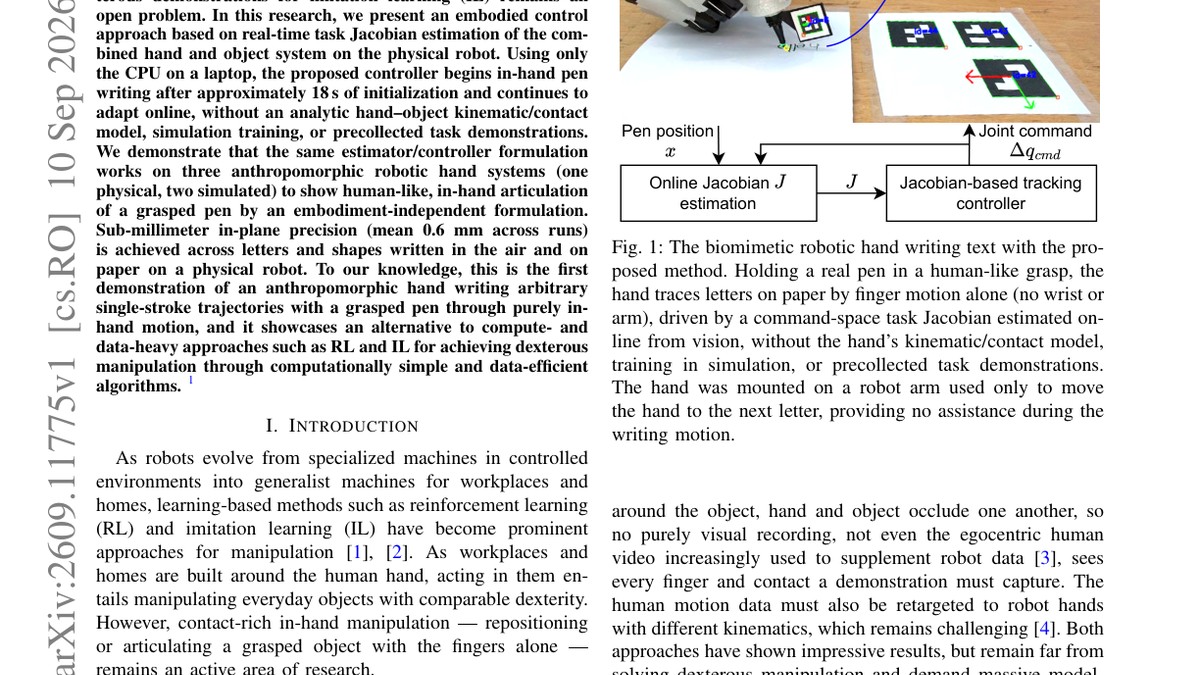
Rapid Learning of Dexterous In-Hand Pen Writing through Real-Time Jacobian Estimation
Kai Stewart, Yasunori Toshimitsu, Robert K. Katzschmann · N/A · 2026
Framework
N/A
License
N/A
Stars
N/A
Summary
Dexterous in-hand manipulation of a grasped object with an anthropomorphic hand is an unsolved frontier for robot dexterity. The contact-richness and highly dynamic nature of object-hand interactions tend to require extensive modeling or data-collection efforts for learning-based approaches. Mode...
Abstract Summary
Key Points
- Dexterous in-hand manipulation of a grasped object with an anthropomorphic hand is an unsolved fr...
- The contact-richness and highly dynamic nature of object-hand interactions tend to require extens...
- Modern simulators used for reinforcement learning (RL) cannot fully replicate the required contac...
- In this research, we present an embodied control approach based on real-time task Jacobian estima...
- Using only the CPU on a laptop, the proposed controller begins in-hand pen writing after approxim...
Rapid Learning of Dexterous In-Hand Pen Writing through Real-Time Jacobian Estimation
|Authors: Kai Stewart, Yasunori Toshimitsu, Robert K. Katzschmann
|Venue: arXiv preprint | Year: 2026
|arXiv: 2609.11775v1
Abstract
Dexterous in-hand manipulation of a grasped object with an anthropomorphic hand is an unsolved frontier for robot dexterity. The contact-richness and highly dynamic nature of object-hand interactions tend to require extensive modeling or data-collection efforts for learning-based approaches. Modern simulators used for reinforcement learning (RL) cannot fully replicate the required contact complexity, while collecting dexterous demonstrations for imitation learning (IL) remains an open problem. In this research, we present an embodied control approach based on real-time task Jacobian estimation of the combined hand and object system on the physical robot. Using only the CPU on a laptop, the proposed controller begins in-hand pen writing after approximately 18 s of initialization and continues to adapt online, without an analytic hand—object kinematic/contact model, simulation training, or precollected task demonstrations. We demonstrate that the same estimator/controller formulation works on three anthropomorphic robotic hand systems (one physical, two simulated) to show human-like, in-hand articulation of a grasped pen by an embodiment-independent formulation. Sub-millimeter in-plane precision (mean 0.6 mm across runs) is achieved across letters and shapes written in the air and on paper on a physical robot. To our knowledge, this is the first demonstration of an anthropomorphic hand writing arbitrary single-stroke trajectories with a grasped pen through purely in-hand motion, and it showcases an alternative to compute- and data-heavy approaches such as RL and IL for achieving dexterous manipulation through computationally simple and data-efficient algorithms.
Key Contributions
- Dexterous in-hand manipulation of a grasped object with an anthropomorphic hand is an unsolved fr…
- The contact-richness and highly dynamic nature of object-hand interactions tend to require extens…
- Modern simulators used for reinforcement learning (RL) cannot fully replicate the required contac…
- In this research, we present an embodied control approach based on real-time task Jacobian estima…
- Using only the CPU on a laptop, the proposed controller begins in-hand pen writing after approxim…
Topics
- manipulation
- reinforcement-learning
- control
- learning-from-demonstration
Code & Data
- GitHub repository: https://github.com/srl-ethz/dexterity_from_jacobian
BibTeX
@article{Stewart2026_260911775v1,
  title     = {Rapid Learning of Dexterous In-Hand Pen Writing through Real-Time Jacobian Estimation},
  author    = {Kai Stewart and Yasunori Toshimitsu and Robert K. Katzschmann},
  year      = {2026},
  eprint    = {2609.11775v1},
  archivePrefix = {arXiv},
  primaryClass  = {cs.RO},
  url       = {https://arxiv.org/abs/2609.11775v1}
}
Related Papers
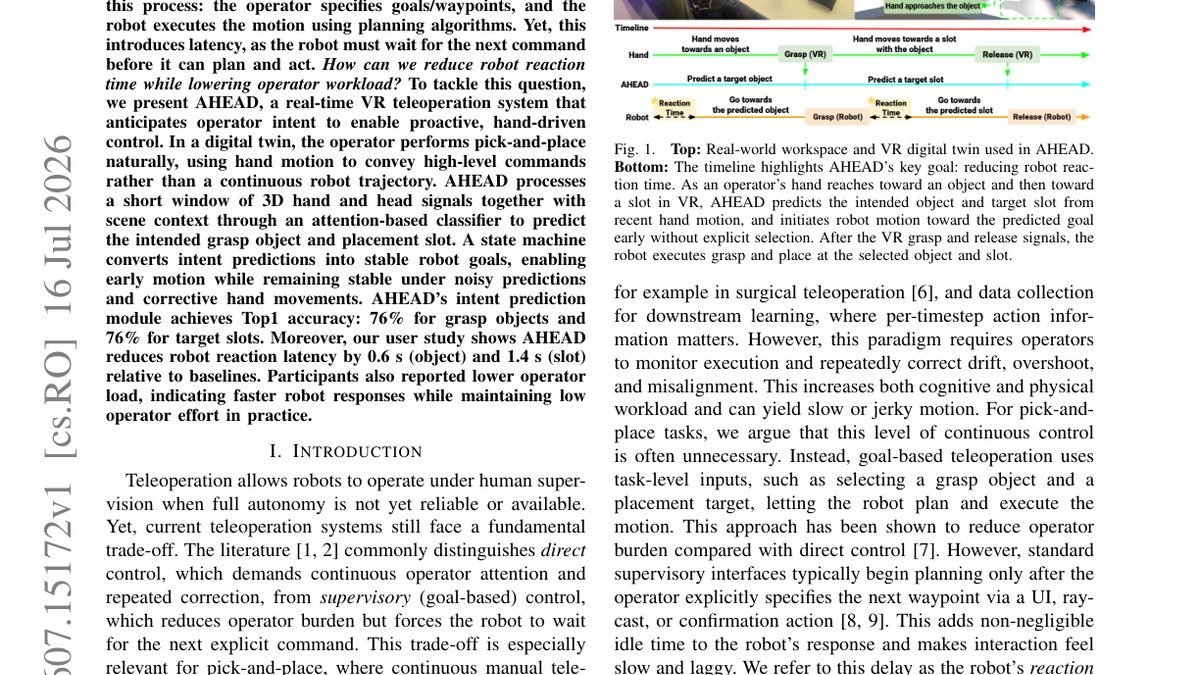
AHEAD: Anticipatory Hand-Driven Teleoperation via Human Intent Prediction
Seok Joon Kim, Junho Lee, Federica Spinola et al. · arXiv preprint · Jul 2026
Direct hand-driven teleoperation maps an operator's hand motion to robot end-effector commands at every frame, enabling precise control, but it requires constant monitoring and correction during approach, grasp, and placement, which can be slow and fatiguing. For repetitive pick-and-place tasks, ...
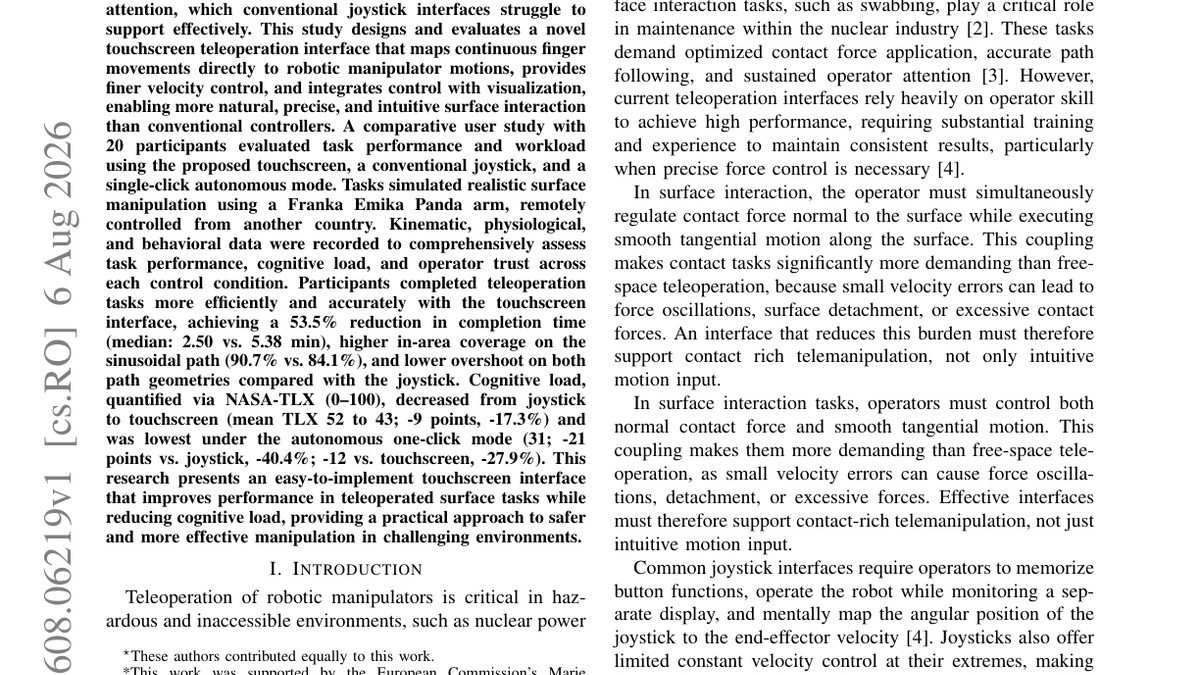
Design and Evaluation of a Touchscreen-Based Teleoperation Interface for Robotic Manipulators
Juan José García Cárdenas, Alperen Kenan, Hamidreza Raei et al. · arXiv preprint · Aug 2026
Intuitive teleoperation interfaces are crucial for the safe and effective operation of robotic manipulators in challenging environments. In the nuclear industry, surface contact tasks such as swab sampling require precise path and force tracking, obstacle avoidance, and sustained operator attenti...
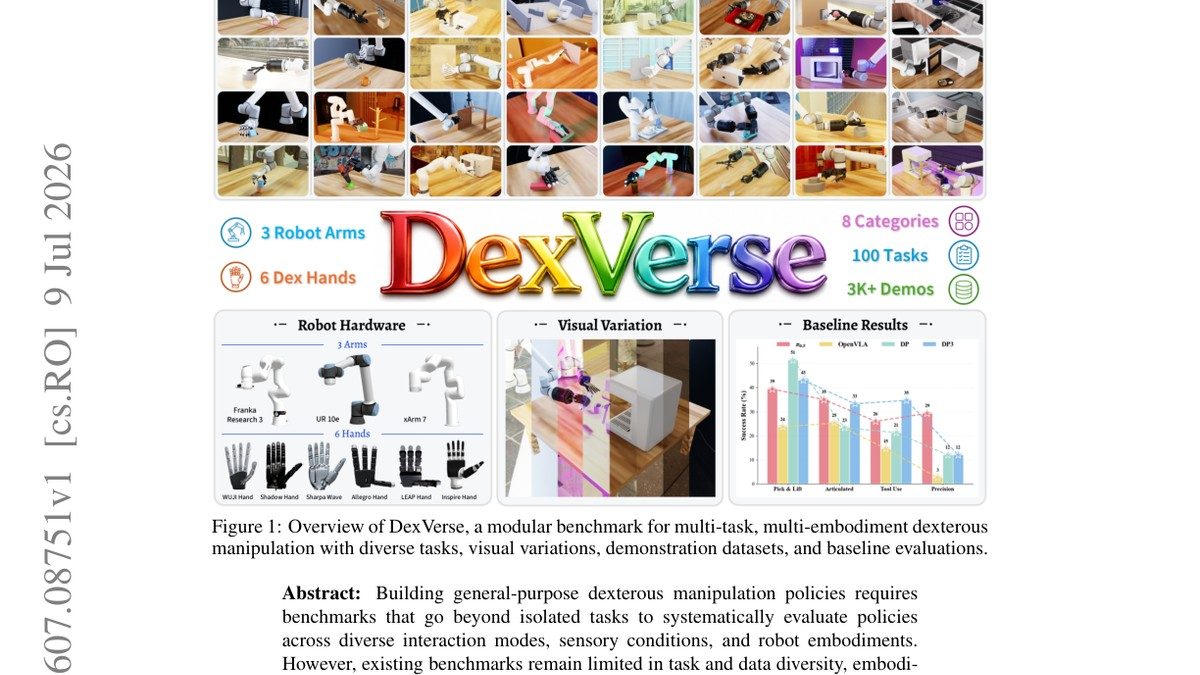
DexVerse: A Modular Benchmark for Multi-Task, Multi-Embodiment Dexterous Manipulation
Yunchao Yao, Zhuxiu Xu, Tianqi Zhang et al. · arXiv preprint · Jul 2026
Building general-purpose dexterous manipulation policies requires benchmarks that go beyond isolated tasks to systematically evaluate policies across diverse interaction modes, sensory conditions, and robot embodiments. However, existing benchmarks remain limited in task and data diversity, embod...
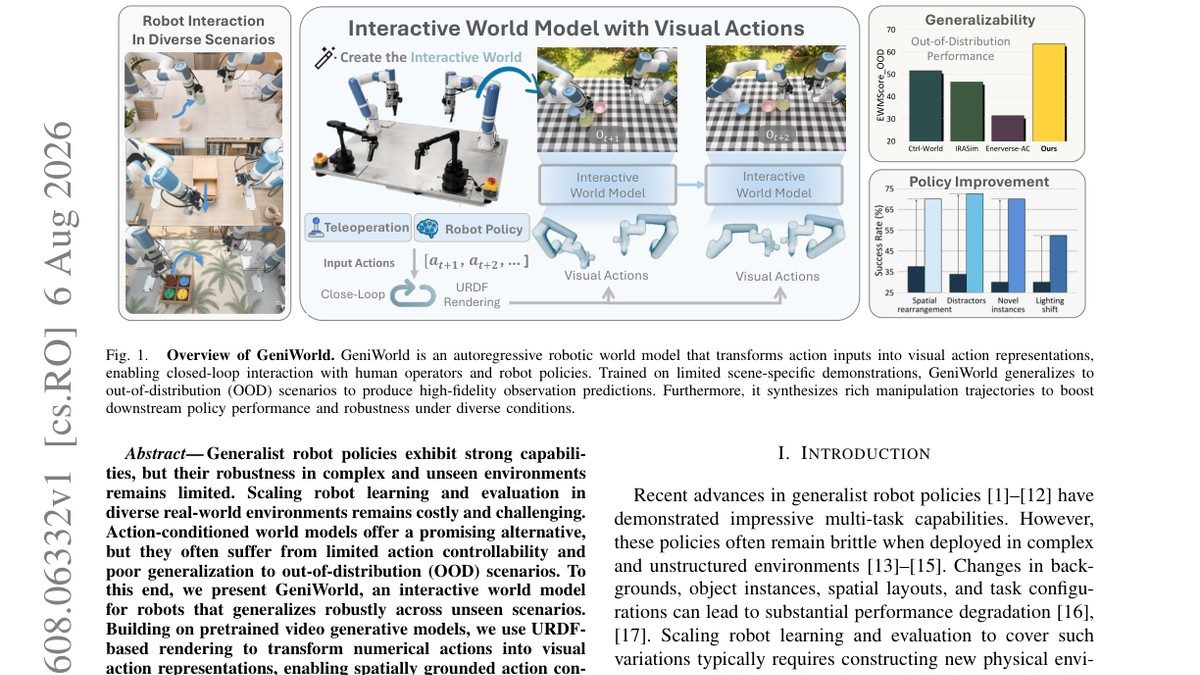
GeniWorld: A Generalizable Interactive World Model for Robotic Manipulation via Visual Actions
Chenghao Gu, Hanyang Yu, Jingbo Zhang et al. · arXiv preprint · Aug 2026
Generalist robot policies exhibit strong capabilities, but their robustness in complex and unseen environments remains limited. Scaling robot learning and evaluation in diverse real-world environments remains costly and challenging. Action-conditioned world models offer a promising alternative, b...