
PAC-MAN: Perception-Aware CBF-RL for Whole-Body Safety in Humanoid Dodgeball
Lizhi Yang, Junheng Li, Aaron D. Ames · N/A · 2026
Framework
N/A
License
N/A
Stars
N/A
Summary
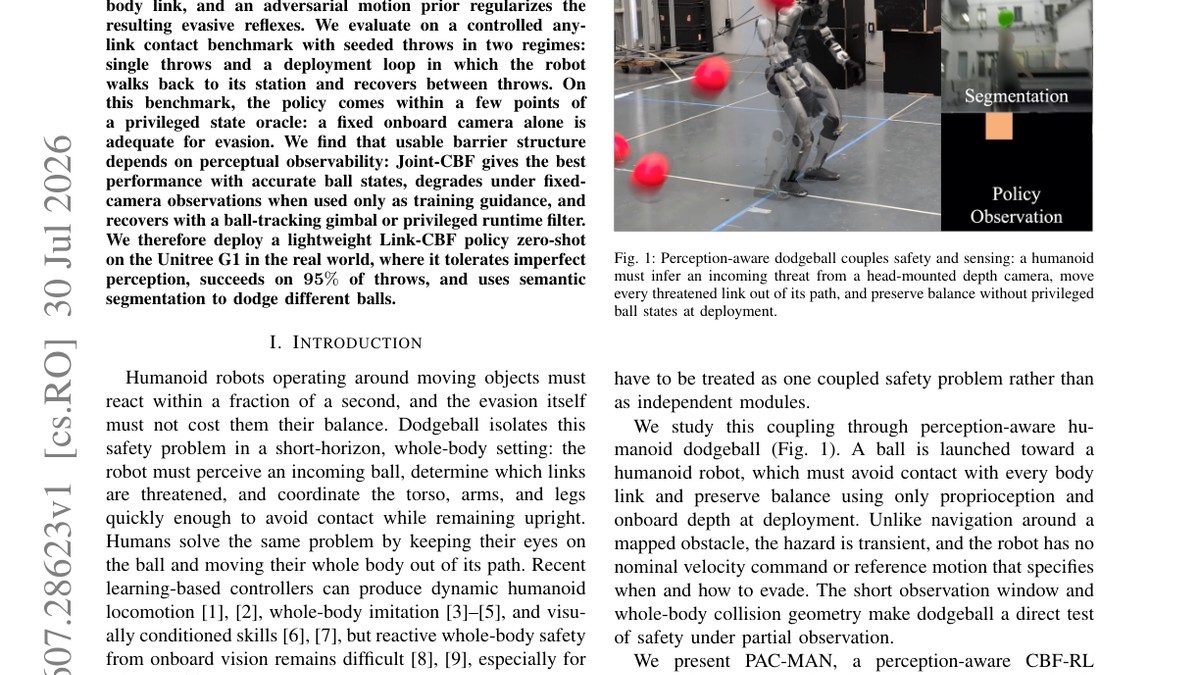
We present PAC-MAN, a perception-aware CBF-RL framework that couples control-barrier safety with deployment-realistic onboard sensing for whole-body humanoid dodgeball. The deployed policy sees the ball only as segmentation-masked depth from a head-mounted camera, while training-time CBF guidance...
Abstract Summary
Key Points
- We present PAC-MAN, a perception-aware CBF-RL framework that couples control-barrier safety with ...
- The deployed policy sees the ball only as segmentation-masked depth from a head-mounted camera, w...
- We evaluate on a controlled any-link contact benchmark with seeded throws in two regimes: single ...
- On this benchmark, the policy comes within a few points of a privileged state oracle: a fixed onb...
- We find that usable barrier structure depends on perceptual observability: Joint-CBF gives the be...
PAC-MAN: Perception-Aware CBF-RL for Whole-Body Safety in Humanoid Dodgeball
|Authors: Lizhi Yang, Junheng Li, Aaron D. Ames
|Venue: arXiv preprint | Year: 2026
|arXiv: 2607.28623v1
Abstract
We present PAC-MAN, a perception-aware CBF-RL framework that couples control-barrier safety with deployment-realistic onboard sensing for whole-body humanoid dodgeball. The deployed policy sees the ball only as segmentation-masked depth from a head-mounted camera, while training-time CBF guidance represents clearance to every body link, and an adversarial motion prior regularizes the resulting evasive reflexes. We evaluate on a controlled any-link contact benchmark with seeded throws in two regimes: single throws and a deployment loop in which the robot walks back to its station and recovers between throws. On this benchmark, the policy comes within a few points of a privileged state oracle: a fixed onboard camera alone is adequate for evasion. We find that usable barrier structure depends on perceptual observability: Joint-CBF gives the best performance with accurate ball states, degrades under fixed-camera observations when used only as training guidance, and recovers with a ball-tracking gimbal or privileged runtime filter. We therefore deploy a lightweight Link-CBF policy zero-shot on the Unitree G1 in the real world, where it tolerates imperfect perception, succeeds on 95% of throws, and uses semantic segmentation to dodge different balls.
Key Contributions
- We present PAC-MAN, a perception-aware CBF-RL framework that couples control-barrier safety with …
- The deployed policy sees the ball only as segmentation-masked depth from a head-mounted camera, w…
- We evaluate on a controlled any-link contact benchmark with seeded throws in two regimes: single …
- On this benchmark, the policy comes within a few points of a privileged state oracle: a fixed onb…
- We find that usable barrier structure depends on perceptual observability: Joint-CBF gives the be…
Topics
- vision
- reinforcement-learning
- control
- benchmark
Code & Data
- GitHub repository: https://github.com/ccrpRepo/AMP_mjlab
BibTeX
@article{Yang2026_260728623v1,
  title     = {PAC-MAN: Perception-Aware CBF-RL for Whole-Body Safety in Humanoid Dodgeball},
  author    = {Lizhi Yang and Junheng Li and Aaron D. Ames},
  year      = {2026},
  eprint    = {2607.28623v1},
  archivePrefix = {arXiv},
  primaryClass  = {cs.RO},
  url       = {https://arxiv.org/abs/2607.28623v1}
}
Related Papers
DECOWAM: Decoupled Whole-Body World-Action Model for Legged Mobile Manipulation
Siyuan Ma, Boshi Zhang, Yutian Zhang et al. · arXiv preprint · Aug 2026
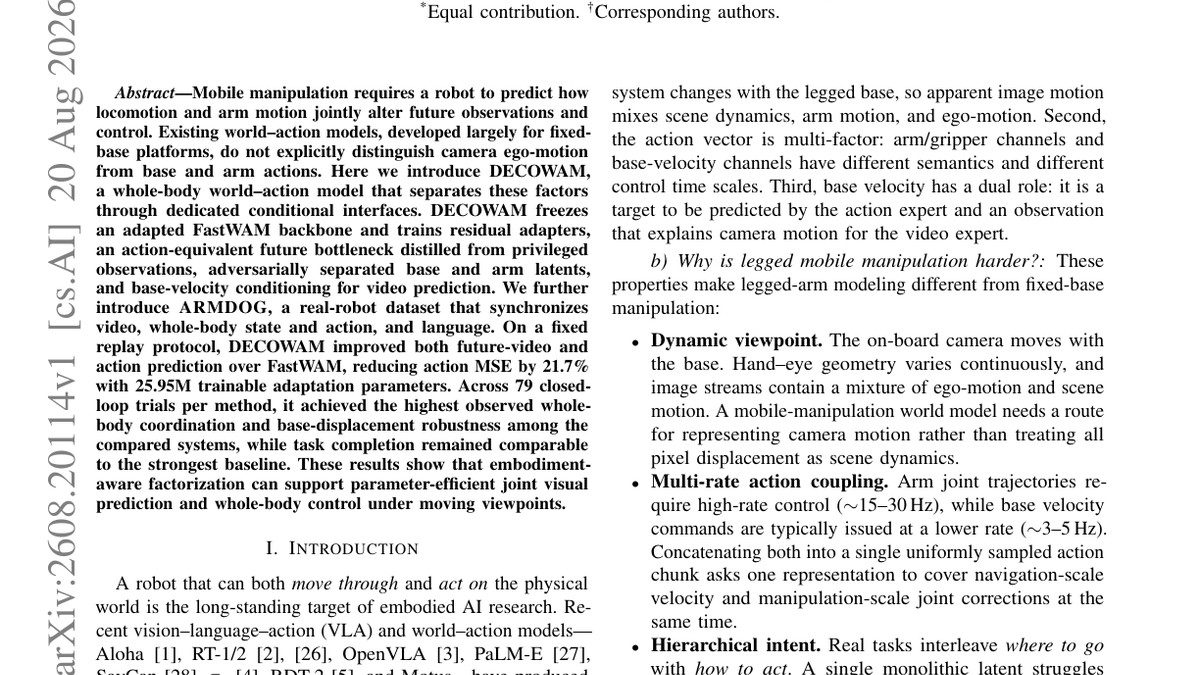
Mobile manipulation requires a robot to predict how locomotion and arm motion jointly alter future observations and control. Existing world-action models, developed largely for fixed-base platforms, do not explicitly distinguish camera ego-motion from base and arm actions. Here we introduce DECOW...
Design and Evaluation of a Touchscreen-Based Teleoperation Interface for Robotic Manipulators
Juan José García Cárdenas, Alperen Kenan, Hamidreza Raei et al. · arXiv preprint · Aug 2026
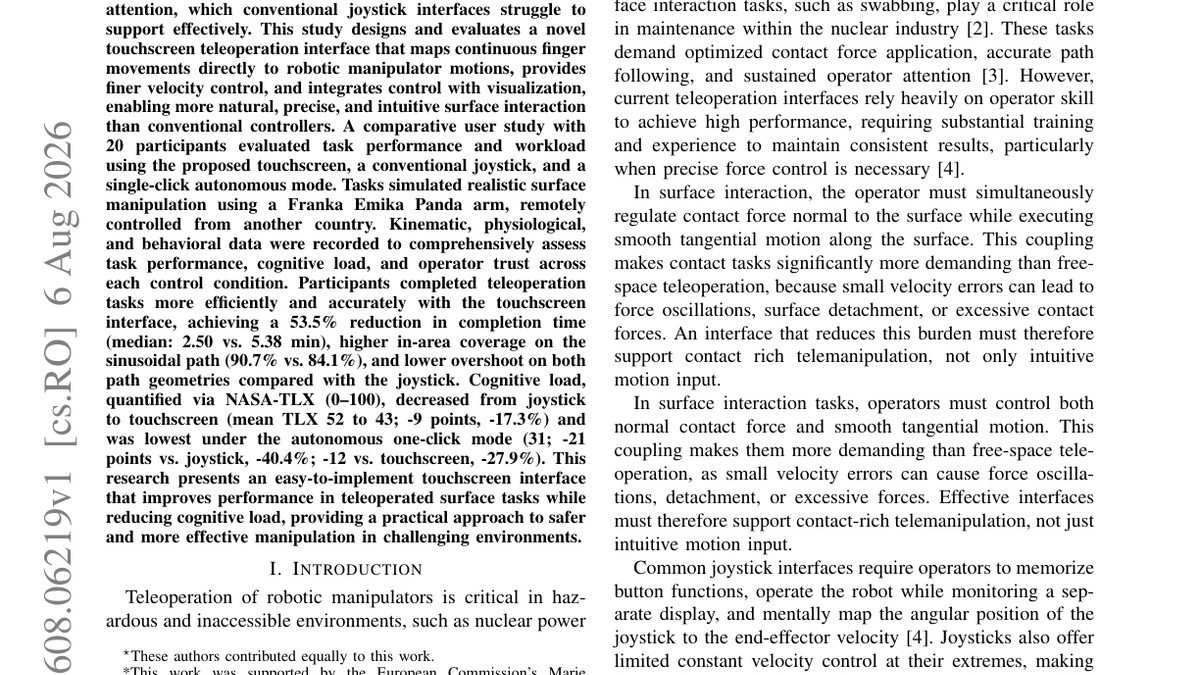
Intuitive teleoperation interfaces are crucial for the safe and effective operation of robotic manipulators in challenging environments. In the nuclear industry, surface contact tasks such as swab sampling require precise path and force tracking, obstacle avoidance, and sustained operator attenti...
DexVerse: A Modular Benchmark for Multi-Task, Multi-Embodiment Dexterous Manipulation
Yunchao Yao, Zhuxiu Xu, Tianqi Zhang et al. · arXiv preprint · Jul 2026
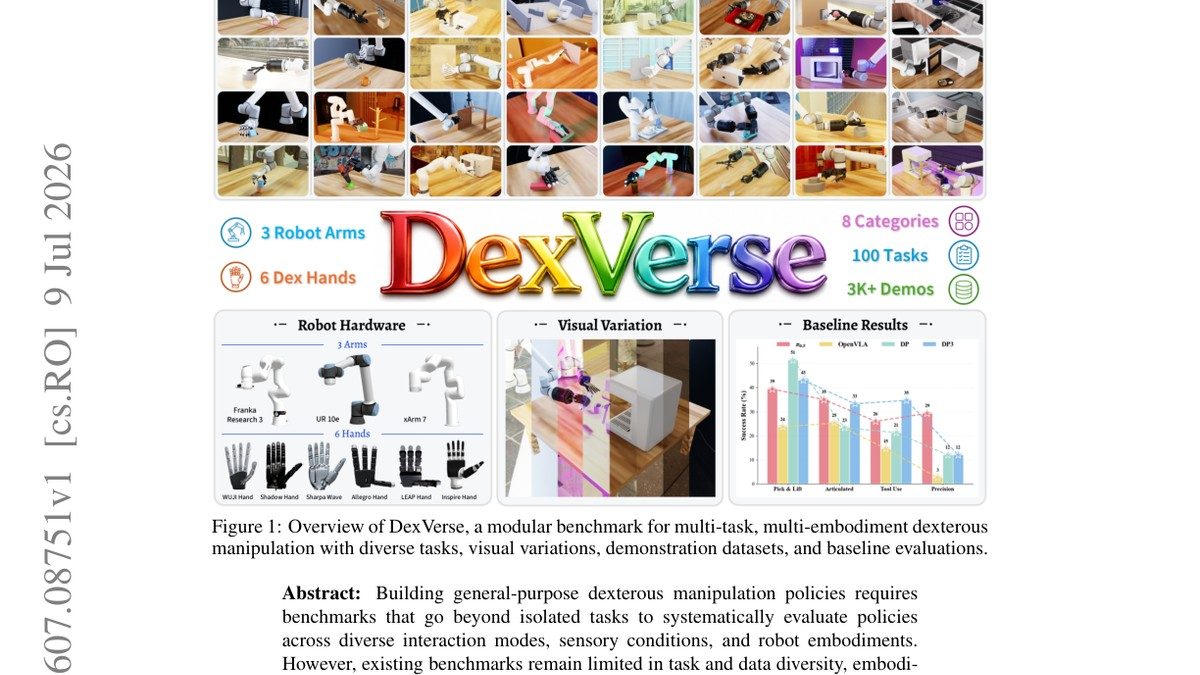
Building general-purpose dexterous manipulation policies requires benchmarks that go beyond isolated tasks to systematically evaluate policies across diverse interaction modes, sensory conditions, and robot embodiments. However, existing benchmarks remain limited in task and data diversity, embod...
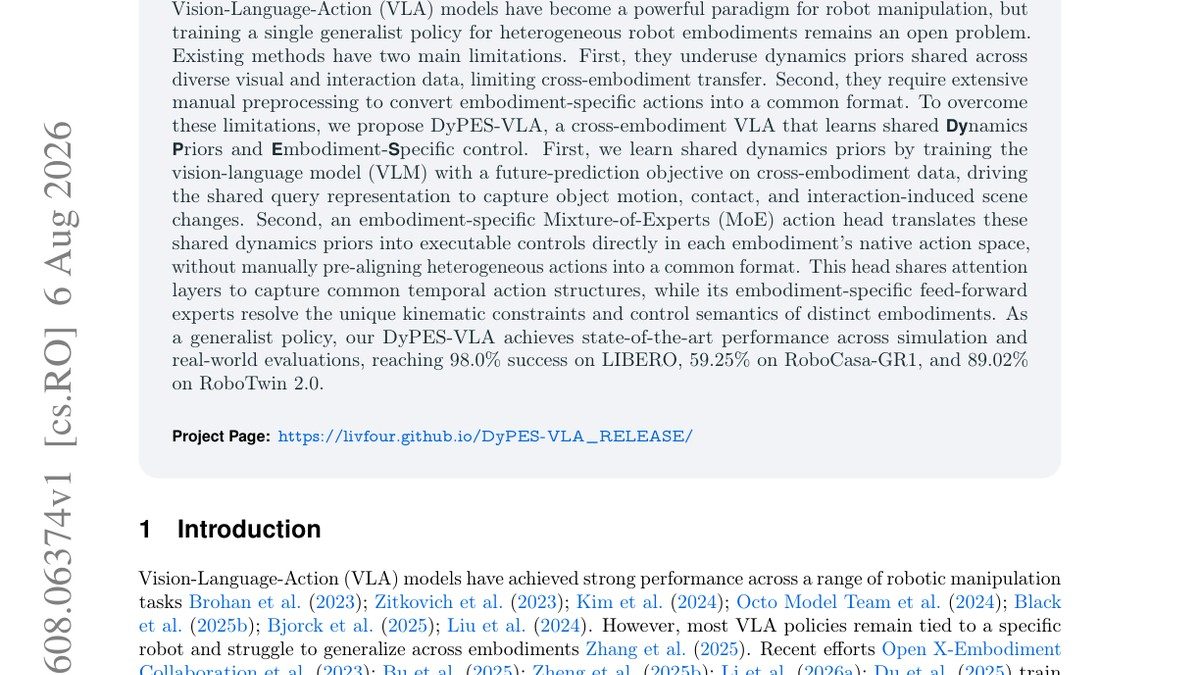
DyPES-VLA: Learning Shared Dynamics Priors and Embodiment-Specific Control for Cross-Embodiment Manipulation
Junfeng Li, Junjie He, Zhide Zhong et al. · arXiv preprint · Aug 2026
Vision-Language-Action (VLA) models have become a powerful paradigm for robot manipulation, but training a single generalist policy for heterogeneous robot embodiments remains an open problem. Existing methods have two main limitations. First, they underuse dynamics priors shared across diverse v...