
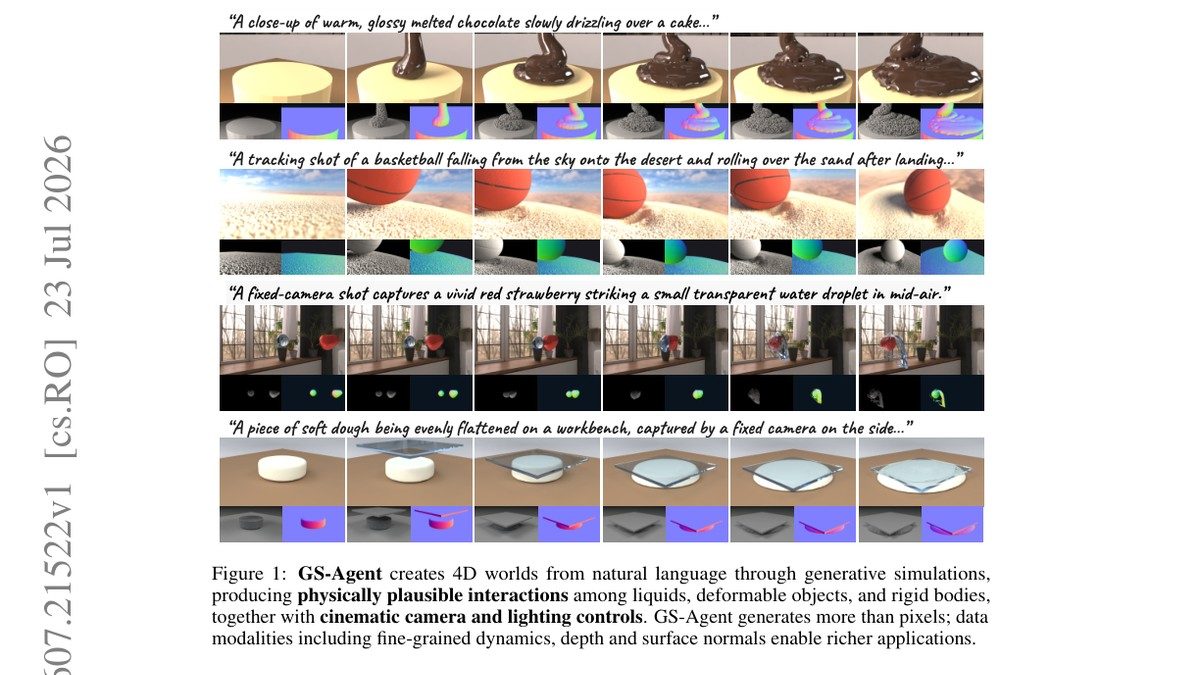
GS-Agent: Creating 4D Physical Worlds With Generative Simulation
Hongxin Zhang, Chunru Lin, Junyan Li, Zhou Xian, Tsun-Hsuan Wang, Chuang Gan · N/A · 2026
Framework
N/A
License
N/A
Stars
N/A
Summary
Creating dynamic and physically realistic 4D worlds from natural language descriptions is both fascinating and challenging. Traditional computer graphics methods rely on manual creation, requiring extensive human effort to fine-tune materials, motions, and visual fidelity. Recent advances in gene...
Abstract Summary
Key Points
- Creating dynamic and physically realistic 4D worlds from natural language descriptions is both fa...
- Traditional computer graphics methods rely on manual creation, requiring extensive human effort t...
- Recent advances in generative foundation models have sparked interest in learning to generate suc...
- In this work, we take a different path by leveraging foundation models to construct an agentic sy...
- We present GS-Agent, an end-to-end multi-agent framework that integrates physics engines in the l...
GS-Agent: Creating 4D Physical Worlds With Generative Simulation
|Authors: Hongxin Zhang, Chunru Lin, Junyan Li, Zhou Xian, Tsun-Hsuan Wang, Chuang Gan
|Venue: arXiv preprint | Year: 2026
|arXiv: 2607.21522v1
Abstract
Creating dynamic and physically realistic 4D worlds from natural language descriptions is both fascinating and challenging. Traditional computer graphics methods rely on manual creation, requiring extensive human effort to fine-tune materials, motions, and visual fidelity. Recent advances in generative foundation models have sparked interest in learning to generate such 4D worlds from large-scale data; however, existing methods still struggle to ensure physical plausibility and controllability. In this work, we take a different path by leveraging foundation models to construct an agentic system that emulates how humans traditionally create 4D worlds, yet automates the entire process. We present GS-Agent, an end-to-end multi-agent framework that integrates physics engines in the loop to generate realistic, dynamic, and controllable 4D physical worlds from natural language. Inspired by how humans build 4D worlds, GS-Agent decomposes the task into entity management, covering 3D asset curation, material tuning, placement, and motion control, and rendering configuration, including camera and lighting manipulation. Multiple agents with distinct expertise interact with the physics engine via code, seek multimodal feedback, and collaborate to iteratively construct 4D worlds that align with the given descriptions. Experimental results show that GS-Agent effectively converts natural language into diverse and physically plausible 4D worlds exhibiting rich interactions among liquids, deformable objects, and rigid bodies, while achieving cinematic camera and lighting control. We envision GS-Agent as a foundation for a new paradigm in 4D world generation, empowering creative content creation and physical AI. Project page at https://umass-embodied-agi.github.io/gs-agent/
Key Contributions
- Creating dynamic and physically realistic 4D worlds from natural language descriptions is both fa…
- Traditional computer graphics methods rely on manual creation, requiring extensive human effort t…
- Recent advances in generative foundation models have sparked interest in learning to generate suc…
- In this work, we take a different path by leveraging foundation models to construct an agentic sy…
- We present GS-Agent, an end-to-end multi-agent framework that integrates physics engines in the l…
Topics
- manipulation
- vision
- reinforcement-learning
- control
Code & Data
- GitHub repository: https://github.com/nerfies/nerfies.github.io
BibTeX
@article{Zhang2026_260721522v1,
  title     = {GS-Agent: Creating 4D Physical Worlds With Generative Simulation},
  author    = {Hongxin Zhang and Chunru Lin and Junyan Li and Zhou Xian and Tsun-Hsuan Wang and Chuang Gan},
  year      = {2026},
  eprint    = {2607.21522v1},
  archivePrefix = {arXiv},
  primaryClass  = {cs.RO},
  url       = {https://arxiv.org/abs/2607.21522v1}
}
Related Papers
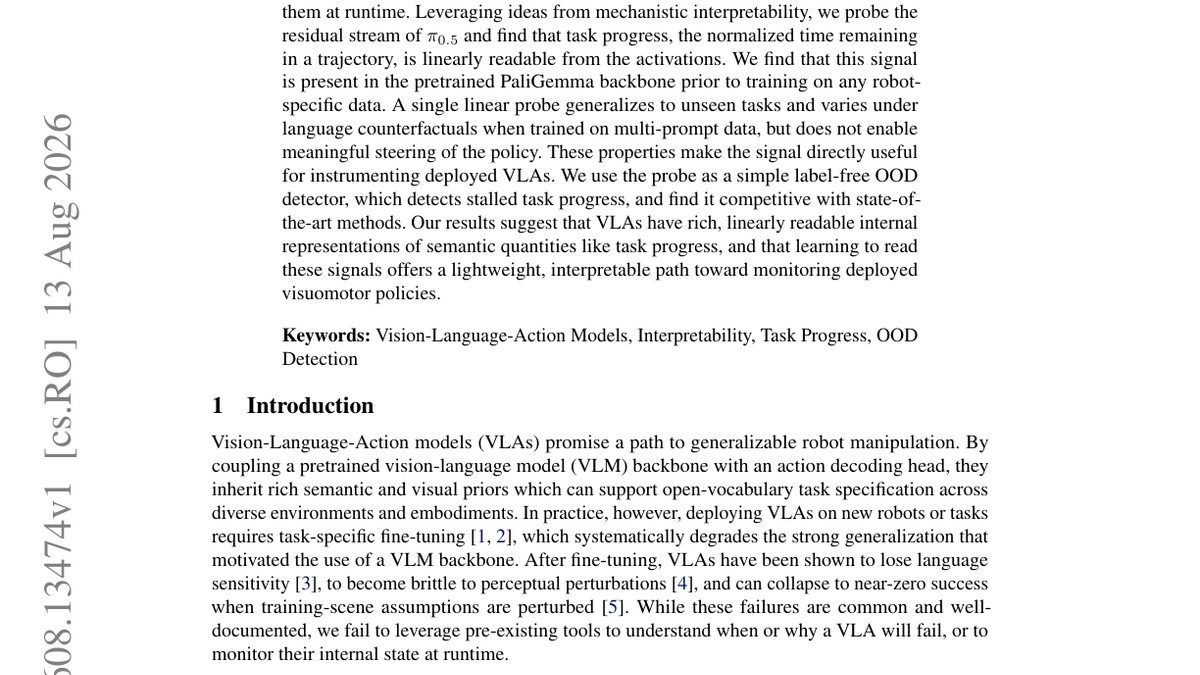
Decoding Task Progress from VLA Representations
Atiksh Bhardwaj, Edward Weiyi Duan, Prithwish Dan et al. · arXiv preprint · Aug 2026
Vision-language-action models (VLAs) are moving rapidly towards deployment as general-purpose manipulation policies, but we currently lack basic tools for understanding what these models represent internally or for monitoring them at runtime. Leveraging ideas from mechanistic interpretability, we...
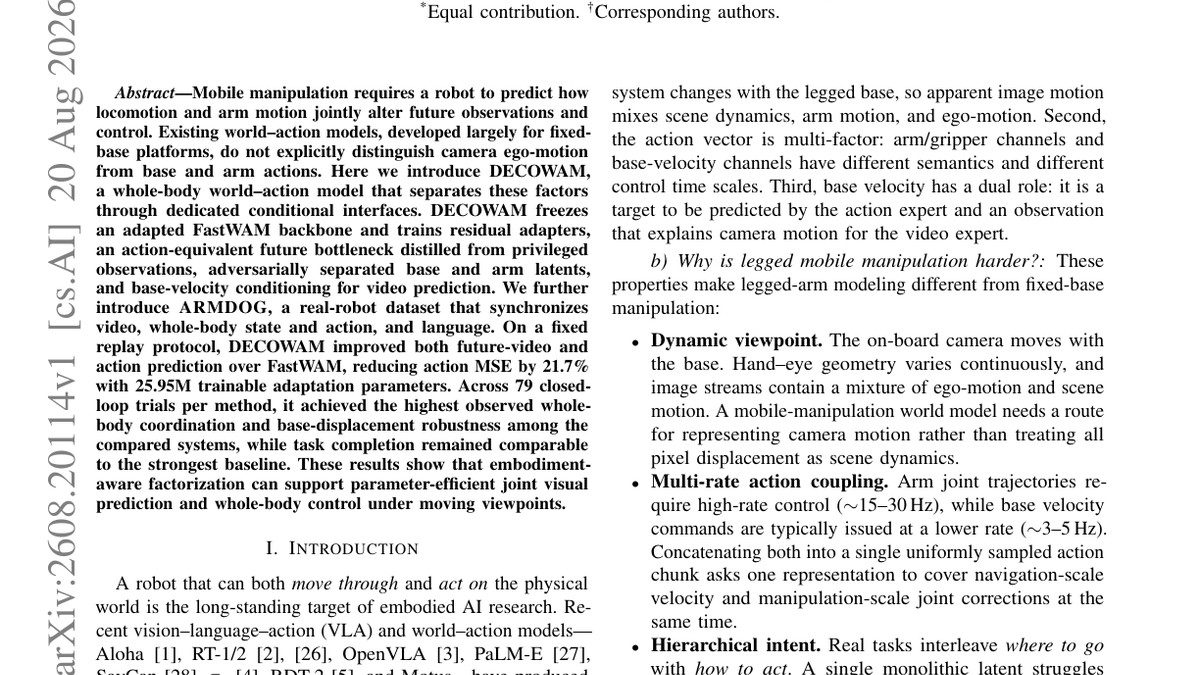
DECOWAM: Decoupled Whole-Body World-Action Model for Legged Mobile Manipulation
Siyuan Ma, Boshi Zhang, Yutian Zhang et al. · arXiv preprint · Aug 2026
Mobile manipulation requires a robot to predict how locomotion and arm motion jointly alter future observations and control. Existing world-action models, developed largely for fixed-base platforms, do not explicitly distinguish camera ego-motion from base and arm actions. Here we introduce DECOW...
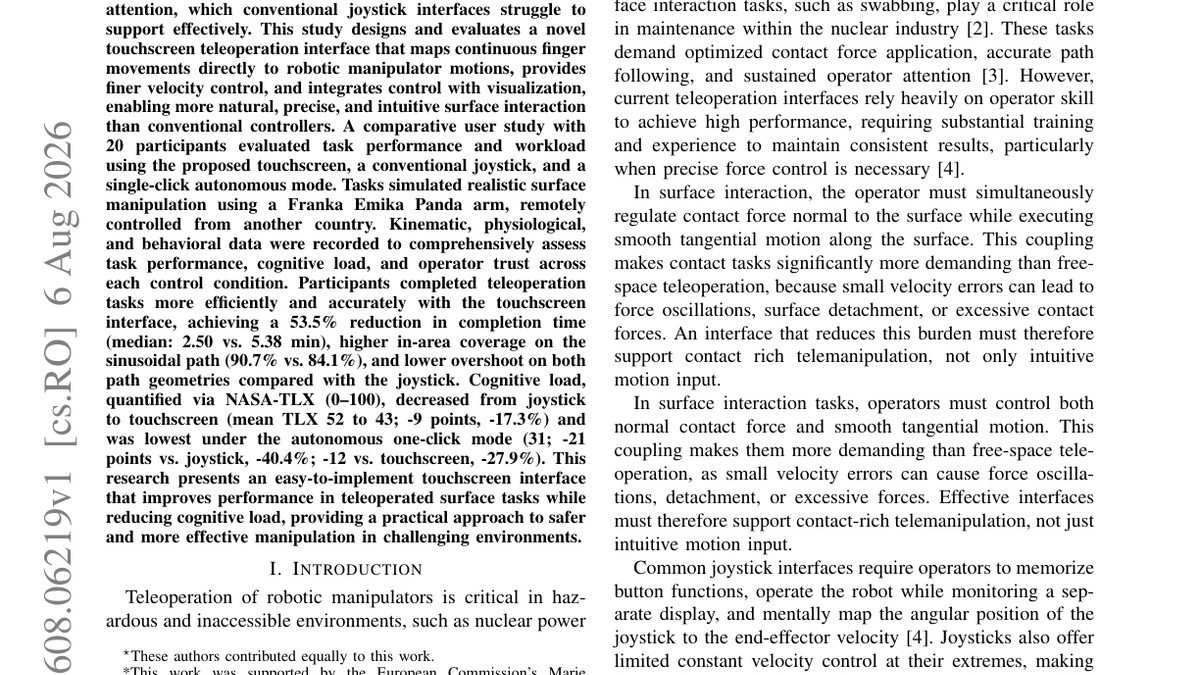
Design and Evaluation of a Touchscreen-Based Teleoperation Interface for Robotic Manipulators
Juan José García Cárdenas, Alperen Kenan, Hamidreza Raei et al. · arXiv preprint · Aug 2026
Intuitive teleoperation interfaces are crucial for the safe and effective operation of robotic manipulators in challenging environments. In the nuclear industry, surface contact tasks such as swab sampling require precise path and force tracking, obstacle avoidance, and sustained operator attenti...
Development of a Humanoid Robot Prototype for Multimodal Human-Robot Interaction
Thang Tran Viet, Thanh Nguyen Canh, Huy Uong Gia et al. · arXiv preprint · Sep 2026
Human-robot interaction (HRI) enables intuitive and intelligent collaboration between humans and robots in real-world environments. This paper introduces a humanoid robot prototype designed as a flexible testbed for developing and integrating artificial intelligence (AI) modules in HRI tasks. The...