
Goal-Oriented Semantic Communication for Distributed ISAC-Enabled Vehicle Coordination
Wenjie Liu, Yansha Deng · N/A · 2026
Framework
N/A
License
N/A
Stars
N/A
Summary
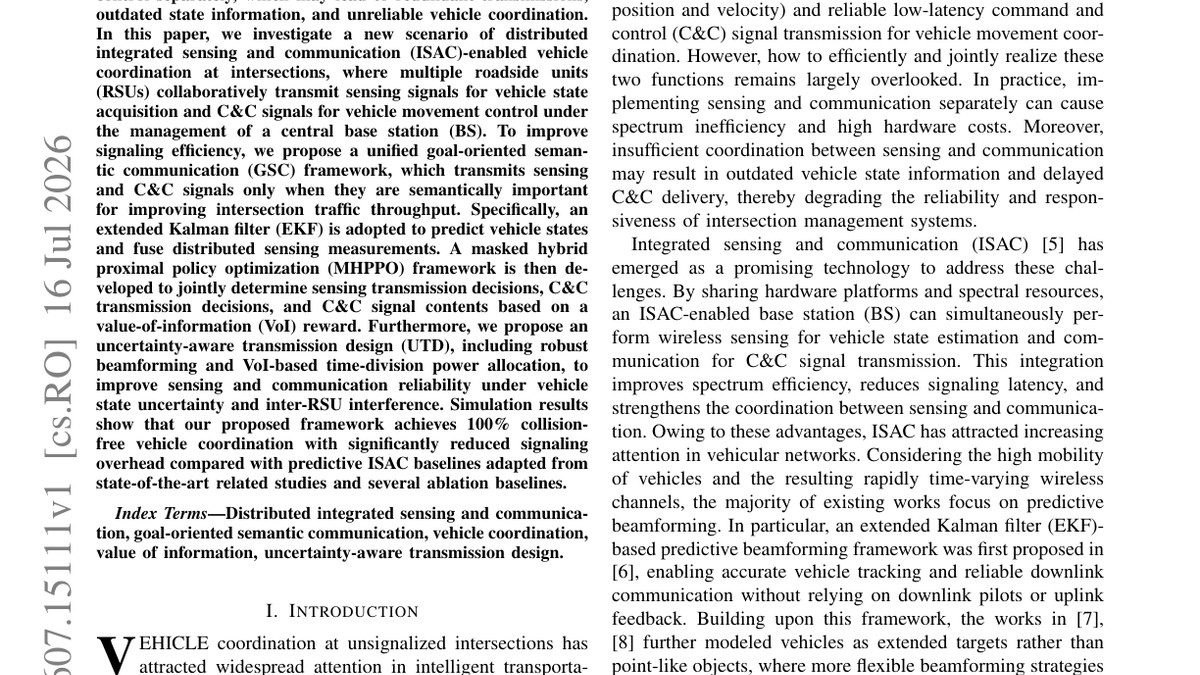
Vehicle coordination at unsignalized intersections relies on accurate real-time vehicle state acquisition and reliable command-and-control (C&C) signal delivery. However, existing studies typically treat sensing, communication, and control separately, which may lead to redundant transmissions, ou...
Abstract Summary
Key Points
- Vehicle coordination at unsignalized intersections relies on accurate real-time vehicle state acq...
- However, existing studies typically treat sensing, communication, and control separately, which m...
- In this paper, we investigate a new scenario of distributed integrated sensing and communication ...
- To improve signaling efficiency, we propose a unified goal-oriented semantic communication (GSC) ...
- Specifically, an extended Kalman filter (EKF) is adopted to predict vehicle states and fuse distr...
Goal-Oriented Semantic Communication for Distributed ISAC-Enabled Vehicle Coordination
|Authors: Wenjie Liu, Yansha Deng
|Venue: arXiv preprint | Year: 2026
|arXiv: 2607.15111v1
Abstract
Vehicle coordination at unsignalized intersections relies on accurate real-time vehicle state acquisition and reliable command-and-control (C&C) signal delivery. However, existing studies typically treat sensing, communication, and control separately, which may lead to redundant transmissions, outdated state information, and unreliable vehicle coordination. In this paper, we investigate a new scenario of distributed integrated sensing and communication (ISAC)-enabled vehicle coordination at intersections, where multiple roadside units (RSUs) collaboratively transmit sensing signals for vehicle state acquisition and C&C signals for vehicle movement control under the management of a central base station (BS). To improve signaling efficiency, we propose a unified goal-oriented semantic communication (GSC) framework, which transmits sensing and C&C signals only when they are semantically important for improving intersection traffic throughput. Specifically, an extended Kalman filter (EKF) is adopted to predict vehicle states and fuse distributed sensing measurements. A masked hybrid proximal policy optimization (MHPPO) framework is then developed to jointly determine sensing transmission decisions, C&C transmission decisions, and C&C signal contents based on a value-of-information (VoI) reward. Furthermore, we propose an uncertainty-aware transmission design (UTD), including robust beamforming and VoI-based time-division power allocation, to improve sensing and communication reliability under vehicle state uncertainty and inter-RSU interference. Simulation results show that our proposed framework achieves 100% collision-free vehicle coordination with significantly reduced signaling overhead compared with predictive ISAC baselines adapted from state-of-the-art related studies and several ablation baselines.
Key Contributions
- Vehicle coordination at unsignalized intersections relies on accurate real-time vehicle state acq…
- However, existing studies typically treat sensing, communication, and control separately, which m…
- In this paper, we investigate a new scenario of distributed integrated sensing and communication …
- To improve signaling efficiency, we propose a unified goal-oriented semantic communication (GSC) …
- Specifically, an extended Kalman filter (EKF) is adopted to predict vehicle states and fuse distr…
Topics
- vision
- reinforcement-learning
- control
Code & Data
No code repository linked in paper metadata.
BibTeX
@article{Liu2026_260715111v1,
  title     = {Goal-Oriented Semantic Communication for Distributed ISAC-Enabled Vehicle Coordination},
  author    = {Wenjie Liu and Yansha Deng},
  year      = {2026},
  eprint    = {2607.15111v1},
  archivePrefix = {arXiv},
  primaryClass  = {cs.RO},
  url       = {https://arxiv.org/abs/2607.15111v1}
}
Related Papers
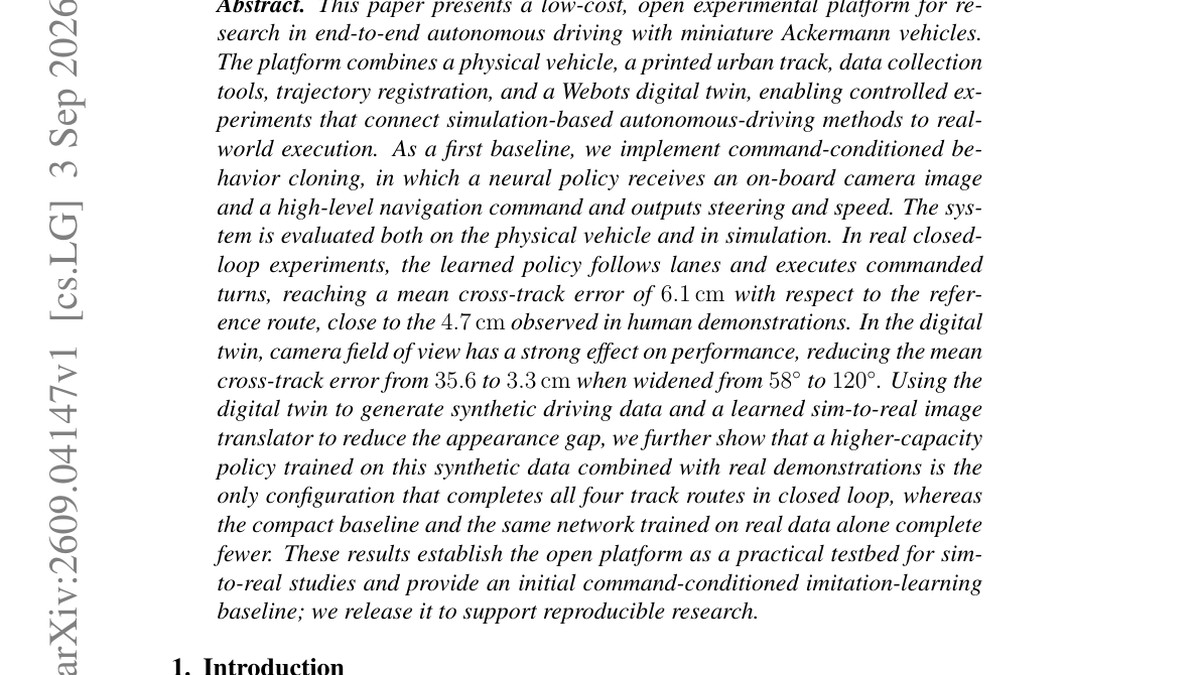
A Low-Cost, Open Platform for End-to-End Autonomous Driving on a Miniature Ackermann Vehicle
Gustavo Claudio Karl Couto, Eric Aislan Antonelo, Gabriel George Zipperer · arXiv preprint · Sep 2026
This paper presents a low-cost, open experimental platform for research in end-to-end autonomous driving with miniature Ackermann vehicles. The platform combines a physical vehicle, a printed urban track, data collection tools, trajectory registration, and a Webots digital twin, enabling controll...
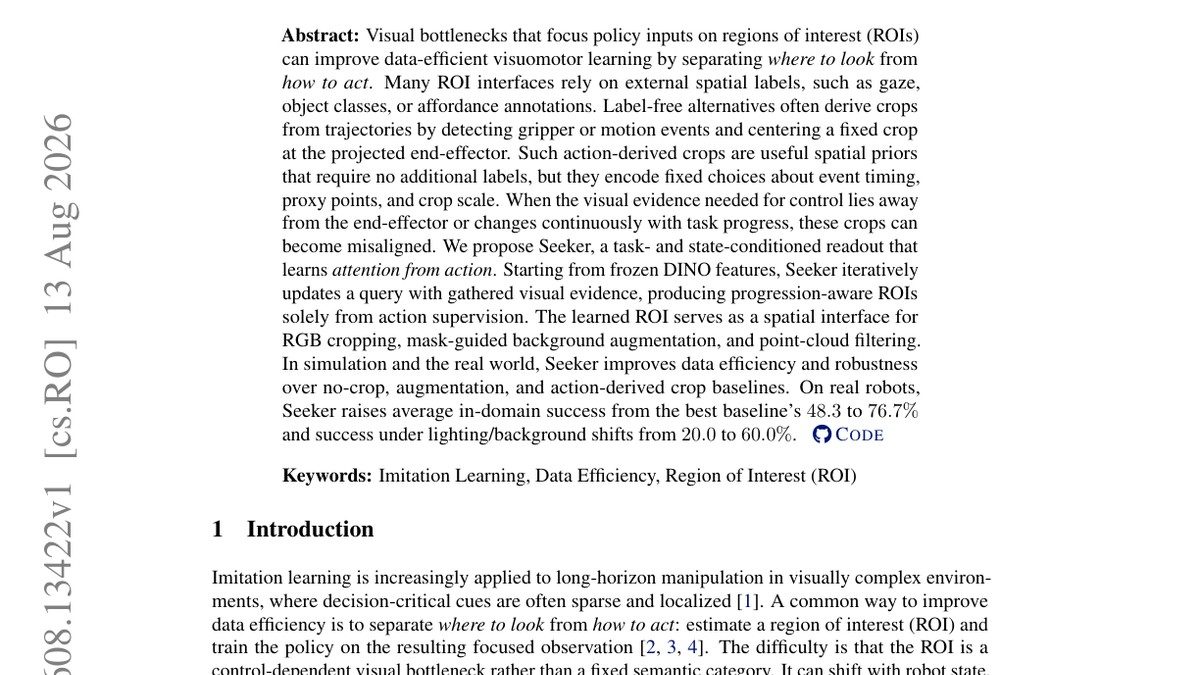
Attention from Action, for Action: Emergent Visual Bottlenecks for Policy Learning
Zheyu Zhuang, Ruiyu Wang, Nick Heppert et al. · arXiv preprint · Aug 2026
Visual bottlenecks that focus policy inputs on regions of interest (ROIs) can improve data-efficient visuomotor learning by separating where to look from how to act. Many ROI interfaces rely on external spatial labels, such as gaze, object classes, or affordance annotations. Label-free alternativ...
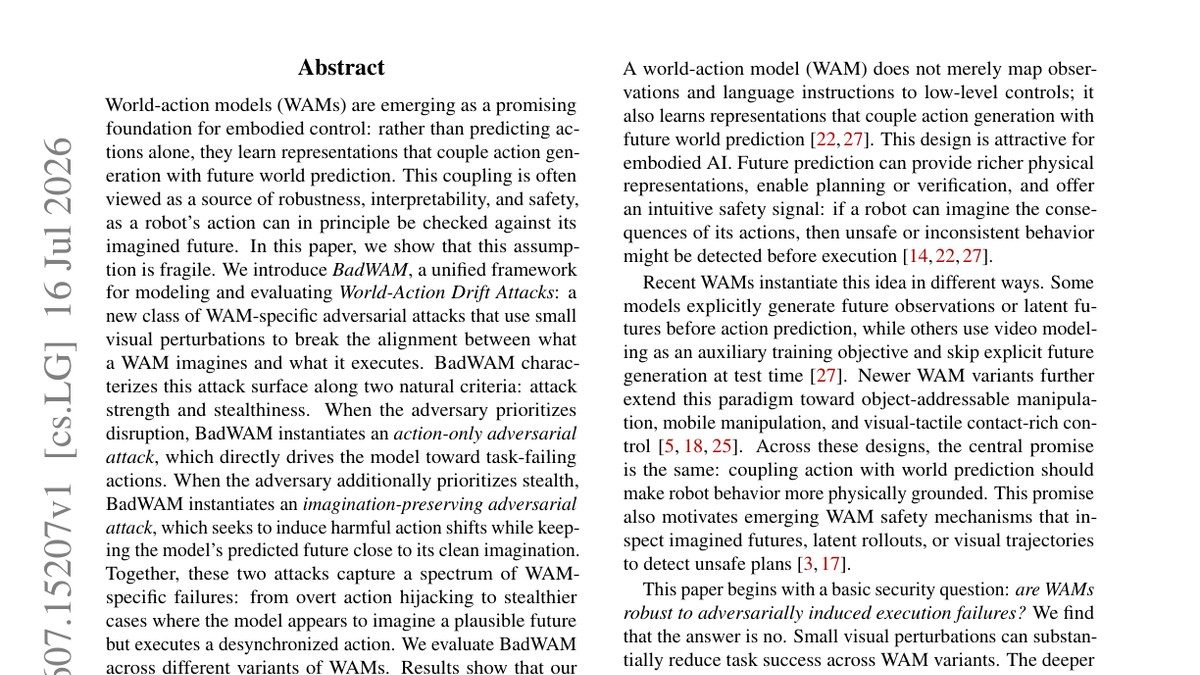
BadWAM: When World-Action Models Dream Right but Act Wrong
Qi Li, Xingyi Yang, Xinchao Wang · arXiv preprint · Jul 2026
World-action models (WAMs) are emerging as a promising foundation for embodied control: rather than predicting actions alone, they learn representations that couple action generation with future world prediction. This coupling is often viewed as a source of robustness, interpretability, and safet...
Can People Distinguish Human and AI Agency in Humanoid Teleoperation? A Preliminary Study of Agency Perception
Xiang Li, Koya Dendo, Keigo Minamida et al. · arXiv preprint · Sep 2026
Can people distinguish between human and AI agency in humanoid teleoperation? To explore this question, we developed \textit{Ghost-in-the-Loop}, a teleoperation framework that supports both human-operated and AI-generated control of a robot's voice, facial expressions, and gestures while maintain...