
GIFT: Guided Intermediate Feature Training via Action-Oriented Structural Supervision for Robotic Manipulation
Yupeng Zheng, Xiang Li, Songen Gu, Yuhang Zheng, Shuai Tian, Weize Li, Linbo Wang, Chaoyue Li, Qichao Zhang, Haoran Li, Zhongpu Xia, Ya-Qin Zhang, Shuicheng Yan, Dongbin Zhao · N/A · 2026
Framework
N/A
License
N/A
Stars
N/A
Summary
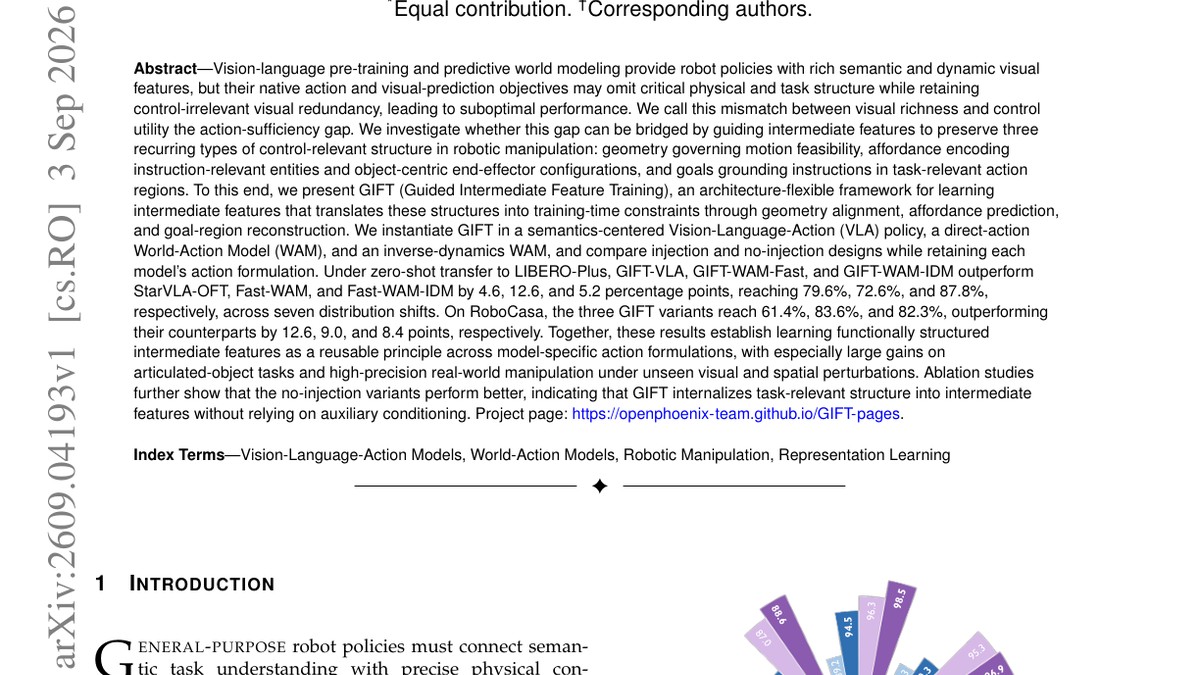
Vision-language pre-training and predictive world modeling provide robot policies with rich semantic and dynamic visual features, but their native action and visual-prediction objectives may omit critical physical and task structure while retaining control-irrelevant visual redundancy. We call th...
Abstract Summary
Key Points
- Vision-language pre-training and predictive world modeling provide robot policies with rich seman...
- We call this mismatch between visual richness and control utility the action-sufficiency gap
- We investigate whether this gap can be bridged by guiding intermediate features to preserve three...
- To this end, we present GIFT (Guided Intermediate Feature Training), an architecture-flexible fra...
- We instantiate GIFT in a Vision-Language-Action (VLA) policy, a direct-action World-Action Model ...
GIFT: Guided Intermediate Feature Training via Action-Oriented Structural Supervision for Robotic Manipulation
|Authors: Yupeng Zheng, Xiang Li, Songen Gu, Yuhang Zheng, Shuai Tian, Weize Li, Linbo Wang, Chaoyue Li, Qichao Zhang, Haoran Li, Zhongpu Xia, Ya-Qin Zhang, Shuicheng Yan, Dongbin Zhao
|Venue: arXiv preprint | Year: 2026
|arXiv: 2609.04193v1
Abstract
Vision-language pre-training and predictive world modeling provide robot policies with rich semantic and dynamic visual features, but their native action and visual-prediction objectives may omit critical physical and task structure while retaining control-irrelevant visual redundancy. We call this mismatch between visual richness and control utility the action-sufficiency gap. We investigate whether this gap can be bridged by guiding intermediate features to preserve three control-relevant structure in robotic manipulation: geometry governing motion feasibility, affordance encoding instruction-relevant entities, and goals grounding instructions in task-relevant regions. To this end, we present GIFT (Guided Intermediate Feature Training), an architecture-flexible framework for learning intermediate features that translates these structures into training-time constraints through geometry alignment, affordance prediction, and goal-region reconstruction. We instantiate GIFT in a Vision-Language-Action (VLA) policy, a direct-action World-Action Model (WAM), and an inverse-dynamics WAM while retaining each model’s action formulation. Under zero-shot transfer to LIBERO-Plus, GIFT-VLA, GIFT-WAM-Fast, and GIFT-WAM-IDM outperform StarVLA-OFT, Fast-WAM, and Fast-WAM-IDM by 4.6, 12.6, and 5.2 points, reaching 79.6%, 72.6%, and 87.8%, respectively. On RoboCasa, the three GIFT variants reach 61.4%, 83.6%, and 82.3%, outperforming their counterparts by 12.6, 9.0, and 8.4 points, respectively. Together, these results establish learning functionally structured intermediate features as a reusable principle across model-specific action formulations, with especially large gains on articulated-object tasks and high-precision real-world manipulation under unseen visual and spatial perturbations. Project page: https://openphoenix-team.github.io/GIFT-pages.
Key Contributions
- Vision-language pre-training and predictive world modeling provide robot policies with rich seman…
- We call this mismatch between visual richness and control utility the action-sufficiency gap
- We investigate whether this gap can be bridged by guiding intermediate features to preserve three…
- To this end, we present GIFT (Guided Intermediate Feature Training), an architecture-flexible fra…
- We instantiate GIFT in a Vision-Language-Action (VLA) policy, a direct-action World-Action Model …
Topics
- manipulation
- vision
- vla
- reinforcement-learning
- control
Code & Data
No code repository linked in paper metadata.
BibTeX
@article{Zheng2026_260904193v1,
  title     = {GIFT: Guided Intermediate Feature Training via Action-Oriented Structural Supervision for Robotic Manipulation},
  author    = {Yupeng Zheng and Xiang Li and Songen Gu and Yuhang Zheng and Shuai Tian and Weize Li and Linbo Wang and Chaoyue Li and Qichao Zhang and Haoran Li and Zhongpu Xia and Ya-Qin Zhang and Shuicheng Yan and Dongbin Zhao},
  year      = {2026},
  eprint    = {2609.04193v1},
  archivePrefix = {arXiv},
  primaryClass  = {cs.RO},
  url       = {https://arxiv.org/abs/2609.04193v1}
}
Related Papers
Decoding Task Progress from VLA Representations
Atiksh Bhardwaj, Edward Weiyi Duan, Prithwish Dan et al. · arXiv preprint · Aug 2026
Vision-language-action models (VLAs) are moving rapidly towards deployment as general-purpose manipulation policies, but we currently lack basic tools for understanding what these models represent internally or for monitoring them at runtime. Leveraging ideas from mechanistic interpretability, we...
Development of a Humanoid Robot Prototype for Multimodal Human-Robot Interaction
Thang Tran Viet, Thanh Nguyen Canh, Huy Uong Gia et al. · arXiv preprint · Sep 2026
Human-robot interaction (HRI) enables intuitive and intelligent collaboration between humans and robots in real-world environments. This paper introduces a humanoid robot prototype designed as a flexible testbed for developing and integrating artificial intelligence (AI) modules in HRI tasks. The...
DexVerse: A Modular Benchmark for Multi-Task, Multi-Embodiment Dexterous Manipulation
Yunchao Yao, Zhuxiu Xu, Tianqi Zhang et al. · arXiv preprint · Jul 2026
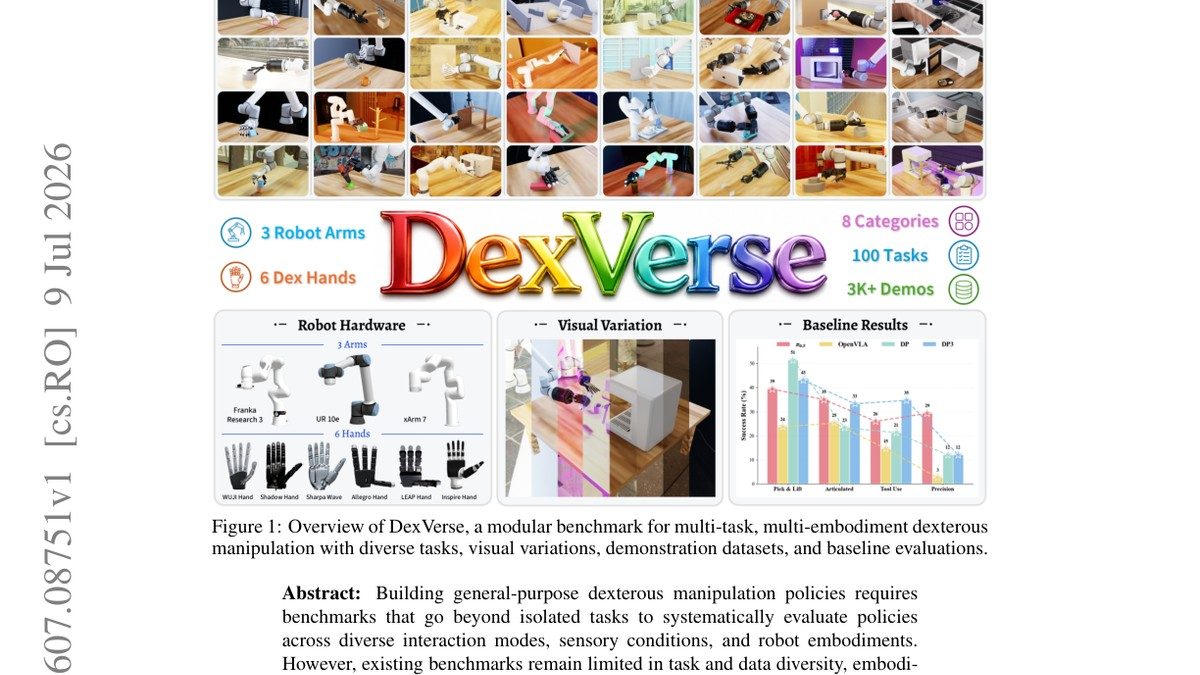
Building general-purpose dexterous manipulation policies requires benchmarks that go beyond isolated tasks to systematically evaluate policies across diverse interaction modes, sensory conditions, and robot embodiments. However, existing benchmarks remain limited in task and data diversity, embod...
DyPES-VLA: Learning Shared Dynamics Priors and Embodiment-Specific Control for Cross-Embodiment Manipulation
Junfeng Li, Junjie He, Zhide Zhong et al. · arXiv preprint · Aug 2026
Vision-Language-Action (VLA) models have become a powerful paradigm for robot manipulation, but training a single generalist policy for heterogeneous robot embodiments remains an open problem. Existing methods have two main limitations. First, they underuse dynamics priors shared across diverse v...