

Frame-Coded Legged Locomotion over Noisy Terrain
Lav R. Varshney · N/A · 2026
Framework
N/A
License
N/A
Stars
N/A
Summary
Open-loop multilegged locomotion over rough terrain has been interpreted as matter transport over a noisy channel: leg-ground interactions are discrete basic active contacts, terrain deletes or perturbs those contacts, and spatial redundancy concentrates the resulting thrust and arrival time. Tha...
Abstract Summary
Key Points
- Open-loop multilegged locomotion over rough terrain has been interpreted as matter transport over...
- That construction is repetition-like because every module carries the same scalar locomotion task
- It consequently provides neither a positive task rate nor a decoder that changes with the survivi...
- Here we formulate locomotion instead as a quantized finite-frame expansion with erasures
- A d-dimensional body-level command is mapped into N>d heterogeneous local contact commands
Frame-Coded Legged Locomotion over Noisy Terrain
|Authors: Lav R. Varshney
|Venue: arXiv preprint | Year: 2026
|arXiv: 2609.10273v1
Abstract
Open-loop multilegged locomotion over rough terrain has been interpreted as matter transport over a noisy channel: leg-ground interactions are discrete basic active contacts, terrain deletes or perturbs those contacts, and spatial redundancy concentrates the resulting thrust and arrival time. That construction is repetition-like because every module carries the same scalar locomotion task. It consequently provides neither a positive task rate nor a decoder that changes with the surviving contact set. Here we formulate locomotion instead as a quantized finite-frame expansion with erasures. A d-dimensional body-level command is mapped into N>d heterogeneous local contact commands. Rough terrain erases or corrupts frame coefficients, while a contact-gated compliant morphology physically realizes the weighted active-subframe decoder. For a linear-Gaussian model, mechanical equilibrium is exactly the posterior mean, tangent stiffness is posterior precision, and mechanical compliance is posterior covariance. Equal-norm Parseval frames are shown to be minimax optimal against one missing contact, two-contact robustness is governed by frame coherence, and a harmonic frame gives a directly realizable gait family. For independently surviving contacts of probability q, random Gaussian gait frames admit exact reconstruction at every analog dimension rate R<q, with a binomial reliability exponent, whereas recovery of arbitrary commands is impossible for R>q. Residual contact noise yields an asymptotic per-mode amplification 1/(q-R) and a vanishing mechanical stiffness margin at the threshold. An information-locomotion inequality and an exact incremental-redundancy rule direct the next gait component toward the softest task-relevant unresolved mode. The resulting analog frame-coding theorem establishes a finite relative redundancy and converse as part of a fundamental limit theory of legged locomotion.
Key Contributions
- Open-loop multilegged locomotion over rough terrain has been interpreted as matter transport over…
- That construction is repetition-like because every module carries the same scalar locomotion task
- It consequently provides neither a positive task rate nor a decoder that changes with the survivi…
- Here we formulate locomotion instead as a quantized finite-frame expansion with erasures
- A d-dimensional body-level command is mapped into N>d heterogeneous local contact commands
Topics
- locomotion
Code & Data
No code repository linked in paper metadata.
BibTeX
@article{Varshney2026_260910273v1,
  title     = {Frame-Coded Legged Locomotion over Noisy Terrain},
  author    = {Lav R. Varshney},
  year      = {2026},
  eprint    = {2609.10273v1},
  archivePrefix = {arXiv},
  primaryClass  = {cs.IT},
  url       = {https://arxiv.org/abs/2609.10273v1}
}
Related Papers
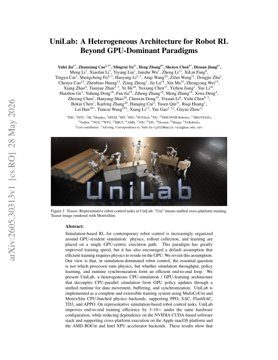
A Heterogeneous Architecture for Robot RL Beyond GPU-Dominant Paradigms
Yufei Jia, Zhanxiang Cao, Mingrui Yu et al. · arXiv preprint · May 2026
Simulation-based RL for contemporary robot control is increasingly organized around GPU-resident simulation: physics, rollout collection, and learning are placed on a single GPU-centric execution path
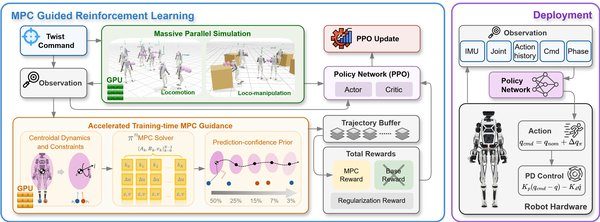
Accelerating and Scaling MPC-Guided Reinforcement Learning for Humanoid Locomotion and Manipulation
Junheng Li, Liang Wu, Sergio A. Esteban et al. · arXiv preprint · Jun 2026
In humanoid motion control, model predictive control (MPC) offers physically grounded prediction and constraint handling, while reinforcement learning (RL) enables robust whole-body skills through large-scale simulation. However, using MPC inside RL often requires time-consuming problem construction or excessive training overhead, making such frameworks difficult to justify in practice. This work studies efficient training-time MPC guidance for humanoid locomotion and manipulation, termed MPC-RL. We introduce a centroidal-dynamics MPC reward formulation that leverages guidance from MPC trajectories in training time. To make this practical in massively parallel RL, we develop π^nMPC, a parallel-in-horizon and construction-free batched GPU MPC solver that operates directly on time-varying dynamics to avoid high memory usage and pre-compilation. Through a variety of comparative studies and hardware validations, we have found that MPC-RL achieves superior performance in locomotion and manipulation skills.
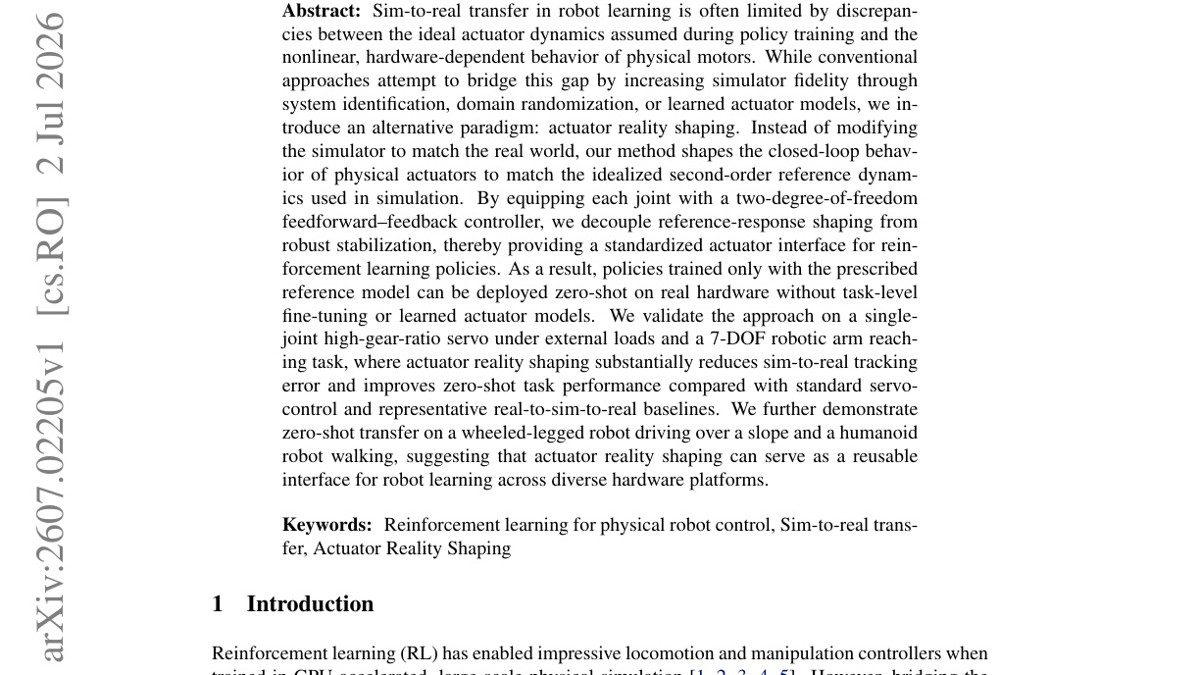
Actuator Reality Shaping for Zero-Shot Sim-to-Real Robot Learning
Satoshi Yamamori, Koji Ishihara, Kentaro Minamikawa et al. · arXiv preprint · Jul 2026
Sim-to-real transfer in robot learning is often limited by discrepancies between the ideal actuator dynamics assumed during policy training and the nonlinear, hardware-dependent be...
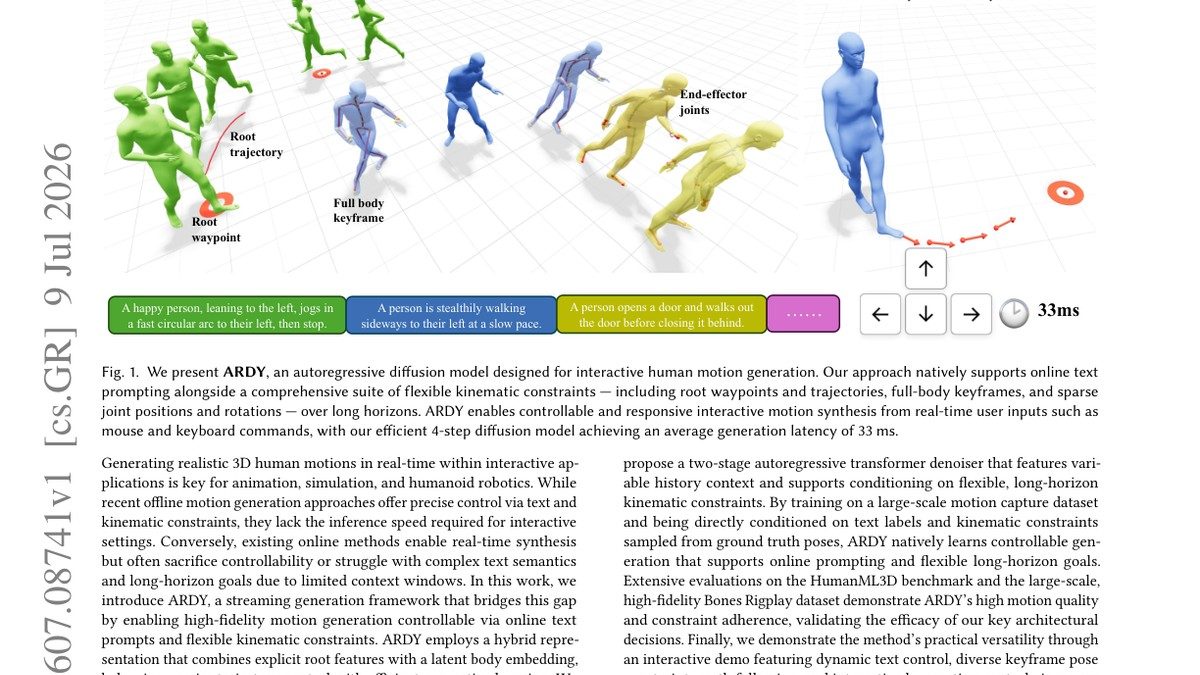
ARDY: Autoregressive Diffusion with Hybrid Representation for Interactive Human Motion Generation
Kaifeng Zhao, Mathis Petrovich, Haotian Zhang et al. · arXiv preprint · Jul 2026
Generating realistic 3D human motions in real-time within interactive applications is key for animation, simulation, and humanoid robotics. While recent offline motion generation approaches offer precise control via text and kinematic constraints, they lack the inference speed required for intera...