

FARM: Reading Failure Signals from the Internal Predictive States of a Frozen Robotic World Model
Haoran Pei, Mingrui Luo, Senbao Wang, Haoran Lv, Jie Guo, Sheng Zhong, Ruixi Ci · N/A · 2026
Framework
N/A
License
N/A
Stars
N/A
Summary
Reliable robot deployment requires online failure monitoring, yet existing monitors mainly derive risk from proxy signals or train dedicated monitoring components. We ask whether the internal predictive states of a frozen pretrained robotic world model already contain directly decodable failure i...
Abstract Summary
Key Points
- Reliable robot deployment requires online failure monitoring, yet existing monitors mainly derive...
- We ask whether the internal predictive states of a frozen pretrained robotic world model already ...
- Failure-Aware Readout from World Models (FARM) trains only a 33,985-parameter supervised readout ...
- Five-fold out-of-fold evaluation across seven source tasks reaches 85.68/88.59 pooled AUROC/AUPRC...
- Across four real-robot populations on PIPER X, SO-101, and Franka, fixed-readout transfer and rea...
FARM: Reading Failure Signals from the Internal Predictive States of a Frozen Robotic World Model
|Authors: Haoran Pei, Mingrui Luo, Senbao Wang, Haoran Lv, Jie Guo, Sheng Zhong, Ruixi Ci
|Venue: arXiv preprint | Year: 2026
|arXiv: 2609.11445v1
Abstract
Reliable robot deployment requires online failure monitoring, yet existing monitors mainly derive risk from proxy signals or train dedicated monitoring components. We ask whether the internal predictive states of a frozen pretrained robotic world model already contain directly decodable failure information. Failure-Aware Readout from World Models (FARM) trains only a 33,985-parameter supervised readout over frozen VLA-JEPA predictive states, producing step-wise failure scores and causal trajectory risk. Five-fold out-of-fold evaluation across seven source tasks reaches 85.68/88.59 pooled AUROC/AUPRC, and FARM gives the best Seen performance among 15 matched baselines on the 10-task benchmark. Across four real-robot populations on PIPER X, SO-101, and Franka, fixed-readout transfer and readout-only adaptation test deployment shifts without updating the predictive backbone. FARM also discriminates failures from partial causal histories and adds 0.2256 ms mean CUDA latency once the frozen state is available. These results support frozen predictive world-model states as reusable features for causal, transferable, and low-overhead execution monitoring.
Key Contributions
- Reliable robot deployment requires online failure monitoring, yet existing monitors mainly derive…
- We ask whether the internal predictive states of a frozen pretrained robotic world model already …
- Failure-Aware Readout from World Models (FARM) trains only a 33,985-parameter supervised readout …
- Five-fold out-of-fold evaluation across seven source tasks reaches 85.68/88.59 pooled AUROC/AUPRC…
- Across four real-robot populations on PIPER X, SO-101, and Franka, fixed-readout transfer and rea…
Topics
- vla
- reinforcement-learning
- benchmark
Code & Data
No code repository linked in paper metadata.
BibTeX
@article{Pei2026_260911445v1,
  title     = {FARM: Reading Failure Signals from the Internal Predictive States of a Frozen Robotic World Model},
  author    = {Haoran Pei and Mingrui Luo and Senbao Wang and Haoran Lv and Jie Guo and Sheng Zhong and Ruixi Ci},
  year      = {2026},
  eprint    = {2609.11445v1},
  archivePrefix = {arXiv},
  primaryClass  = {cs.RO},
  url       = {https://arxiv.org/abs/2609.11445v1}
}
Related Papers
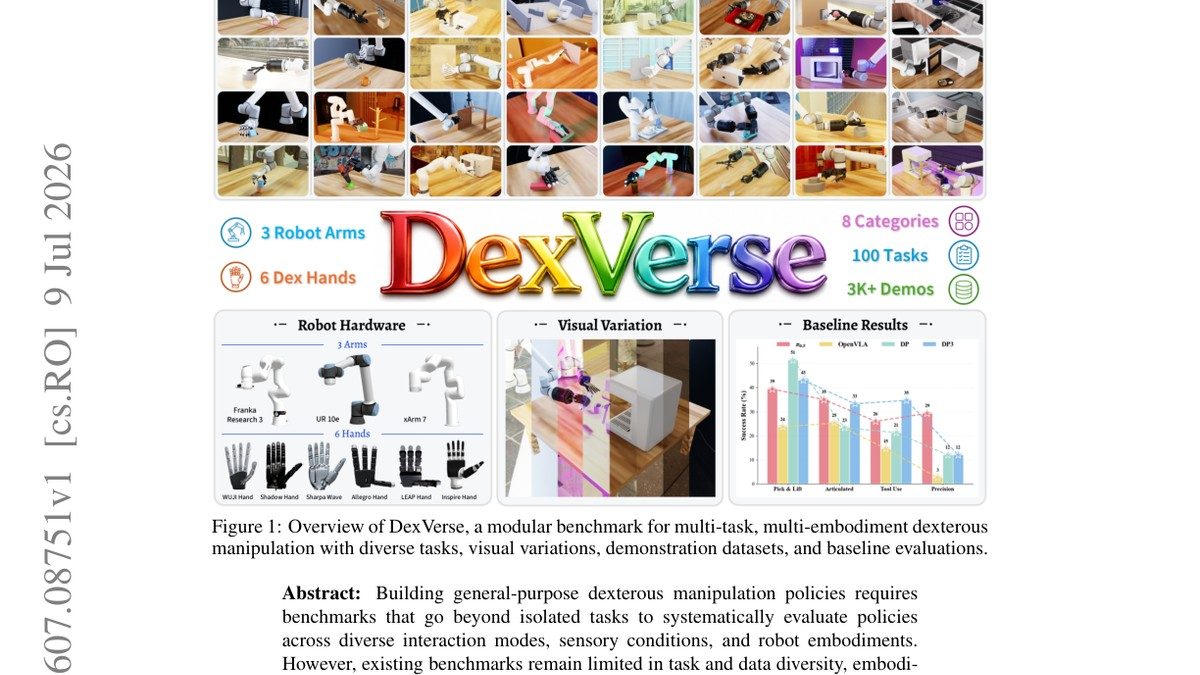
DexVerse: A Modular Benchmark for Multi-Task, Multi-Embodiment Dexterous Manipulation
Yunchao Yao, Zhuxiu Xu, Tianqi Zhang et al. · arXiv preprint · Jul 2026
Building general-purpose dexterous manipulation policies requires benchmarks that go beyond isolated tasks to systematically evaluate policies across diverse interaction modes, sensory conditions, and robot embodiments. However, existing benchmarks remain limited in task and data diversity, embod...
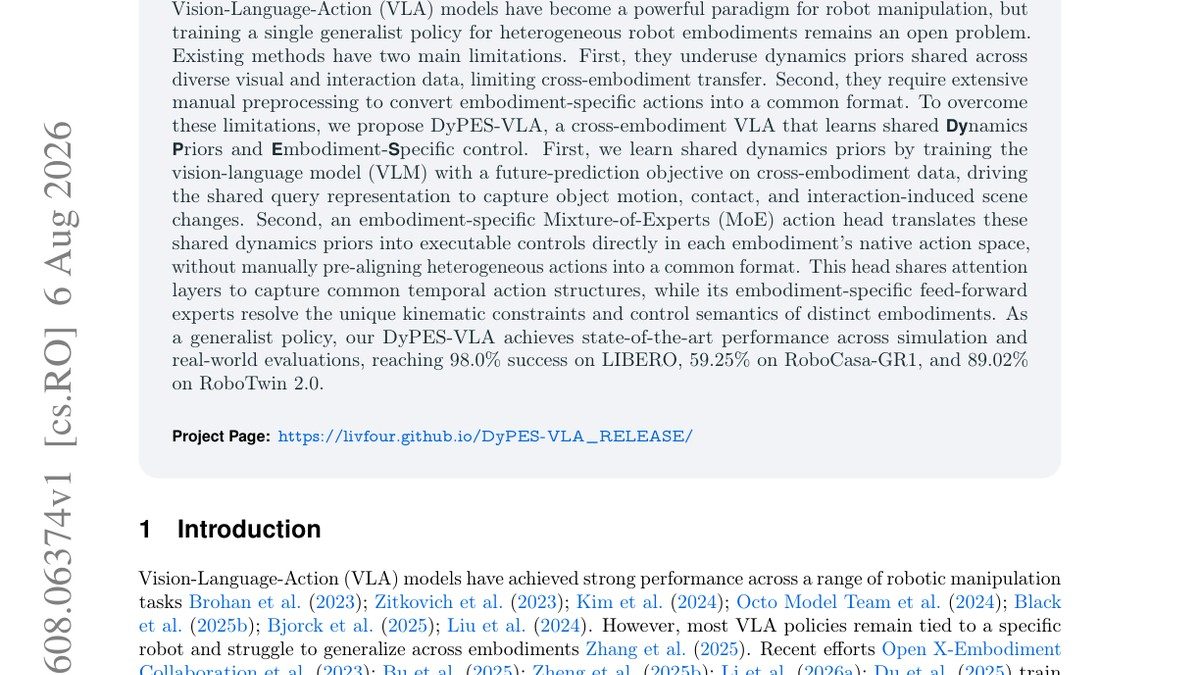
DyPES-VLA: Learning Shared Dynamics Priors and Embodiment-Specific Control for Cross-Embodiment Manipulation
Junfeng Li, Junjie He, Zhide Zhong et al. · arXiv preprint · Aug 2026
Vision-Language-Action (VLA) models have become a powerful paradigm for robot manipulation, but training a single generalist policy for heterogeneous robot embodiments remains an open problem. Existing methods have two main limitations. First, they underuse dynamics priors shared across diverse v...

FabriVLA: A Lightweight Vision-Language-Action Model for Precise Multi-Task Manipulation
Shiyuan Yang, Borong Zhang, Jizheng Zhang et al. · arXiv preprint · Jul 2026
We present FabriVLA, a lightweight Vision-Language-Action model for Precise Multi-Task Manipulation. FabriVLA combines an InternVL3.5 vision-language backbone with a flow-matching action head featuring gated self-attention across action tokens and shallow VLM layer fusion for enriched spatial con...

FolDeX: A Physical-World Benchmark for Long-Horizon Robotic Manipulation of Deformable Objects
Chenhuan Liu, Yi Xu, Feng Wu et al. · arXiv preprint · Sep 2026
Embodied AI, including vision-language-action and world-action models, must operate reliably in the physical world. Yet methods that perform well in simulation can degrade substantially on real robots, especially in long-horizon deformable-object manipulation, where policies must track changing s...