
Effect of Twisted-Yarn Architecture on Pressure and Proximity Sensing Characteristics of Textile Capacitive Sensors for Robotic Skin
Ishtia Zahir, Eslam Saleh, Maryam Rezayati, Güunter Grabher, Gaffar Hossain · N/A · 2026
Framework
N/A
License
N/A
Stars
N/A
Summary
Textile-integrated capacitive sensors offer flexible and conformable tactile sensing for wearable electronics and human-robot interaction; however, the influence of yarn-level architecture on capacitive transduction characteristics remains insufficiently quantified. This work presents a textile c...
Abstract Summary
Key Points
- Textile-integrated capacitive sensors offer flexible and conformable tactile sensing for wearable...
- This work presents a textile capacitive sensing platform based on silver-coated yarns coated with...
- The influence of effective electrode overlap area and inter-fiber separation on the capacitive re...
- Pressure was calculated using the localized single-fiber contact area, corresponding to stresses ...
- Increasing the layer number improved mechanical strength and sensing performance: elongation at b...
Effect of Twisted-Yarn Architecture on Pressure and Proximity Sensing Characteristics of Textile Capacitive Sensors for Robotic Skin
|Authors: Ishtia Zahir, Eslam Saleh, Maryam Rezayati, Güunter Grabher, Gaffar Hossain
|Venue: arXiv preprint | Year: 2026
|arXiv: 2608.14406v1
Abstract
Textile-integrated capacitive sensors offer flexible and conformable tactile sensing for wearable electronics and human-robot interaction; however, the influence of yarn-level architecture on capacitive transduction characteristics remains insufficiently quantified. This work presents a textile capacitive sensing platform based on silver-coated yarns coated with polydimethylsiloxane and assembled into one-, two-, and four-layer twisted configurations. The influence of effective electrode overlap area and inter-fiber separation on the capacitive response is systematically investigated, enabling architecture-dependent tuning of pressure and proximity sensing characteristics. Pressure was calculated using the localized single-fiber contact area, corresponding to stresses of 0.4-3.9 MPa. Increasing the layer number improved mechanical strength and sensing performance: elongation at break increased from 37.5% to 62.5% and 85.0%, while the maximum load increased from 23.3 to 42.7 and 89.7 N. Sensitivity increased with layer number and frequency, reaching 0.1331 MPa$^{-1}$ for the four-layer sensor at 100 kHz. The four-layer configuration also exhibited low hysteresis, minimal thermal drift from 25 to 90 $^\circ$C, and stable operation over 15,000 cycles. Proximity detection ranges of 60, 50, and 40 mm were obtained for the one-, two-, and four-layer sensors, respectively, revealing an architecture-dependent sensitivity-range trade-off. A 4$\times$4 textile sensing array enabled spatial contact mapping, while robotic-arm integration demonstrated real-time touch and proximity detection with an end-to-end robotic system latency (from detection to robot reaction) of 403 ms. The results establish yarn architecture as a tunable design parameter governing the measurement characteristics of textile-integrated capacitive sensing systems.
Key Contributions
- Textile-integrated capacitive sensors offer flexible and conformable tactile sensing for wearable…
- This work presents a textile capacitive sensing platform based on silver-coated yarns coated with…
- The influence of effective electrode overlap area and inter-fiber separation on the capacitive re…
- Pressure was calculated using the localized single-fiber contact area, corresponding to stresses …
- Increasing the layer number improved mechanical strength and sensing performance: elongation at b…
Topics
- vision
- reinforcement-learning
- human-robot-interaction
- tactile
Code & Data
No code repository linked in paper metadata.
BibTeX
@article{Zahir2026_260814406v1,
  title     = {Effect of Twisted-Yarn Architecture on Pressure and Proximity Sensing Characteristics of Textile Capacitive Sensors for Robotic Skin},
  author    = {Ishtia Zahir and Eslam Saleh and Maryam Rezayati and Güunter Grabher and Gaffar Hossain},
  year      = {2026},
  eprint    = {2608.14406v1},
  archivePrefix = {arXiv},
  primaryClass  = {cs.RO},
  url       = {https://arxiv.org/abs/2608.14406v1}
}
Related Papers
Assessing Physical Frailty and Fall-Risk Indicators with Social Robots: An in situ Evaluation with Older Adults
Aniol Civit, Antonio Andriella, Alba Martínez et al. · arXiv preprint · Jul 2026
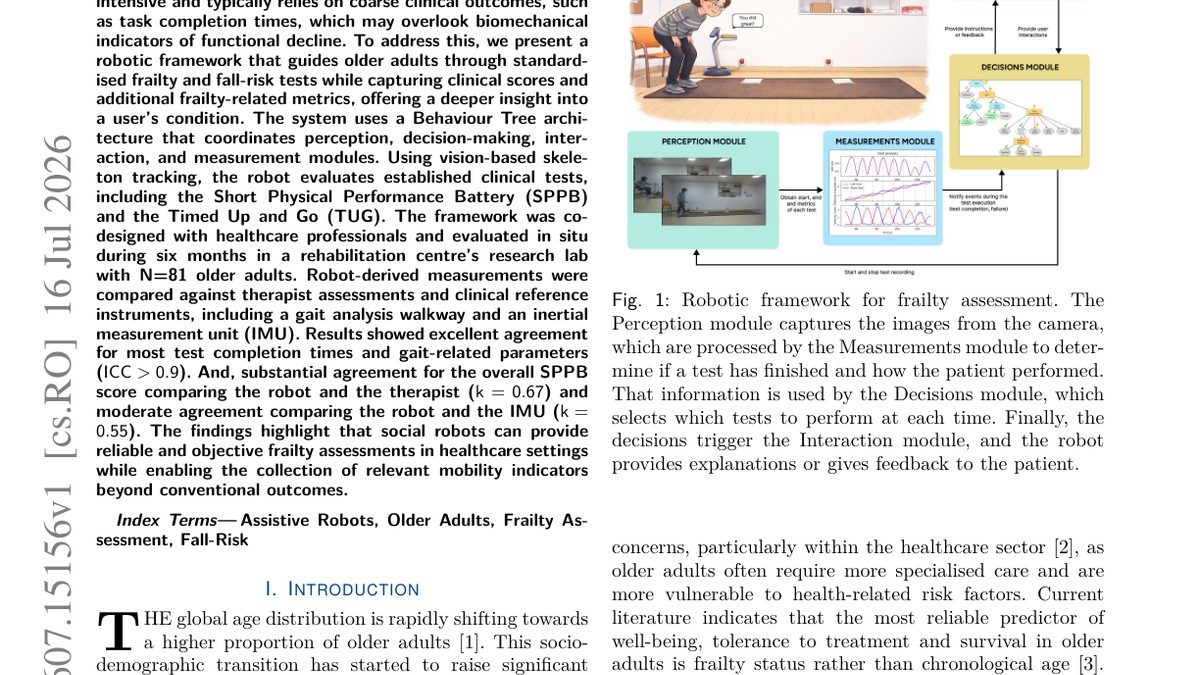
Frailty assessments are crucial to evaluate the risk of adverse events and the health and social care needs of older adults, yet their administration remains resource-intensive and typically relies on coarse clinical outcomes, such as task completion times, which may overlook biomechanical indica...
Catch, Throw, Repeat: Planning for Human-Robot Partner Juggling
Jonathan Rainer Lippert, Kai Ploeger, Abir Chowdhury et al. · arXiv preprint · Jul 2026
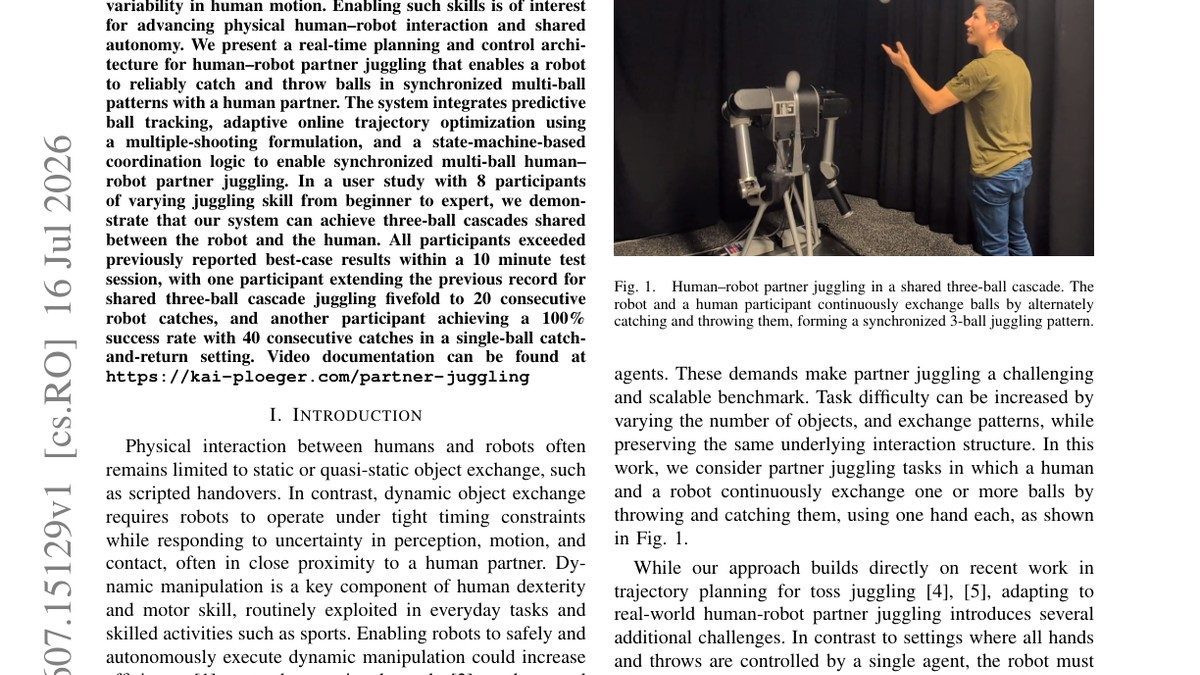
Dynamic object exchange between humans and robots remains a challenging problem due to uncertainty in perception, timing, and contact-rich interaction. Human-robot juggling represents a particularly demanding instance of this problem, requiring precise real-time coordination, predictive motion pl...
Design and Evaluation of a Touchscreen-Based Teleoperation Interface for Robotic Manipulators
Juan José García Cárdenas, Alperen Kenan, Hamidreza Raei et al. · arXiv preprint · Aug 2026
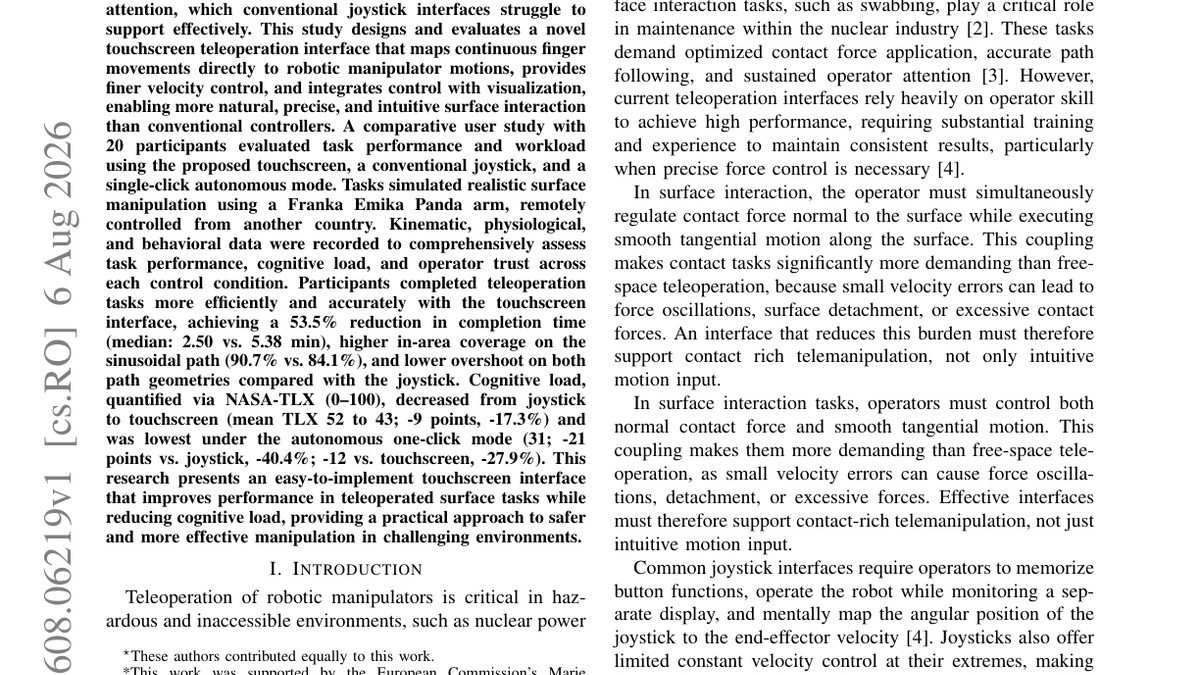
Intuitive teleoperation interfaces are crucial for the safe and effective operation of robotic manipulators in challenging environments. In the nuclear industry, surface contact tasks such as swab sampling require precise path and force tracking, obstacle avoidance, and sustained operator attenti...
Development of a Humanoid Robot Prototype for Multimodal Human-Robot Interaction
Thang Tran Viet, Thanh Nguyen Canh, Huy Uong Gia et al. · arXiv preprint · Sep 2026
Human-robot interaction (HRI) enables intuitive and intelligent collaboration between humans and robots in real-world environments. This paper introduces a humanoid robot prototype designed as a flexible testbed for developing and integrating artificial intelligence (AI) modules in HRI tasks. The...