
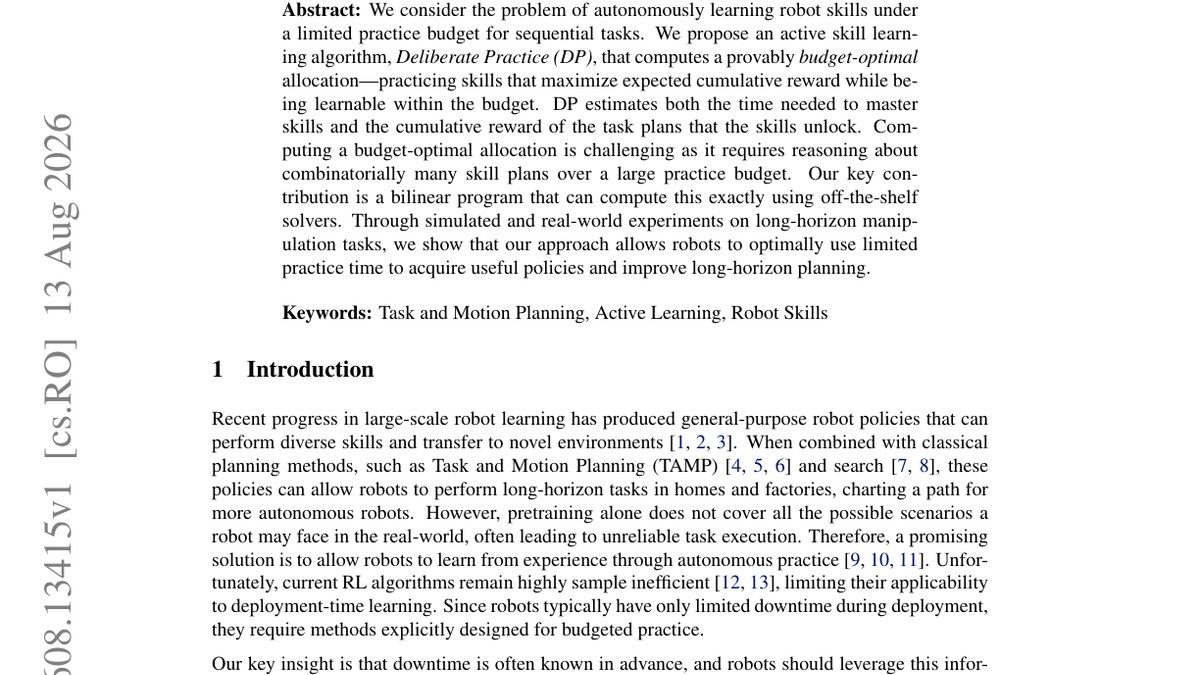
Deliberate Practice: Learning Robot Skills under a Budget
Shivam Vats, Sudarshan Harithas, Mete Tuluhan Akbulut, Arvind Raghunathan, George Konidaris · N/A · 2026
Framework
N/A
License
N/A
Stars
N/A
Summary
We consider the problem of autonomously learning robot skills under a limited practice budget for sequential tasks. We propose an active skill learning algorithm, \emph{Deliberate Practice (DP)}, that computes a provably \emph{budget-optimal} allocation---practicing skills that maximize expected ...
Abstract Summary
Key Points
- We consider the problem of autonomously learning robot skills under a limited practice budget for...
- We propose an active skill learning algorithm, \emph{Deliberate Practice (DP)}, that computes a p...
- DP estimates both the time needed to master skills and the cumulative reward of the task plans th...
- Computing a budget-optimal allocation is challenging as it requires reasoning about combinatorial...
- Our key contribution is a bilinear program that can compute this exactly using off-the-shelf solvers
Deliberate Practice: Learning Robot Skills under a Budget
|Authors: Shivam Vats, Sudarshan Harithas, Mete Tuluhan Akbulut, Arvind Raghunathan, George Konidaris
|Venue: arXiv preprint | Year: 2026
|arXiv: 2608.13415v1
Abstract
We consider the problem of autonomously learning robot skills under a limited practice budget for sequential tasks. We propose an active skill learning algorithm, \emph{Deliberate Practice (DP)}, that computes a provably \emph{budget-optimal} allocation---practicing skills that maximize expected cumulative reward while being learnable within the budget. DP estimates both the time needed to master skills and the cumulative reward of the task plans that the skills unlock. Computing a budget-optimal allocation is challenging as it requires reasoning about combinatorially many skill plans over a large practice budget. Our key contribution is a bilinear program that can compute this exactly using off-the-shelf solvers. Through simulated and real-world experiments on long-horizon manipulation tasks, we show that our approach allows robots to optimally use limited practice time to acquire useful policies and improve long-horizon planning.
Key Contributions
- We consider the problem of autonomously learning robot skills under a limited practice budget for…
- We propose an active skill learning algorithm, \emph{Deliberate Practice (DP)}, that computes a p…
- DP estimates both the time needed to master skills and the cumulative reward of the task plans th…
- Computing a budget-optimal allocation is challenging as it requires reasoning about combinatorial…
- Our key contribution is a bilinear program that can compute this exactly using off-the-shelf solvers
Topics
- manipulation
- reinforcement-learning
- planning
Code & Data
No code repository linked in paper metadata.
BibTeX
@article{Vats2026_260813415v1,
  title     = {Deliberate Practice: Learning Robot Skills under a Budget},
  author    = {Shivam Vats and Sudarshan Harithas and Mete Tuluhan Akbulut and Arvind Raghunathan and George Konidaris},
  year      = {2026},
  eprint    = {2608.13415v1},
  archivePrefix = {arXiv},
  primaryClass  = {cs.RO},
  url       = {https://arxiv.org/abs/2608.13415v1}
}
Related Papers
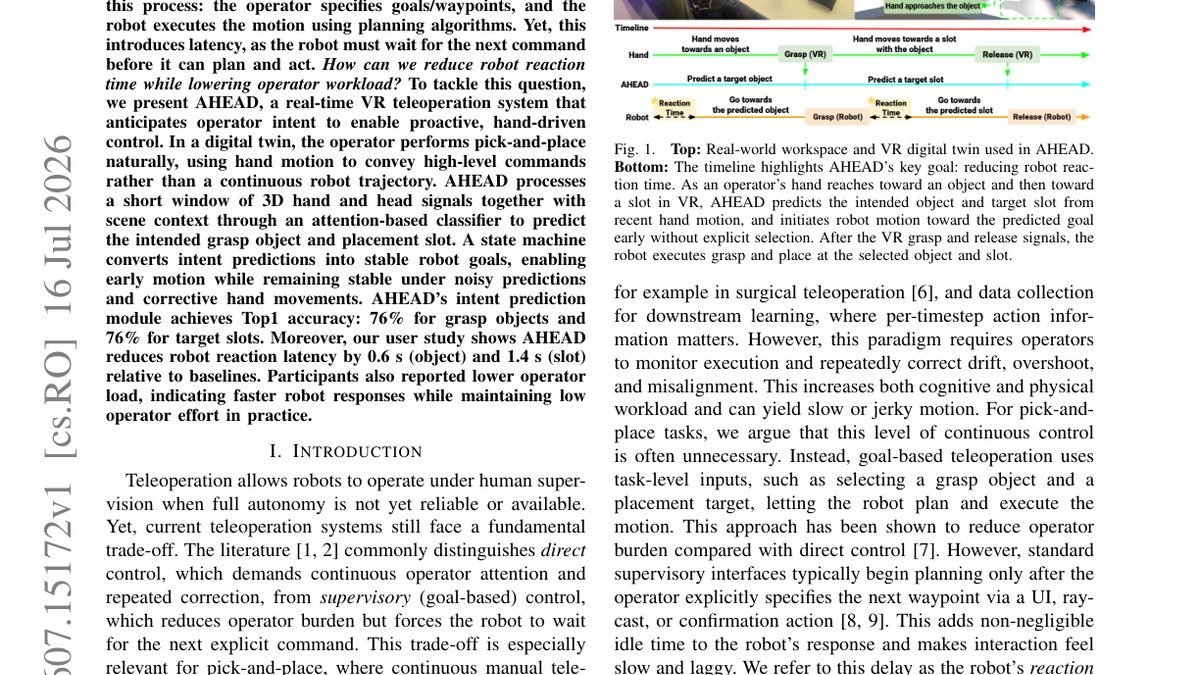
AHEAD: Anticipatory Hand-Driven Teleoperation via Human Intent Prediction
Seok Joon Kim, Junho Lee, Federica Spinola et al. · arXiv preprint · Jul 2026
Direct hand-driven teleoperation maps an operator's hand motion to robot end-effector commands at every frame, enabling precise control, but it requires constant monitoring and correction during approach, grasp, and placement, which can be slow and fatiguing. For repetitive pick-and-place tasks, ...
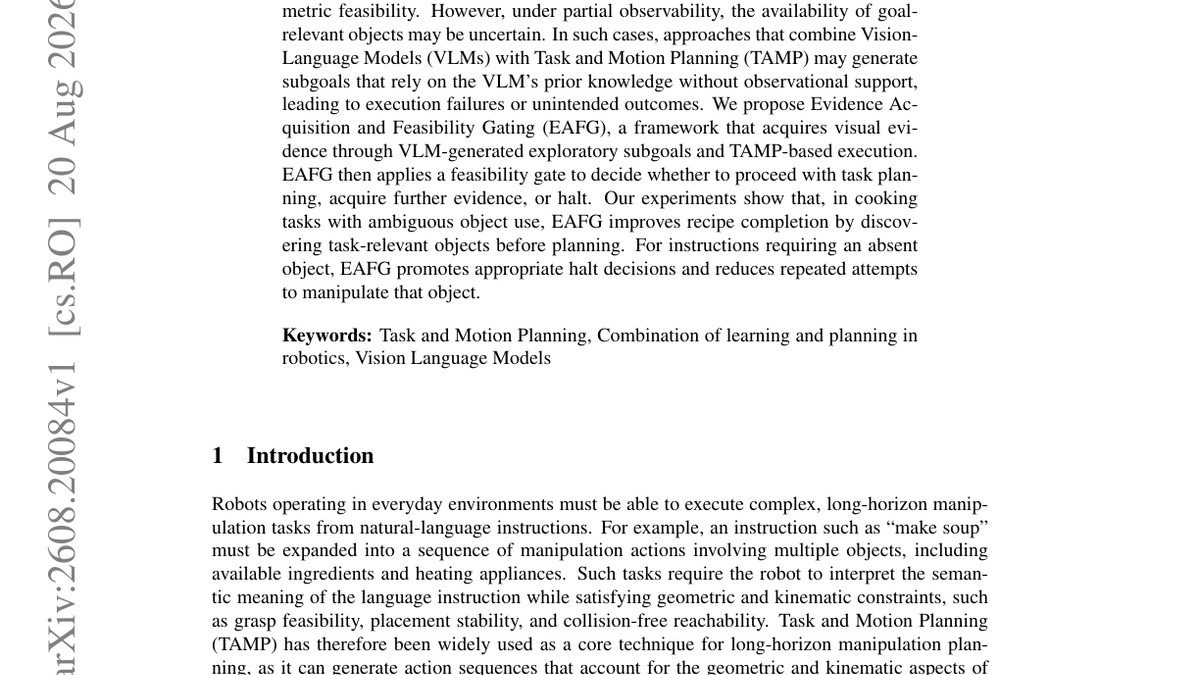
Evidence-Gated Task and Motion Planning with Vision-Language Models
Tsunehiko Tanaka, Matthew Stephenson, Alistair Macvicar et al. · arXiv preprint · Aug 2026
Robots executing long-horizon manipulation tasks from natural-language instructions must reason about both semantic task structure and geometric feasibility. However, under partial observability, the availability of goal-relevant objects may be uncertain. In such cases, approaches that combine Vi...
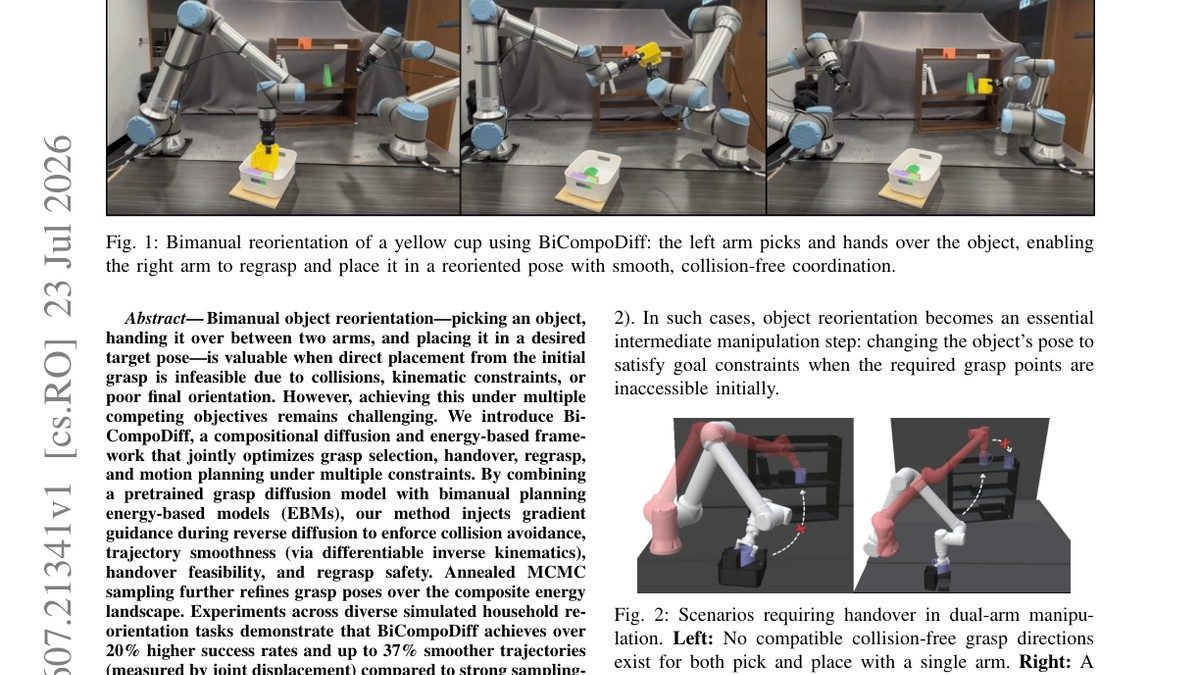
Grasp, Handover, Rotate: Bimanual Object Reorientation via Compositional Diffusion and Energy-Based Optimization
Wun Lam Yeung, Wenjun Liu, Yui Cheung Yu et al. · arXiv preprint · Jul 2026
Bimanual object reorientation - picking an object, handing it over between two arms, and placing it in a desired target pose - is valuable when direct placement from the initial grasp is infeasible due to collisions, kinematic constraints, or poor final orientation. However, achieving this under ...

Memory as Plans: World-Action Modeling with Memory-Grounded Planning
Sizhe Zhao, Haozhe Xie, Weiyu Zhao et al. · arXiv preprint · Sep 2026
Mainstream robotic policies often adopt a Markovian formulation, but many complex real-world manipulation tasks are inherently non-Markovian, requiring long-horizon memory beyond the current observation. Existing memory mechanisms often rely on language summaries, growing visual windows, or their...