CLIPort: What and Where Pathways for Robotic Manipulation

CLIPort: What and Where Pathways for Robotic Manipulation

Mohit Shridhar, Lucas Manuelli, Dieter Fox · University of Washington, NVIDIA · 2021

Framework

PyTorch + PyBullet

License

MIT

Stars

546

Summary

CLIPort fuses CLIP's semantic understanding with Transporter Networks' spatial precision to perform language-conditioned manipulation tasks like 'stack the red block on the blue block' with 2D pick-and-place affordances.

Abstract Summary

CLIPort is one of the earliest works to combine pretrained vision-language models with robot manipulation. The core idea is disentangling the "what" and "where" of manipulation: CLIP provides the semantic understanding ("red block" vs "blue block"), while a Transporter Network handles the spatial precision (exact pixel coordinates for picking and placing). This two-stream architecture is simple, interpretable, and surprisingly effective for tabletop manipulation. The model takes an RGB image and a language instruction as input, and outputs two heatmaps: a pick affordance (where to grasp) and a place affordance (where to release). Training uses 1000+ demonstrations per task in a simulated tabletop environment (PyBullet), with data augmentation (color jittering, camera noise) to improve sim-to-real transfer. The model is trained end-to-end with cross-entropy loss on the affordance maps. On the Ravens benchmark (15 language-conditioned tasks: packing, stacking, sorting, aligning), CLIPort achieves 85% success—outperforming pure CLIP-based baselines (which lack spatial precision) and pure Transporter baselines (which lack semantic grounding). The sim-to-real transfer is strong: the policy deploys directly on a real UR5 arm with a wrist-mounted camera, achieving 70% success on unseen object instances. The open-source release includes the full PyTorch implementation, the Ravens benchmark environments, training scripts, and pretrained weights for all 15 tasks. The codebase is compact (~2K lines) and well-documented, making it a popular starting point for researchers new to language-conditioned manipulation. The modular design also allows swapping CLIP for newer VLMs (e.g., SigLIP, OpenCLIP) with minimal code changes.

Key Points

  • Two-stream: CLIP for semantics, Transporter for spatial precision.
  • 85% on Ravens benchmark; 70% sim-to-real transfer to UR5.
  • Outputs interpretable pick/place heatmaps from RGB + language.
  • Compact codebase (~2K lines), well-documented for beginners.
  • Swappable VLMs: CLIP, SigLIP, OpenCLIP supported.
Share

Related Papers

π0: A Vision-Language-Action Flow Model for General Robot Control

π0: A Vision-Language-Action Flow Model for General Robot Control

Karl Pertsch, Oliver Groth, Jonas Frey et al. · arXiv preprint · Oct 2024

π0 is a 3.5B-parameter VLA flow model from Physical Intelligence that achieves state-of-the-art general robot manipulation by mixing online RL with high-quality human demonstrations, available as an open-source PyTorch implementation.
foundation-models vla manipulation il
Code PDF Advanced
GitHub ★ 11,990 Code updated: May 2026
RT-1: Robotics Transformer for Real-World Control at Scale

RT-1: Robotics Transformer for Real-World Control at Scale

Anthony Brohan, Yevgen Chebotar, Chelsea Finn et al. · RSS 2023 · Jul 2023

RT-1 is a 35M-parameter transformer trained on 130K robot demonstrations that generalizes to new tasks, objects, and environments, forming the foundation for Google's RT-2 and RT-X line of VLA models.
foundation-models vla il manipulation
Code PDF Intermediate
GitHub ★ 1,723 Code updated: May 2026
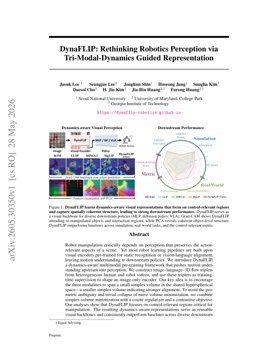
DynaFLIP: Rethinking Robotics Perception via Tri-Modal-Dynamics Guided Representation

DynaFLIP: Rethinking Robotics Perception via Tri-Modal-Dynamics Guided Representation

Jusuk Lee, Seungjae Lee, Jonghun Shin et al. · arXiv preprint · May 2026

Robot manipulation critically depends on perception that preserves the action-relevant aspects of a scene. Yet most robot learning pipelines are built upon visual encoders pre-trained for static recog
foundation-models perception manipulation representation-learning vla
PDF Intermediate
No code repo Code updated: May 2026
EgoForce: Forearm-Guided Camera-Space 3D Hand Pose from a Monocular Egocentric Camera

EgoForce: Forearm-Guided Camera-Space 3D Hand Pose from a Monocular Egocentric Camera

Christen Millerdurai, Shaoxiang Wang, Yaxu Xie et al. · SIGGRAPH 2026 · May 2026

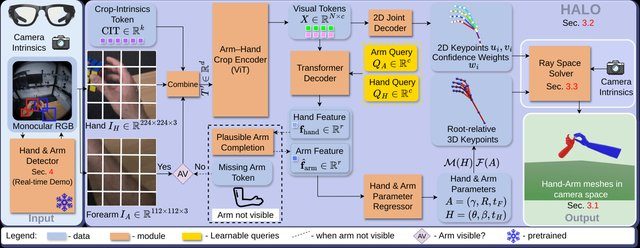
Reconstructing the absolute 3D pose and shape of the hands from the user's viewpoint using a single head-mounted camera is crucial for practical egocentric interaction in AR/VR, telepresence, and hand-centric manipulation tasks, where sensing must...

manipulation manipulation simulation
Code PDF Intermediate
Code ★ 0 May 2026