
π0: A Vision-Language-Action Flow Model for General Robot Control
FeaturedKarl Pertsch, Oliver Groth, Jonas Frey, Mingtian Zhang, Huy Ha, Xuanlin Li, Xialing Li, Kuan Fang, Kevin Black, Dorsa Sadigh, Quan Vuong, Sergey Levine · Physical Intelligence (π0) · 2024
Framework
PyTorch
License
Apache-2.0
Stars
11,990
Summary
π0 is a 3.5B-parameter VLA flow model from Physical Intelligence that achieves state-of-the-art general robot manipulation by mixing online RL with high-quality human demonstrations, available as an open-source PyTorch implementation.
Abstract Summary
Key Points
- 3.5B-parameter VLA model using flow matching for action generation.
- Diffusion-inspired trajectory denoising captures multimodal manipulation.
- Outperforms RT-2-X, Octo, and OpenVLA on real-world manipulation.
- Open-source weights + training code + Gradio demo on RTX 4090.
- Compatible with 7-DoF pose and delta control; ALOHA/Bridge data loaders.
Related Papers

RT-1: Robotics Transformer for Real-World Control at Scale
Anthony Brohan, Yevgen Chebotar, Chelsea Finn et al. · RSS 2023 · Jul 2023
RT-1 is a 35M-parameter transformer trained on 130K robot demonstrations that generalizes to new tasks, objects, and environments, forming the foundation for Google's RT-2 and RT-X line of VLA models.
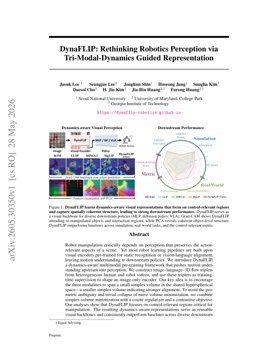
DynaFLIP: Rethinking Robotics Perception via Tri-Modal-Dynamics Guided Representation
Jusuk Lee, Seungjae Lee, Jonghun Shin et al. · arXiv preprint · May 2026
Robot manipulation critically depends on perception that preserves the action-relevant aspects of a scene. Yet most robot learning pipelines are built upon visual encoders pre-trained for static recog
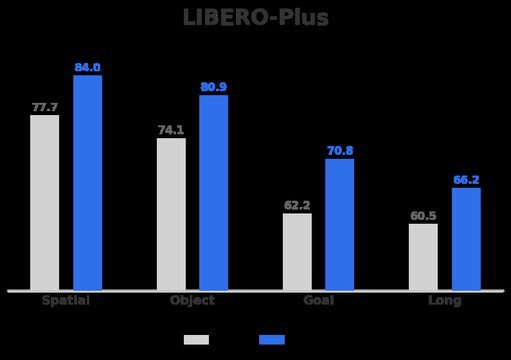
GuidedVLA: Specifying Task-Relevant Factors via Plug-and-Play Action Attention Specialization
Xiaosong Jia, Bowen Yang, Zuhao Ge et al. · RSS 2026 · May 2026
Vision-Language-Action (VLA) models aim for general robot learning by aligning action as a modality within powerful Vision-Language Models (VLMs). Existing VLAs rely on end-to-end supervision to implicitly enable the action decoding process to learn...
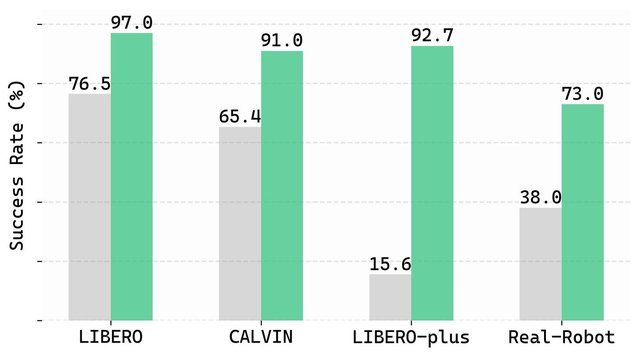
From Imagined Futures to Executable Actions: Mixture of Latent Actions for Robot Manipulation
Yajie Li, Bozhou Zhang, Chun Gu et al. · ICML 2026 · May 2026
Video foundation-models models offer a promising imagination mechanism for robot manipulation by predicting long-horizon future observations, but effectively exploiting these imagined futures for action execution remains challenging. Existing approaches...