

VibeAct: Vibration to Actions for Contact-Rich Reactive Robot Dexterity
FeaturedYuemin Mao, Uksang Yoo, Jean Oh, Jonathan Francis, Jeffrey Ichnowski · · 2026
Framework
N/A
License
N/A
Stars
0
Summary
Dexterous manipulation depends on contact events that are fast, local, and often visually occluded. Piezoelectric microphones offer a compact and high-bandwidth way to sense these interactions, but the resulting vibro-acoustic signals are difficult to simulate faithfully enoug...
Abstract Summary
Key Points
- Dexterous manipulation depends on contact events that are fast, local, and often visually occluded. Piezoelectric microphones offer a compact and high...
Abstract
Dexterous manipulation depends on contact events that are fast, local, and often visually occluded. Piezoelectric microphones offer a compact and high-bandwidth way to sense these interactions, but the resulting vibro-acoustic signals are difficult to simulate faithfully enough for end-to-end sim-to-real policy learning on dexterous robot hands. We propose VibeAct, a framework that bridges real vibrotactile sensing and simulation-based reinforcement learning through a shared physical representation of contact and slip. In the real world, we embed piezoelectric microphones into a dexterous robot hand and collect vibro-acoustic data through teleoperation, then replay the recordings in a calibrated digital clone to automatically label per-finger contact and slip. A tactile estimator learns to predict contact and slip from real microphone waveforms, while manipulation policies are trained in simulation on the same representation computed directly from simulated contacts. This decoupling lets policies exploit rapid tactile feedback without simulating raw audio. Across five contact-rich tasks spanning regrasping, in-hand reorientation, and insertion, VibeAct consistently outperforms a proprioception-and-point-cloud baseline in simulation, with the largest gains on tasks requiring sustained reactive control, where the continuous slip-magnitude channel proves the most informative observation. The learned policies transfer to a physical dexterous hand-arm platform, improving success rates on deployed tasks. Project videos and additional details are at https://vibeact.github.io/.
Links
- Paper (PDF): 2606.27344v1
- arXiv: 2606.27344v1
- Project Page: https://vibeact.github.io
Related Papers

Scalable Behavior Cloning with Open Data, Training, and Evaluation
Arthur Allshire, Himanshu Gaurav Singh, Ritvik Singh et al. · arXiv · Jun 2026
We introduce ABC, a fully open-source stack for manipulation with behavior cloning. At its core is ABC-130K: the largest open-source teleoperation dataset to date, featuring 3,500 hours of data spanning over 130K episodes across 195 diverse tasks. Furthermore, we open-source o...
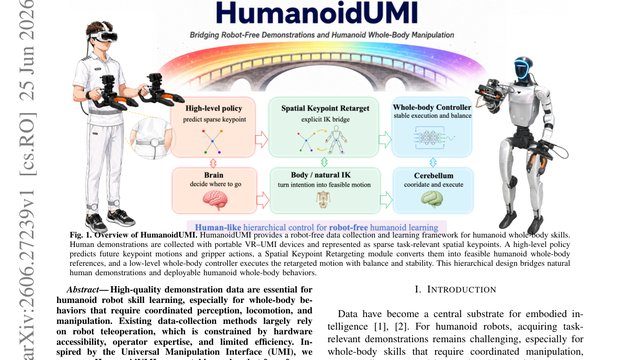
HumanoidUMI: Bridging Robot-Free Demonstrations and Humanoid Whole-Body Manipulation
Hongwu Wang, Chenhao Yu, Youhao Hu et al. · arXiv · Jun 2026
High-quality demonstration data are essential for humanoid robot skill learning, especially for whole-body behaviors that require coordinated perception, locomotion, and manipulation. Existing data-collection methods largely rely on robot teleoperation, which is constrained by...

LA4VLA: Learning to Act without Seeing via Language-Action Pretraining
Tao Lin, Yuxin Du, Yiran Mao et al. · arXiv · Jun 2026
Vision-Language-Action (VLA) models are commonly pretrained on robot demonstrations by jointly mapping visual observations and language instructions to actions. However, dense visual-action supervision can dominate the comparatively sparse language-action signal. As a result, ...

Learning to Fold: prizewinning solution at LeHome Challenge 2026 (1st place online, 2nd offline)
Ilia Larchenko · arXiv · Jun 2026
I describe my solution to the LeHome Challenge 2026, an ICRA 2026 competition on bimanual garment folding. The system placed 1st of 62 teams in the online (simulation) round and 2nd in the real-world final. It improves a vision-language-action (VLA) policy with a reinforcement...