
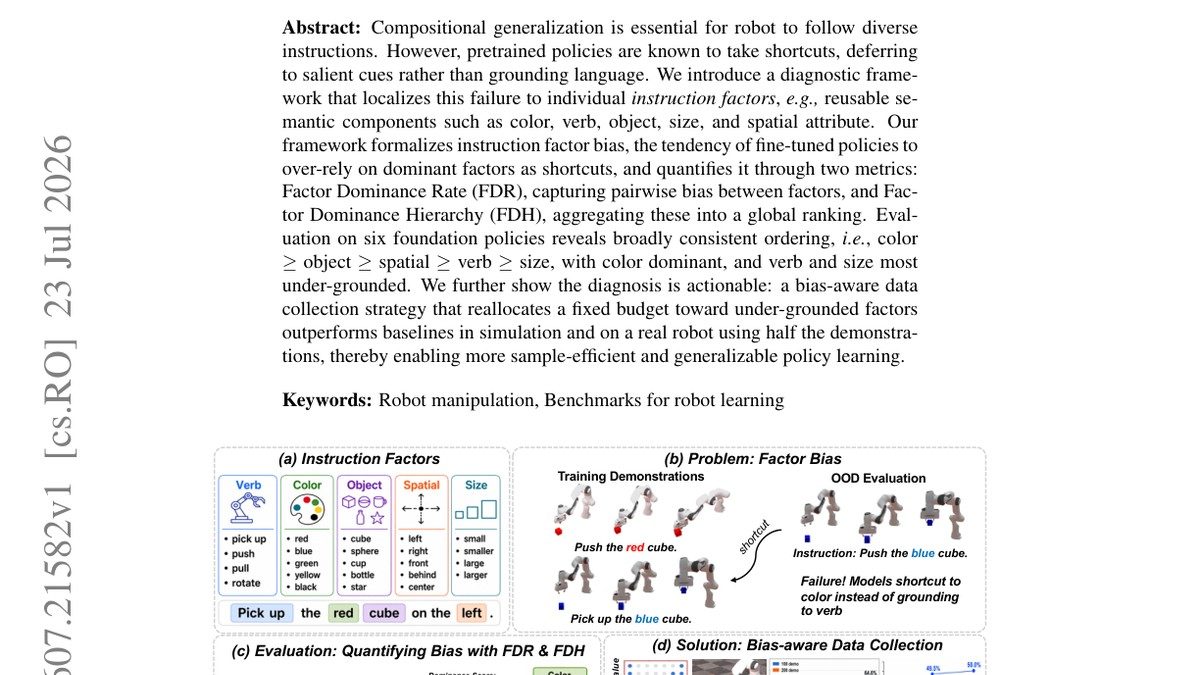
Scale Up Strategically: Learning Compositional Generalization via Bias-Aware Evaluation and Data Collection for Robotic Manipulation
Yu Qi, Zhang Ye, Xinyi Xu, Yuxuan Lu, Amitoj Sandhu, Boce Hu, Haojie Huang, Jonathan Tremblay, Lawson L. S. Wong · N/A · 2026
Framework
N/A
License
N/A
Stars
N/A
Summary
Compositional generalization is essential for robot to follow diverse instructions. However, pretrained policies are known to take shortcuts, deferring to salient cues rather than grounding language. We introduce a diagnostic framework that localizes this failure to individual \textit{instruction...
Abstract Summary
Key Points
- Compositional generalization is essential for robot to follow diverse instructions
- However, pretrained policies are known to take shortcuts, deferring to salient cues rather than g...
- We introduce a diagnostic framework that localizes this failure to individual \textit{instruction...
- Our framework formalizes instruction factor bias, the tendency of fine-tuned policies to over-rel...
- Evaluation on six foundation policies reveals broadly consistent ordering, \textit{i.e.}, color $...
Scale Up Strategically: Learning Compositional Generalization via Bias-Aware Evaluation and Data Collection for Robotic Manipulation
|Authors: Yu Qi, Zhang Ye, Xinyi Xu, Yuxuan Lu, Amitoj Sandhu, Boce Hu, Haojie Huang, Jonathan Tremblay, Lawson L. S. Wong
|Venue: arXiv preprint | Year: 2026
|arXiv: 2607.21582v1
Abstract
Compositional generalization is essential for robot to follow diverse instructions. However, pretrained policies are known to take shortcuts, deferring to salient cues rather than grounding language. We introduce a diagnostic framework that localizes this failure to individual \textit{instruction factors}, \textit{e.g.,} reusable semantic components such as color, verb, object, size, and spatial attribute. Our framework formalizes instruction factor bias, the tendency of fine-tuned policies to over-rely on dominant factors as shortcuts, and quantifies it through two metrics: Factor Dominance Rate (FDR), capturing pairwise bias between factors, and Factor Dominance Hierarchy (FDH), aggregating these into a global ranking. Evaluation on six foundation policies reveals broadly consistent ordering, \textit{i.e.}, color $\geq$ object $\geq$ spatial $\geq$ verb $\geq$ size, with color dominant, and verb and size most under-grounded. We further show the diagnosis is actionable: a bias-aware data collection strategy that reallocates a fixed budget toward under-grounded factors outperforms baselines in simulation and on a real robot using half the demonstrations, thereby enabling more sample-efficient and generalizable policy learning.
Key Contributions
- Compositional generalization is essential for robot to follow diverse instructions
- However, pretrained policies are known to take shortcuts, deferring to salient cues rather than g…
- We introduce a diagnostic framework that localizes this failure to individual \textit{instruction…
- Our framework formalizes instruction factor bias, the tendency of fine-tuned policies to over-rel…
- Evaluation on six foundation policies reveals broadly consistent ordering, \textit{i.e.}, color $…
Topics
- manipulation
- reinforcement-learning
- learning-from-demonstration
- benchmark
Code & Data
No code repository linked in paper metadata.
BibTeX
@article{Qi2026_260721582v1,
  title     = {Scale Up Strategically: Learning Compositional Generalization via Bias-Aware Evaluation and Data Collection for Robotic Manipulation},
  author    = {Yu Qi and Zhang Ye and Xinyi Xu and Yuxuan Lu and Amitoj Sandhu and Boce Hu and Haojie Huang and Jonathan Tremblay and Lawson L. S. Wong},
  year      = {2026},
  eprint    = {2607.21582v1},
  archivePrefix = {arXiv},
  primaryClass  = {cs.RO},
  url       = {https://arxiv.org/abs/2607.21582v1}
}
Related Papers
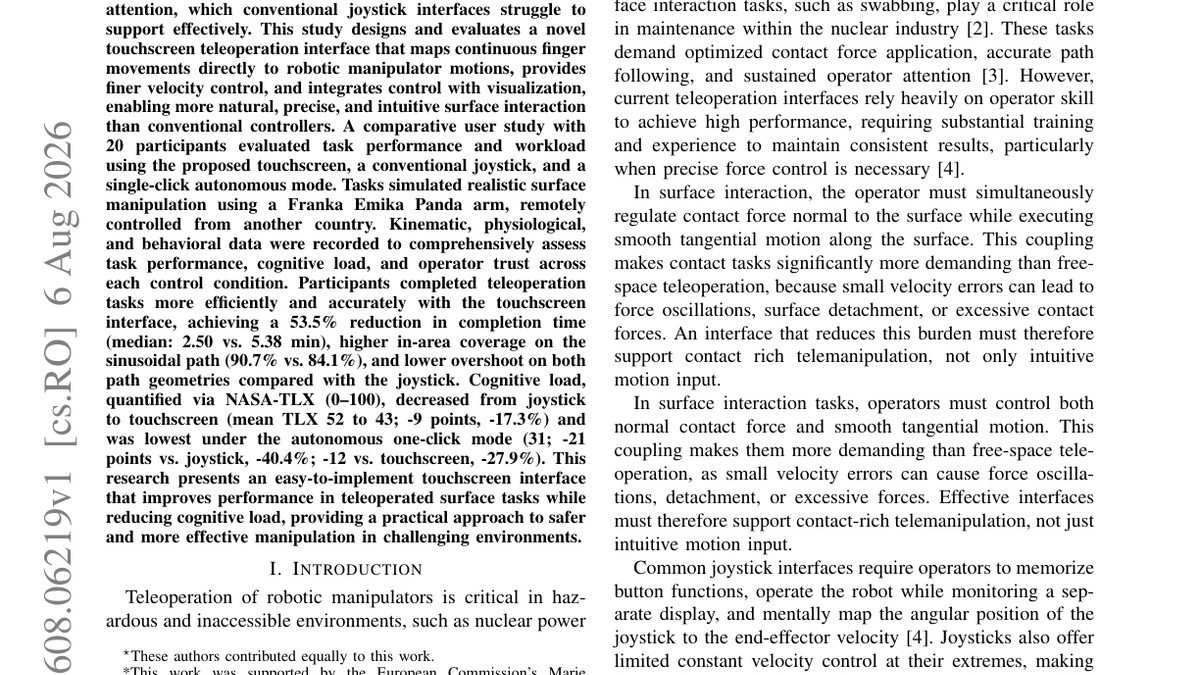
Design and Evaluation of a Touchscreen-Based Teleoperation Interface for Robotic Manipulators
Juan José García Cárdenas, Alperen Kenan, Hamidreza Raei et al. · arXiv preprint · Aug 2026
Intuitive teleoperation interfaces are crucial for the safe and effective operation of robotic manipulators in challenging environments. In the nuclear industry, surface contact tasks such as swab sampling require precise path and force tracking, obstacle avoidance, and sustained operator attenti...
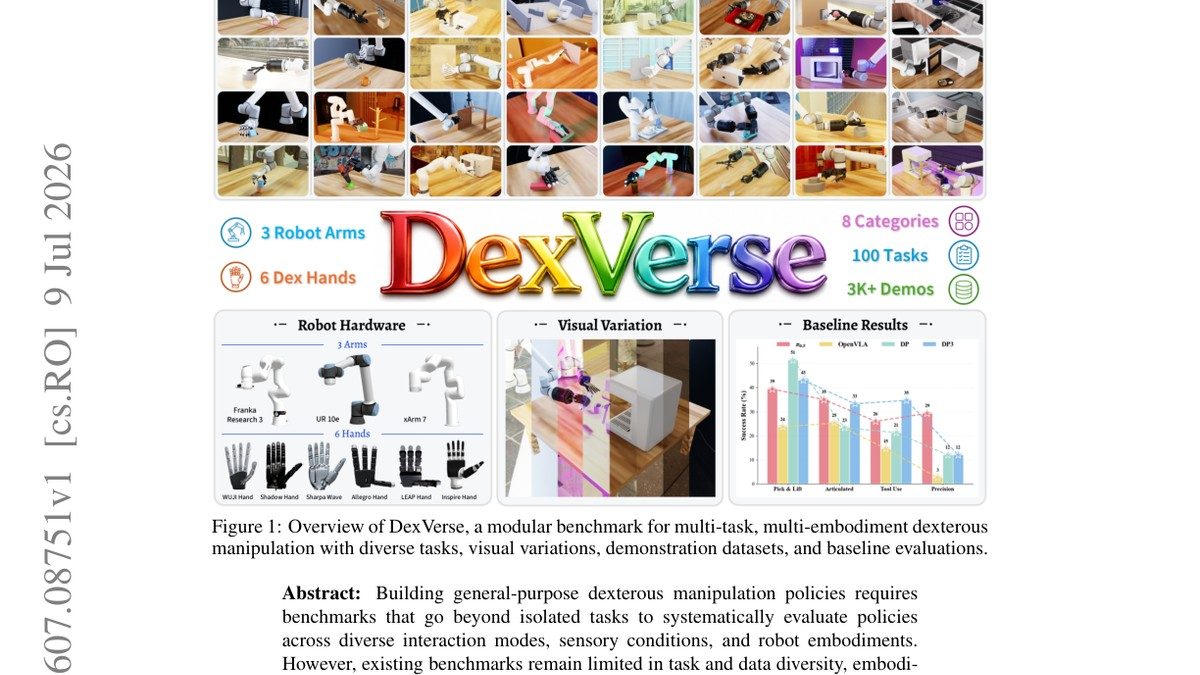
DexVerse: A Modular Benchmark for Multi-Task, Multi-Embodiment Dexterous Manipulation
Yunchao Yao, Zhuxiu Xu, Tianqi Zhang et al. · arXiv preprint · Jul 2026
Building general-purpose dexterous manipulation policies requires benchmarks that go beyond isolated tasks to systematically evaluate policies across diverse interaction modes, sensory conditions, and robot embodiments. However, existing benchmarks remain limited in task and data diversity, embod...
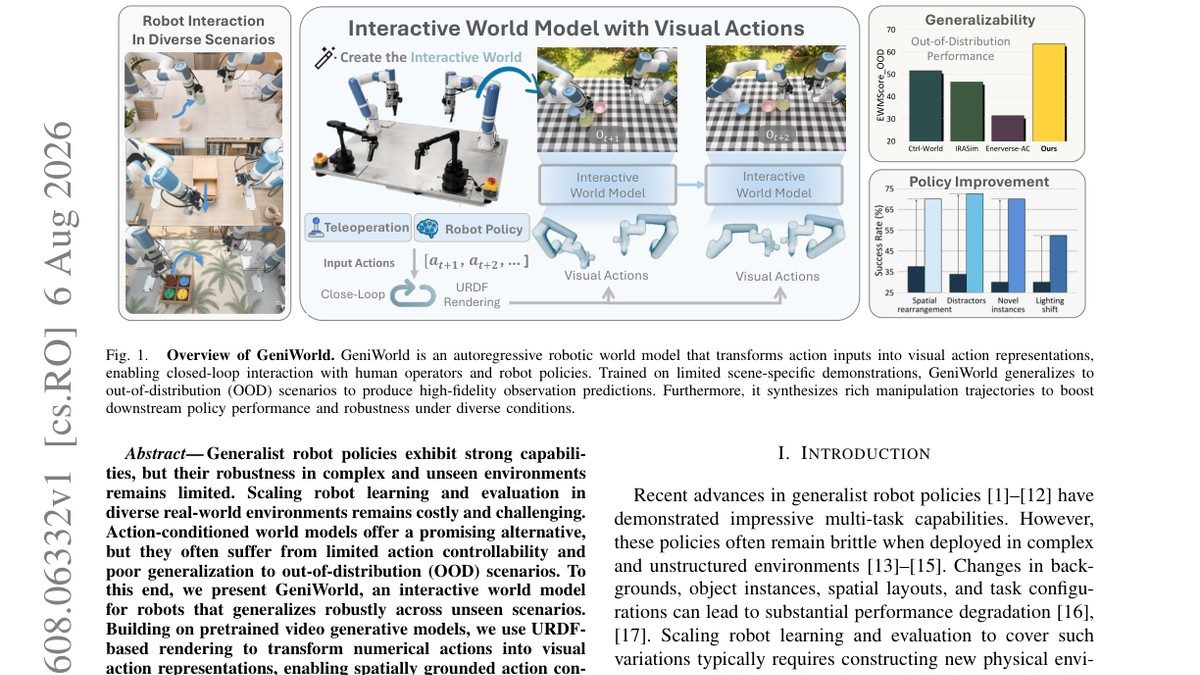
GeniWorld: A Generalizable Interactive World Model for Robotic Manipulation via Visual Actions
Chenghao Gu, Hanyang Yu, Jingbo Zhang et al. · arXiv preprint · Aug 2026
Generalist robot policies exhibit strong capabilities, but their robustness in complex and unseen environments remains limited. Scaling robot learning and evaluation in diverse real-world environments remains costly and challenging. Action-conditioned world models offer a promising alternative, b...
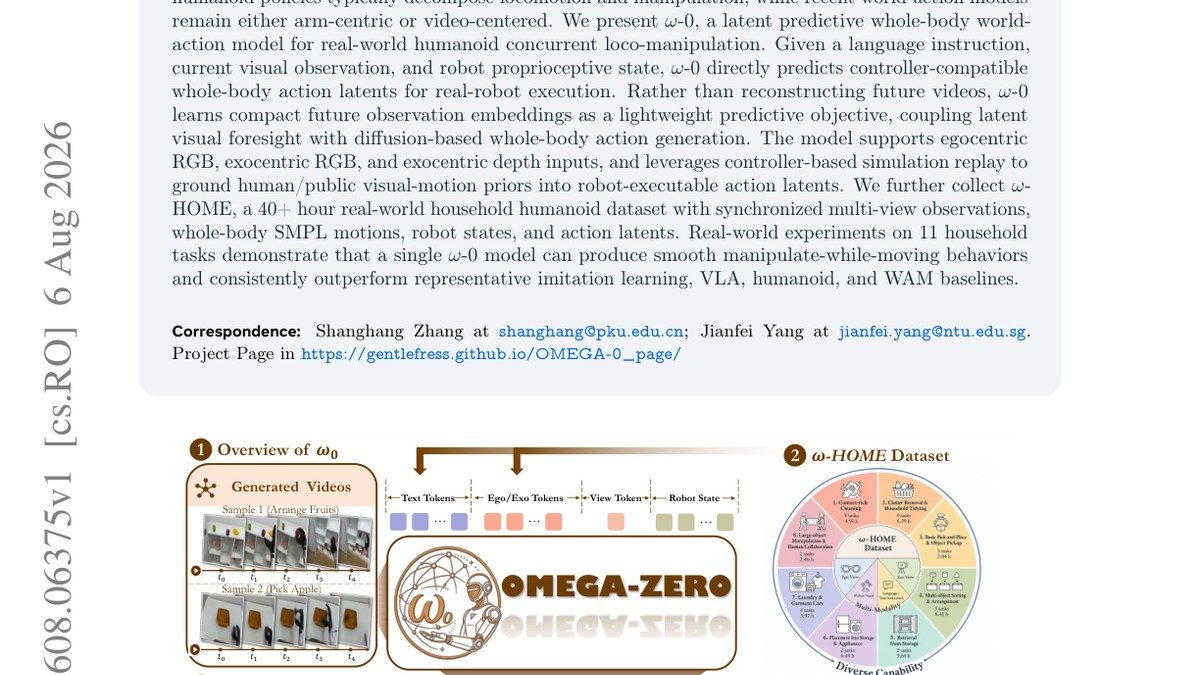
$ω$-0: A Latent Predictive World Action Model for Concurrent Humanoid Loco-Manipulation
Zhe Li, Zhenzhe Zhang, Yangyang Wei et al. · arXiv preprint · Aug 2026
Humanoid household tasks often require concurrent loco-manipulation, where the robot must move, adjust posture, maintain balance, and manipulate objects as a single coordinated behavior. Yet existing humanoid policies typically decompose locomotion and manipulation, while recent world-action mode...