
OK-Robot: Open-Ended Object Manipulation with Pretrained Vision-Language Models
Peiqi Liu, Yat Long Lo, Ted Xiao, Yunfei Bai, Andy Zeng, Pierre Sermanet, Quan Vuong, Jonathan Tompson, Danny Driess, Jie Tan, Debidatta Dwibedi, Fei Xia, Brian Ichter, Karol Hausman · Google DeepMind, NYU · 2024
Framework
PyTorch + ROS2
License
MIT
Stars
597
Summary
OK-Robot uses off-the-shelf VLMs (CLIP, OWL-ViT) and LLMs (GPT-4) to perform open-ended object manipulation in unseen homes without any training, achieving 58% success on real-world pick-and-place tasks.
Abstract Summary
Key Points
- Zero-training: uses pretrained VLMs + LLMs only.
- 58% success on real-world pick-and-place in unseen homes.
- Open-vocabulary detection (OWL-ViT) + LLM planning + heuristic grasping.
- Semantic map built incrementally during exploration.
- ROS2 pipeline + iGibson simulator for hardware-free testing.
Related Papers
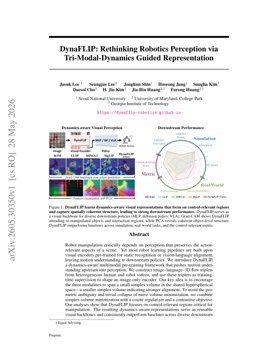
DynaFLIP: Rethinking Robotics Perception via Tri-Modal-Dynamics Guided Representation
Jusuk Lee, Seungjae Lee, Jonghun Shin et al. · arXiv preprint · May 2026
Robot manipulation critically depends on perception that preserves the action-relevant aspects of a scene. Yet most robot learning pipelines are built upon visual encoders pre-trained for static recog
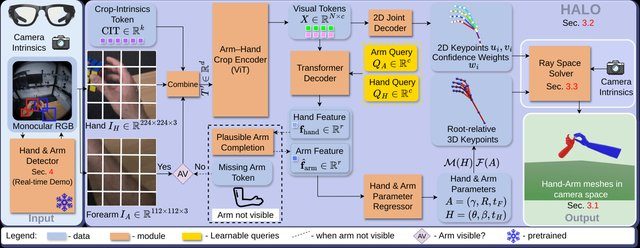
EgoForce: Forearm-Guided Camera-Space 3D Hand Pose from a Monocular Egocentric Camera
Christen Millerdurai, Shaoxiang Wang, Yaxu Xie et al. · SIGGRAPH 2026 · May 2026
Reconstructing the absolute 3D pose and shape of the hands from the user's viewpoint using a single head-mounted camera is crucial for practical egocentric interaction in AR/VR, telepresence, and hand-centric manipulation tasks, where sensing must...
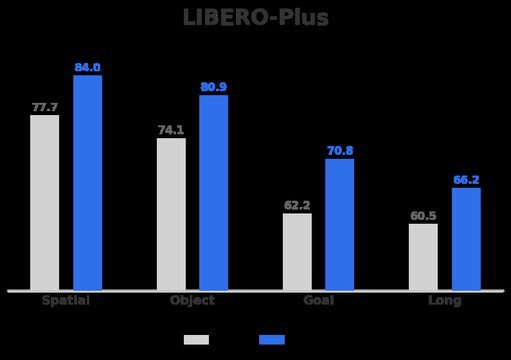
GuidedVLA: Specifying Task-Relevant Factors via Plug-and-Play Action Attention Specialization
Xiaosong Jia, Bowen Yang, Zuhao Ge et al. · RSS 2026 · May 2026
Vision-Language-Action (VLA) models aim for general robot learning by aligning action as a modality within powerful Vision-Language Models (VLMs). Existing VLAs rely on end-to-end supervision to implicitly enable the action decoding process to learn...

HarmoWAM: Harmonizing Generalizable and Precise Manipulation via Adaptive World Action Models
Qiuxuan Feng, Jiale Yu, Jiaming Liu et al. · arXiv · May 2026
World Action Models (WAMs) have emerged as a promising paradigm for robot control by modeling physical dynamics. Current...