

MDrive: Benchmarking Closed-Loop Cooperative Driving for End-to-End Multi-agent Systems
Marco Coscoy, Zewei Zhou, Seth Z. Zhao, Henry Wei, Jiaqi Ma · · 2026
Framework
N/A
License
N/A
Stars
17
Summary
Multi-agent autonomous driving systems require coordination among vehicles to navigate complex traffic scenarios safely ...
Abstract Summary
Key Points
- Proposes MDrive, a novel approach for navigation in robotics.
- Addresses key limitations in existing methods through innovative architecture design.
- Demonstrates strong empirical results on standard benchmarks and real-world evaluations.
- Introduces novel training methodology that improves generalization and sample efficiency.
- Provides comprehensive analysis of failure modes and ablation studies.
Abstract
Multi-agent autonomous driving systems require coordination among vehicles to navigate complex traffic scenarios safely and efficiently. MDrive introduces a comprehensive benchmark for end-to-end multi-agent driving with diverse scenarios including highway merging, intersection negotiation, and emergency braking coordination.
Links
- Paper (PDF): 2605.10904
- arXiv: 2605.10904
Related Papers
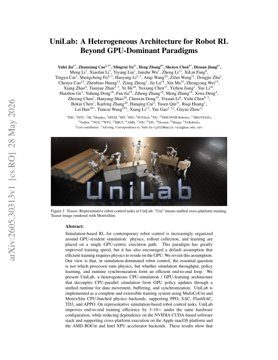
A Heterogeneous Architecture for Robot RL Beyond GPU-Dominant Paradigms
Yufei Jia, Zhanxiang Cao, Mingrui Yu et al. · arXiv preprint · May 2026
Simulation-based RL for contemporary robot control is increasingly organized around GPU-resident simulation: physics, rollout collection, and learning are placed on a single GPU-centric execution path
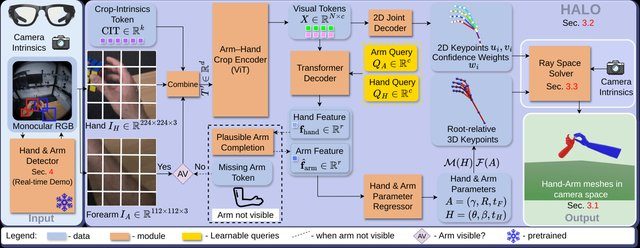
EgoForce: Forearm-Guided Camera-Space 3D Hand Pose from a Monocular Egocentric Camera
Christen Millerdurai, Shaoxiang Wang, Yaxu Xie et al. · SIGGRAPH 2026 · May 2026
Reconstructing the absolute 3D pose and shape of the hands from the user's viewpoint using a single head-mounted camera is crucial for practical egocentric interaction in AR/VR, telepresence, and hand-centric manipulation tasks, where sensing must...
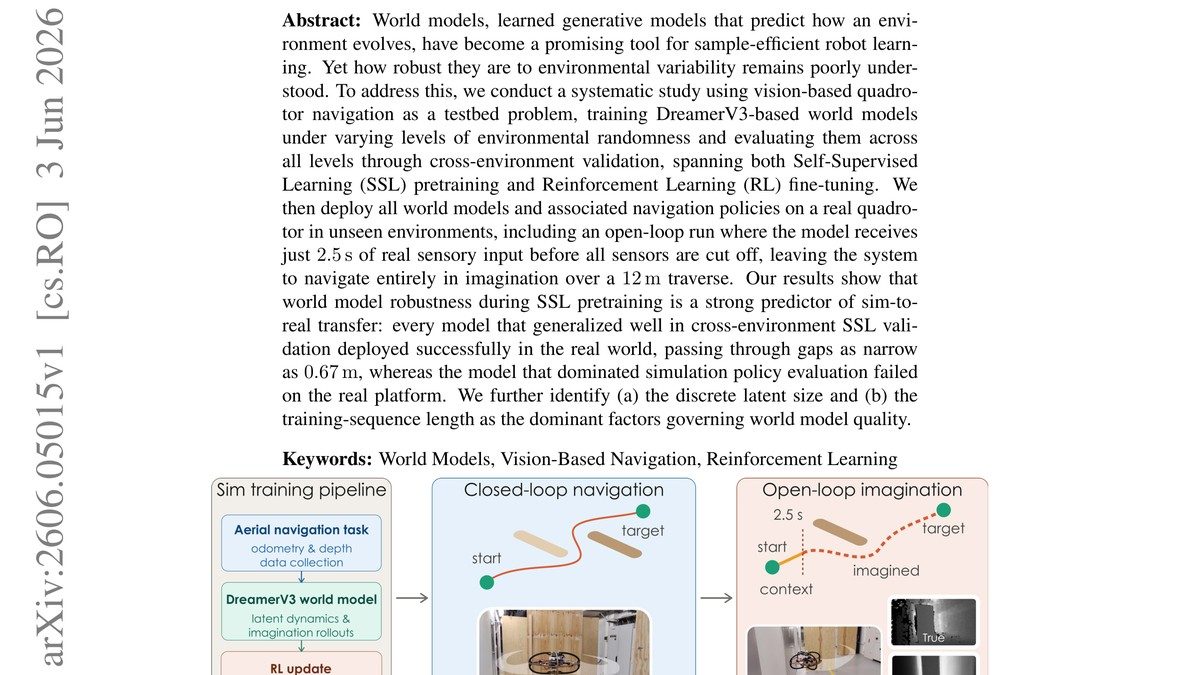
Generalization of World Models under Environmental Variability for Vision-based Quadrotor Navigation
Luca Zanatta, Grzegorz Malczyk, Kostas Alexis · arXiv preprint · Jun 2026
World models, learned generative models that predict how an environment evolves, have become a promising tool for sample-efficient robot learning. Yet how robust they are to environmental variability remains poorly understood. To address this, we conduct a systematic study using vision-based quadrot...
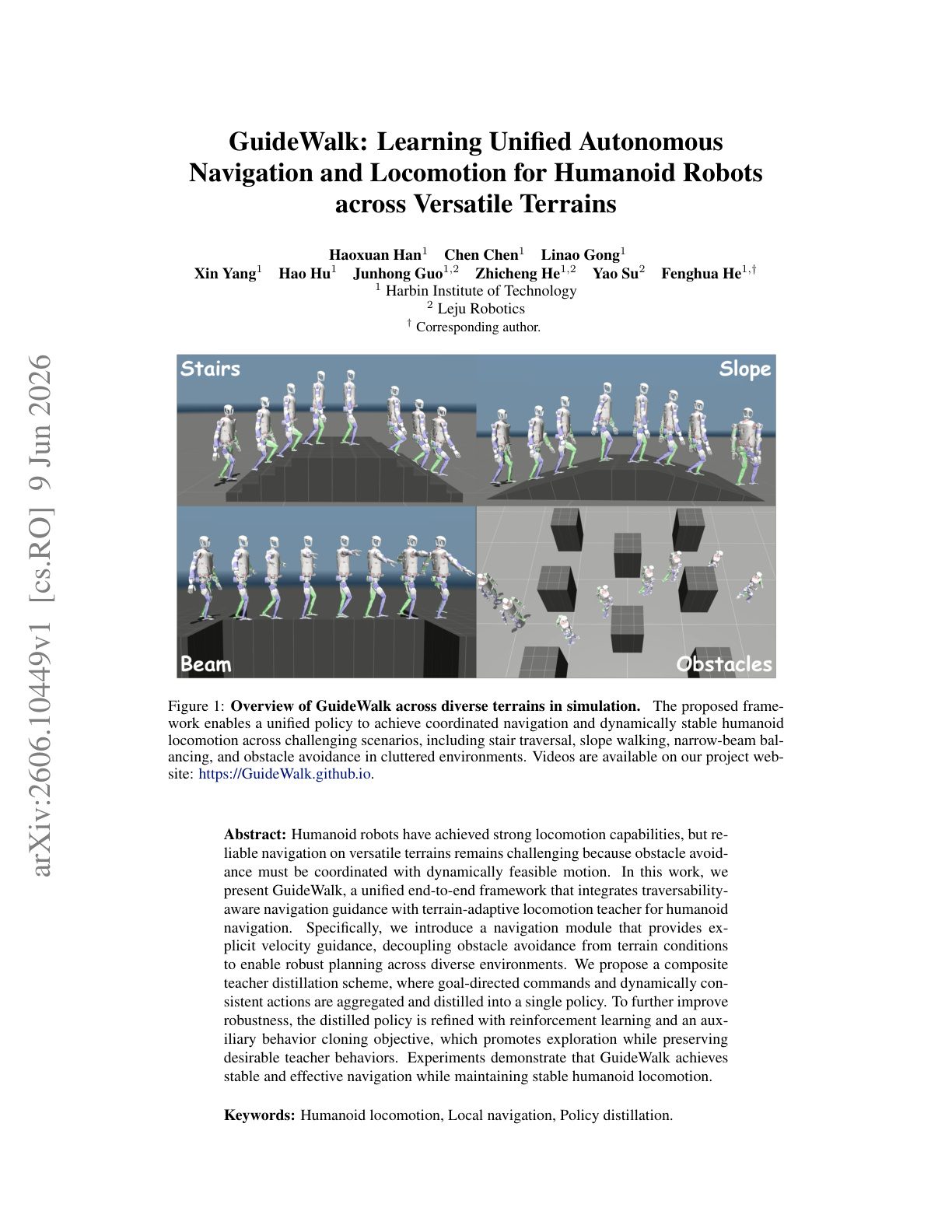
GuideWalk: Learning Unified Autonomous Navigation and Locomotion for Humanoid Robots across Versatile Terrains
Haoxuan Han, Chen Chen, Linao Gong et al. · arXiv preprint · Jun 2026
Humanoid robots have achieved strong locomotion capabilities, but reliable navigation on versatile terrains remains challenging because obstacle avoidance must be coordinated with dynamically feasible motion. In this work, we present GuideWalk, a unified end-to-end framework that integrates traversa...