
Energy-Efficient Quadruped Locomotion with Compliant Feet
FeaturedPramod Pal, Shishir Kolathaya, Ashitava Ghosal · · 2026
Framework
N/A
License
N/A
Stars
0
Summary
Quadruped robots are often designed with rigid feet to simplify control and maintain stable contact during locomotion. While this approach is straightforward, it limits the ability of the legs to absorb impact forces and reuse stored elastic energy, leading to higher energy expenditure during locomo...
Abstract Summary
Key Points
- Uses reinforcement learning for policy optimization
- Targets physical robot platforms
Abstract
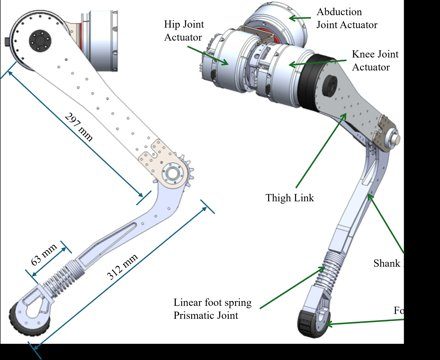
Quadruped robots are often designed with rigid feet to simplify control and maintain stable contact during locomotion. While this approach is straightforward, it limits the ability of the legs to absorb impact forces and reuse stored elastic energy, leading to higher energy expenditure during locomotion. To explore whether compliant feet can provide an advantage, we integrate foot compliance into a reinforcement learning (RL) locomotion controller and study its effect on walking efficiency. In simulation, we train eight policies corresponding to eight different spring stiffness values and then cross-evaluate their performance by measuring mechanical energy consumed per meter traveled. In experiments done on a developed quadruped, the energy consumption for the intermediate stiffness spring is lower by ~ 17% when compared to a very stiff or a very flexible spring incorporated in the feet, with similar trends appearing in the simulation results. These results indicate that selecting an appropriate foot compliance can improve locomotion efficiency without destabilizing the robot during motion.
Links
- Paper (PDF): 2605.14411v1
- arXiv: 2605.14411v1
Related Papers

Scalable Behavior Cloning with Open Data, Training, and Evaluation
Arthur Allshire, Himanshu Gaurav Singh, Ritvik Singh et al. · arXiv · Jun 2026
We introduce ABC, a fully open-source stack for manipulation with behavior cloning. At its core is ABC-130K: the largest open-source teleoperation dataset to date, featuring 3,500 hours of data spanning over 130K episodes across 195 diverse tasks. Furthermore, we open-source o...

Bridging Performance and Generalization in Reinforcement Learning for Agile Flight
Jonathan Green, Jiaxu Xing, Nico Messikommer et al. · arXiv · Jun 2026
Autonomous drone racing is a fundamentally challenging regime for autonomous aerial robots, requiring time-optimal control while operating under persistent actuation saturation. While reinforcement learning (RL) has achieved human-level performance in this domain, current meth...

E-TTS: A New Embodied Test-Time Scaling Framework for Robotic Manipulation
Wen Ye, Peiyan Li, Tingyu Yuan et al. · arXiv · Jun 2026
Recently, a few works have made early attempts to study test-time scaling for embodied tasks. However, two major challenges remain unsolved: (1) reasoning can effectively improve the performance of the policy, but its scaling mechanism has seldom been studied; (2) historical i...
HumanoidUMI: Bridging Robot-Free Demonstrations and Humanoid Whole-Body Manipulation
Hongwu Wang, Chenhao Yu, Youhao Hu et al. · arXiv · Jun 2026
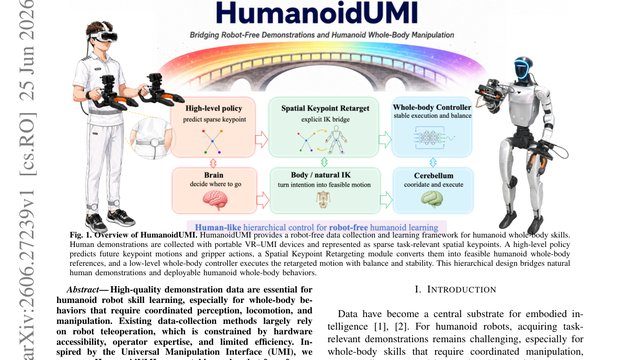
High-quality demonstration data are essential for humanoid robot skill learning, especially for whole-body behaviors that require coordinated perception, locomotion, and manipulation. Existing data-collection methods largely rely on robot teleoperation, which is constrained by...