

Bridging Performance and Generalization in Reinforcement Learning for Agile Flight
FeaturedJonathan Green, Jiaxu Xing, Nico Messikommer, Angel Romero, Davide Scaramuzza · · 2026
Framework
N/A
License
N/A
Stars
0
Summary
Autonomous drone racing is a fundamentally challenging regime for autonomous aerial robots, requiring time-optimal control while operating under persistent actuation saturation. While reinforcement learning (RL) has achieved human-level performance in this domain, current meth...
Abstract Summary
Key Points
- Autonomous drone racing is a fundamentally challenging regime for autonomous aerial robots, requiring time-optimal control while operating under persi...
Abstract
Autonomous drone racing is a fundamentally challenging regime for autonomous aerial robots, requiring time-optimal control while operating under persistent actuation saturation. While reinforcement learning (RL) has achieved human-level performance in this domain, current methods fail to generalize; policies trained on specific environments often crash immediately in unseen configurations. This failure reflects the intrinsic difficulty of zero-shot generalization in agile flight, arising from high-dimensional task variation and the tight coupling between safety and performance at high speeds. Existing approaches that improve generalization impose a substantial cost on flight speed: control policies must significantly degrade performance to achieve even modest levels of generalization. In this work, we propose a framework for zero-shot generalization in agile flight for RL-based drone racing. By combining task-aware switching based on learning progress with a physically informed procedural track generator, the framework produces a fast and robust generalist policy without test-time adaptation. Our method achieves strong zero-shot performance across a wide range of unseen racetracks in the real world, demonstrating a 7.4x improvement in generalization over the state-of-the-art approaches, while maintaining competitive racing speeds. We validate our method’s results in both simulation and real-world settings, including a challenging vision-based, end-to-end control setting that operates without explicit state estimation, where all prior approaches fail to generalize.
Links
- Paper (PDF): 2606.27348v1
- arXiv: 2606.27348v1
Related Papers

Scalable Behavior Cloning with Open Data, Training, and Evaluation
Arthur Allshire, Himanshu Gaurav Singh, Ritvik Singh et al. · arXiv · Jun 2026
We introduce ABC, a fully open-source stack for manipulation with behavior cloning. At its core is ABC-130K: the largest open-source teleoperation dataset to date, featuring 3,500 hours of data spanning over 130K episodes across 195 diverse tasks. Furthermore, we open-source o...

E-TTS: A New Embodied Test-Time Scaling Framework for Robotic Manipulation
Wen Ye, Peiyan Li, Tingyu Yuan et al. · arXiv · Jun 2026
Recently, a few works have made early attempts to study test-time scaling for embodied tasks. However, two major challenges remain unsolved: (1) reasoning can effectively improve the performance of the policy, but its scaling mechanism has seldom been studied; (2) historical i...
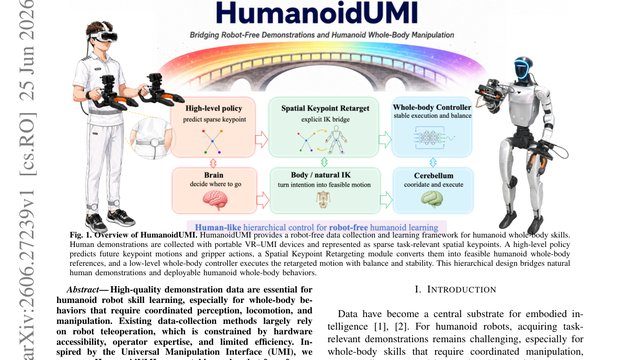
HumanoidUMI: Bridging Robot-Free Demonstrations and Humanoid Whole-Body Manipulation
Hongwu Wang, Chenhao Yu, Youhao Hu et al. · arXiv · Jun 2026
High-quality demonstration data are essential for humanoid robot skill learning, especially for whole-body behaviors that require coordinated perception, locomotion, and manipulation. Existing data-collection methods largely rely on robot teleoperation, which is constrained by...

LA4VLA: Learning to Act without Seeing via Language-Action Pretraining
Tao Lin, Yuxin Du, Yiran Mao et al. · arXiv · Jun 2026
Vision-Language-Action (VLA) models are commonly pretrained on robot demonstrations by jointly mapping visual observations and language instructions to actions. However, dense visual-action supervision can dominate the comparatively sparse language-action signal. As a result, ...