
At a glance
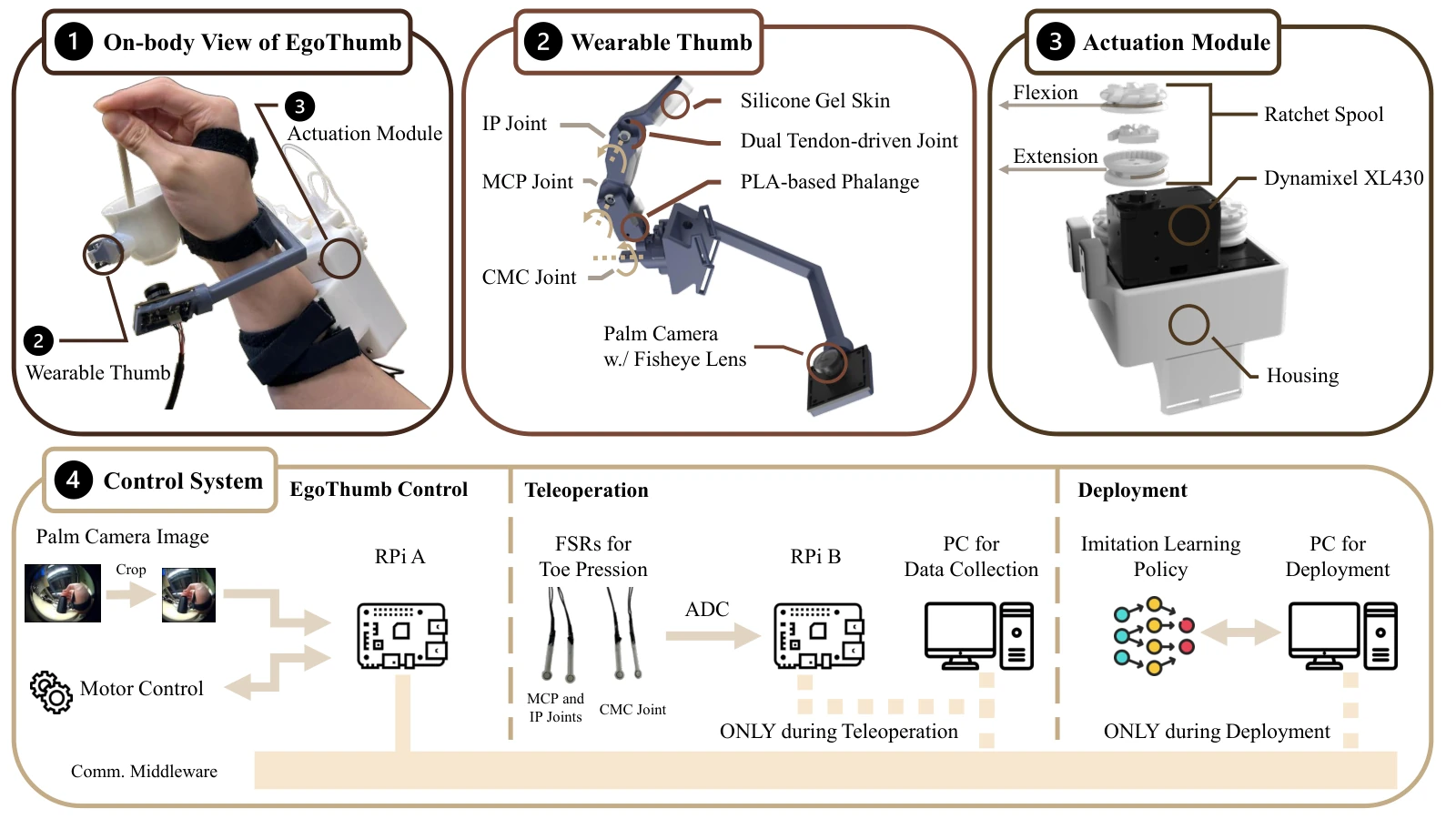
- The thumb uses tendon-driven joints with actuators mounted on the forearm. Source
- A palm-facing camera captures the hand and surrounding visual context. Source
- A visual imitation policy maps egocentric images to joint positions. Source
Evaluation scope EgoThumb combines a wearable thumb with a vision-based imitation policy for hold-and-manipulate tasks. Source
How it works
Evidence & results
Limitations & boundaries
Takeaway
Performance drops on longer tasks when the initial and target areas vary, and high-speed manipulation remains unevaluated. Source
Resources
Figures: the paper's authors. Editorial source and image review: 2026-10-29. Findings are author-reported, not independently reproduced by Robotics Research Hub.
Original abstract
Supernumerary robotic fingers augment human dexterity by enabling a single hand to perform complex "hold-and-manipulate" tasks that typically require bimanual coordination. However, existing devices are often hindered by bulky hardware that limits interaction to large objects and rely on explicit hand motion triggers that lack environmental context. To address these challenges, we present EgoThumb, a fully open-source, vision-driven supernumerary robotic thumb. EgoThumb features a compact, dual tendon-driven finger whose actuation is relocated to the forearm, reducing distal weight while enabling precise active joint control. The system utilizes a visual imitation learning policy that maps egocentric images from a palm-facing camera directly to continuous joint positions. By implicitly decoding human intent from visual cues capturing both the hand and the object of interest, EgoThumb achieves robust autonomous manipulation and strong generalization across diverse users and environments. All hardware designs and software implementations are fully open-sourced at https://ego-thumb.github.io.
Citation
@article{Hou2026_261037582v1,
  title     = {EgoThumb: A Vision-Driven Supernumerary Robotic Thumb for Autonomous Grasp and Holding Assistance},
  author    = {Jianyu Hou and Jiawei Fu and Weikang Wan and Minghui Jiang and Jiajun Li and Hao Su},
  year      = {2026},
  eprint    = {2610.37582v1},
  archivePrefix = {arXiv},
  primaryClass  = {cs.RO},
  url       = {https://arxiv.org/abs/2610.37582v1}
}