
At a glance
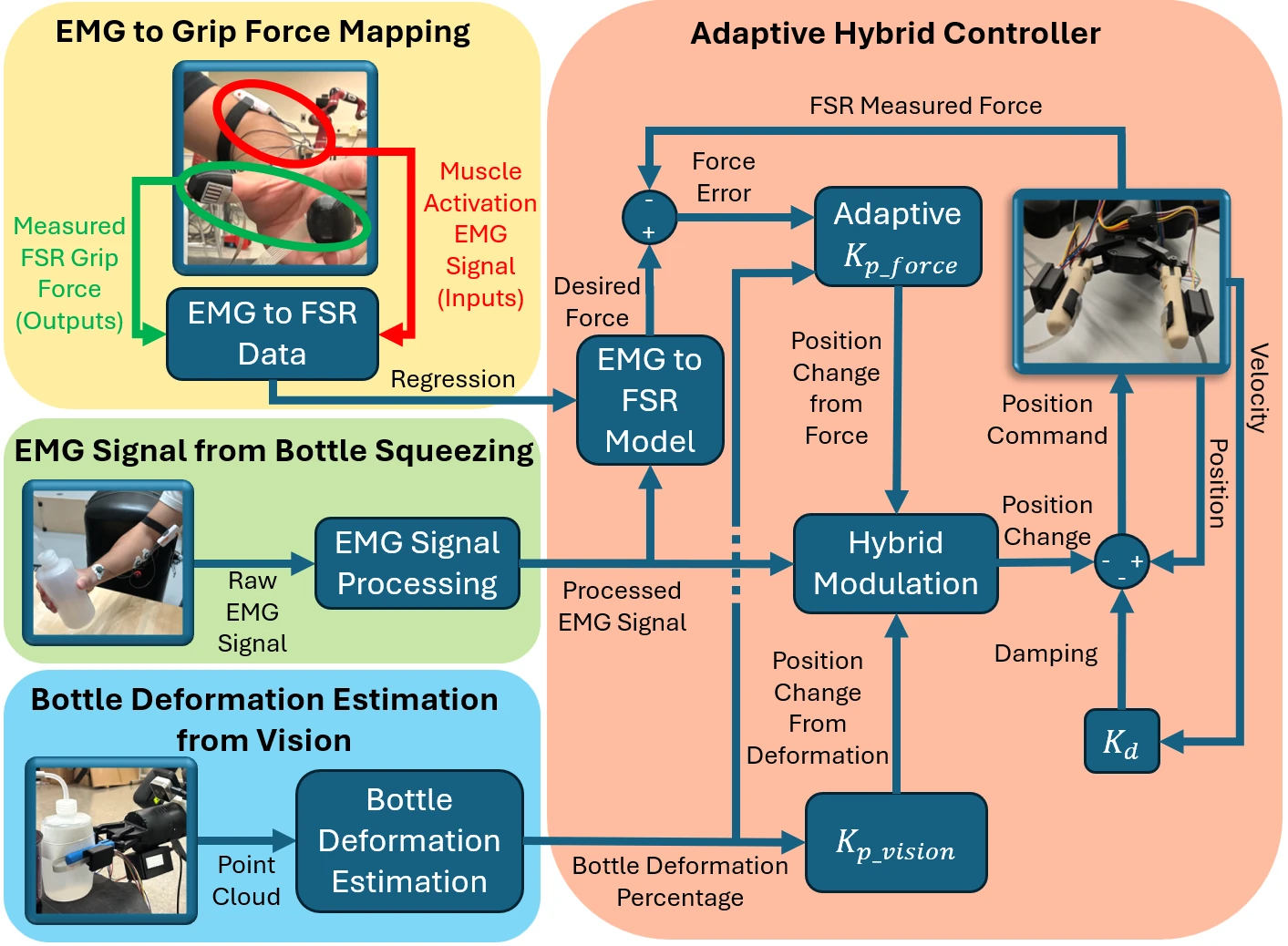
- The framework maps sEMG activity to a grip-force reference and combines it with FSR and depth-camera measurements. Source
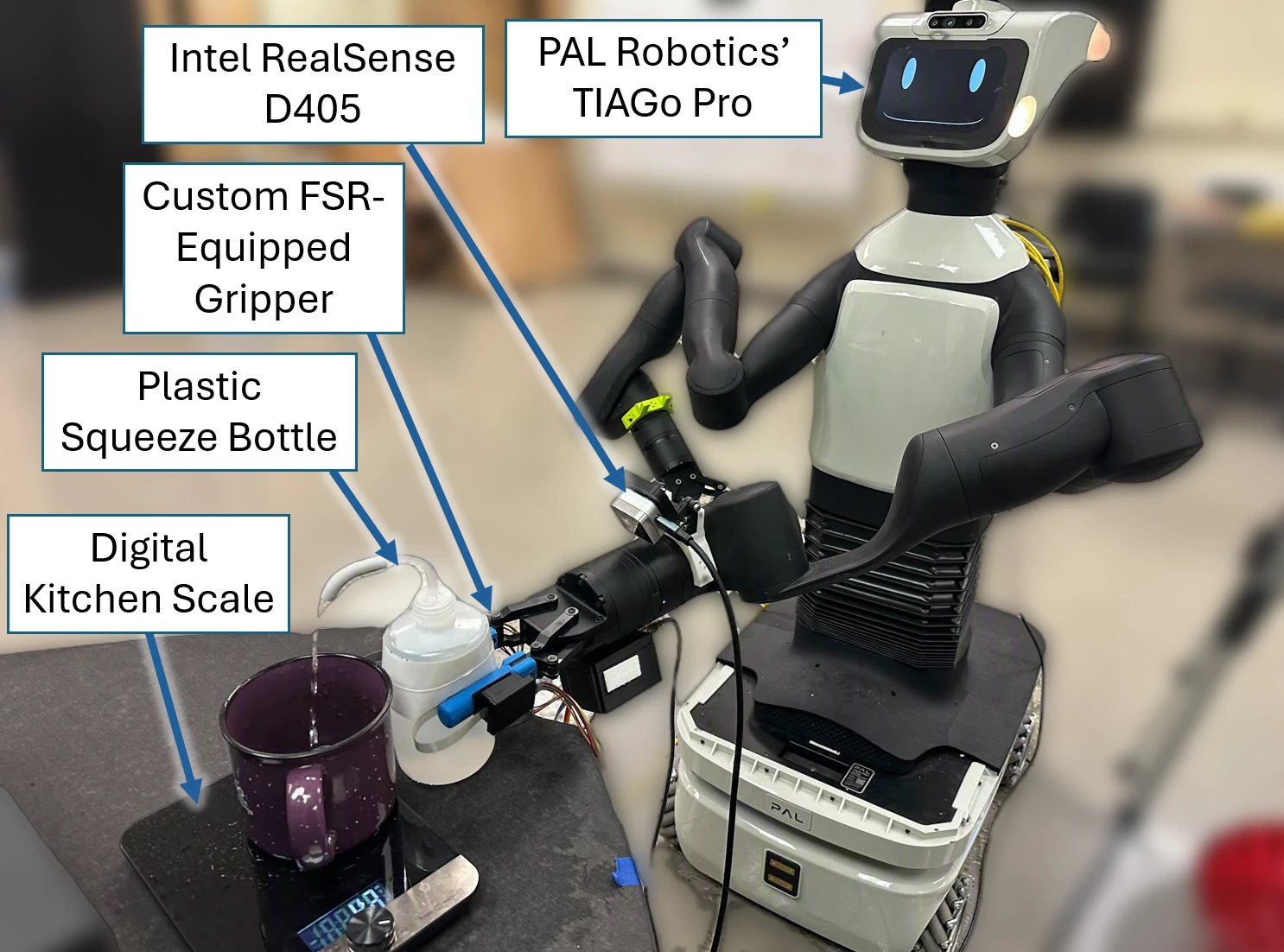
- The gripper uses a wrist-mounted Intel RealSense D405 and custom rounded fingers with force-sensitive resistors on a TIAGo Pro. Source
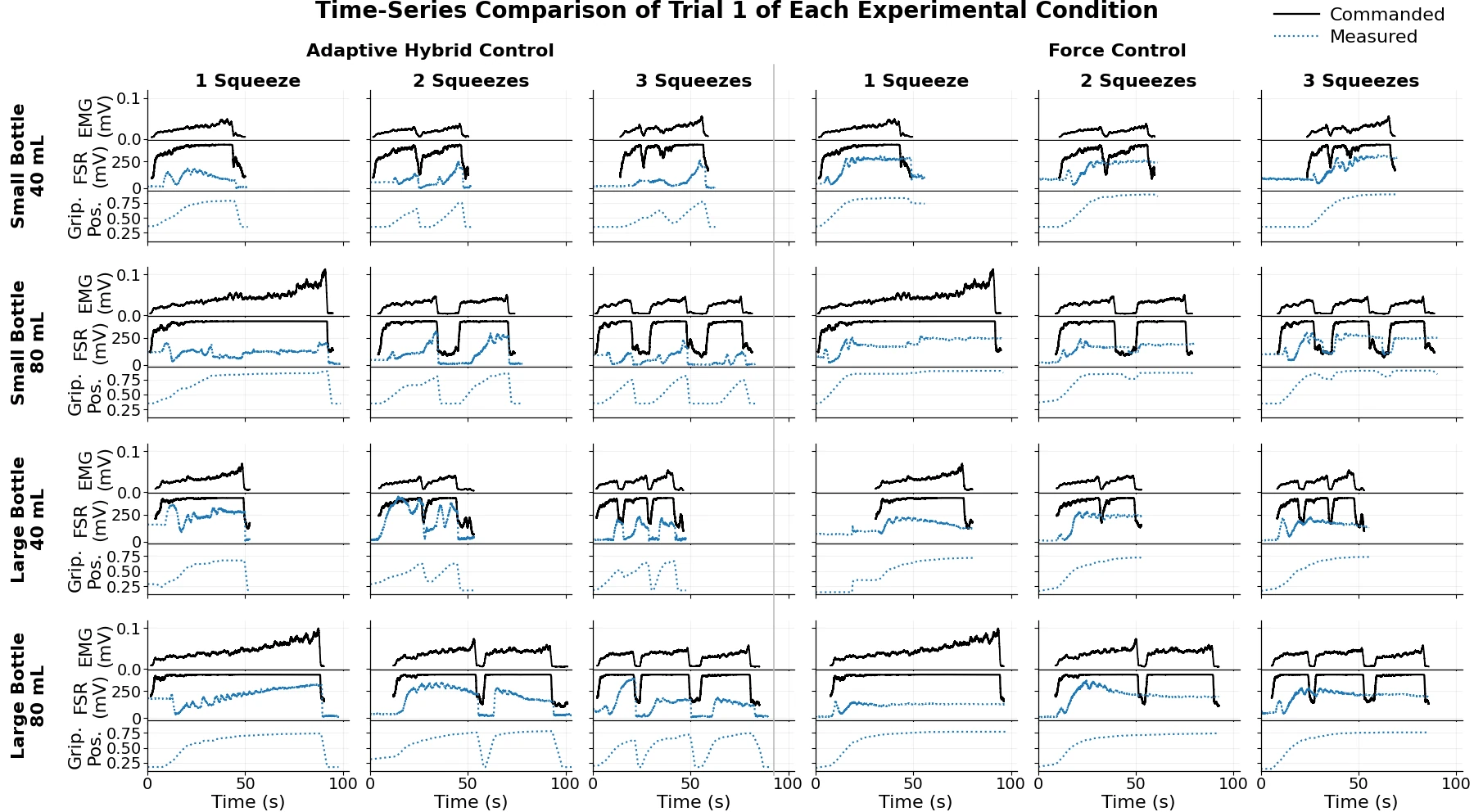
- The experiment compares adaptive hybrid force-vision control with tuned force control over five repeated robot trials per condition. Source
Evaluation scope The study evaluates an adaptive hybrid force-vision controller for robotic squeezing and water dispensing with plastic laboratory bottles. Source
How it works
- sEMG was sampled at 1024 Hz, rectified, and filtered with a fourth-order 20–500 Hz Butterworth bandpass filter. Source
- Bottle deformation is estimated from RGB-D point clouds by extracting bottle points, aligning a cross-section, and comparing undeformed and deformed widths over 1 cm slices. Source
- The controller weights force feedback during active squeezing and deformation feedback during low-EMG release, with a deformation-adaptive force gain. Source
- The EMG-to-FSR mapping used one operator and 50 foam-block trials; dispensing trials used small 250 mL and large 500 mL bottles with approximately 40 mL or 80 mL targets. Source
Evidence & results
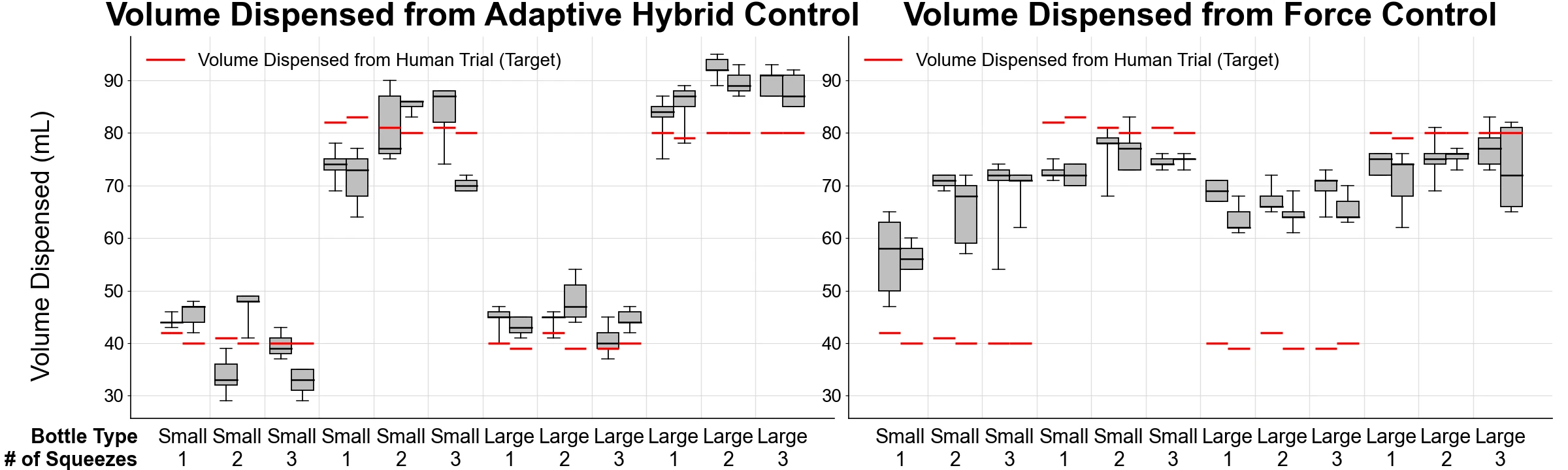
- The adaptive controller was evaluated on 12 dispensing-condition combinations with five repeated robot trials per condition and compared against corresponding human demonstrations. Evidence
- The adaptive controller generally kept dispensed volume closer to the human target than force control, especially for 40 mL conditions. Evidence
- The vision system reported MAE of 5.26% for small bottles and 6.96% for large bottles over its accurate deformation range. Evidence
Limitations & boundaries
Takeaway
Across 24 condition-demonstration combinations, the adaptive controller had lower dispensing error than force control, with MAE 6.54 mL versus 15.92 mL and RMSE 6.96 mL versus 16.45 mL. Source
Resources
Figures: the paper's authors. Editorial source and image review: 2026-11-07. Findings are author-reported, not independently reproduced by Robotics Research Hub.
Original abstract
Robotic automation of laboratory tasks has become a growing interest to remove researchers from hazardous environments and repetitive procedures. However, even equipment as simple as squeeze bottles poses a challenging manipulation problem due to its deformability. This paper presents an adaptive hybrid vision-force controller for robotic grippers to effectively manipulate laboratory squeeze bottles to dispense liquid. This approach integrates force and vision feedback according to the interaction state, enabling effective squeezing while accounting for bottle deformation and recovery. The proposed controller is validated by comparing its performance with a pure force controller on 12 combinations of conditions consisting of 2 target dispense volumes, 2 plastic squeeze bottles, and 1 to 3 squeezes used to dispense. Human demonstrations of these operating conditions were collected using electromyography (EMG) sensing mapped to a desired grip force, which was then used as the force reference for the controllers to squeeze the bottles. Results demonstrated that the proposed adaptive hybrid vision-force controller achieved more accurate liquid dispensing with a mean absolute error (MAE) of 6.54 mL compared to a MAE of 15.92 mL from the pure force controller, while also replicating the human action recorded from the EMG signal more closely.
Citation
@article{Lee2026_261107235,
  title     = {Adaptive Hybrid Force-Vision Control with EMG-Derived References for Deformable Bottle Manipulation},
  author    = {Jeffrey Lee and Geoffrey Hanks and Evangeline Bouganim and Yue Hu},
  year      = {2026},
  eprint    = {2611.07235},
  archivePrefix = {arXiv},
  primaryClass  = {cs.RO},
  url       = {https://arxiv.org/abs/2611.07235}
}