
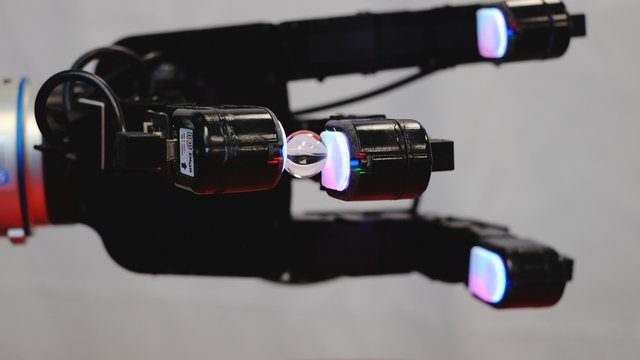
DIGIT: A Low-Cost Compact High-Resolution Tactile Sensor with Application to In-Hand Manipulation
Mike Lambeta, Po-Wei Chou, Stephen Tian, Brian Yang, Benjamin Maloon, Victoria Rose Most, Dougal Sutherland, Alexander Melnikov, Ellen K. Li, Zhenyu Jing, Huazhe Xu, Kuang-Huei Lee, Tingfan Wu, Yuanyuan Li, Jonathan Tremblay, Stan Birchfield, Freddy Mwinyi, Karan Khare, Rene Holladay, Bill Wen, Yunhao Ba, Roberto Calandra · Meta AI / New York University · 2020
Framework
ROS / Python
License
MIT
Stars
650
Summary
An affordable, compact, high-resolution vision-based tactile sensor optimized for in-hand manipulation with real-time fingertip deformation sensing.
Abstract Summary
Key Points
- Compact 15-mm vision-based tactile sensor with sub-millimeter deformation imaging.
- Parts cost ~$25; assembled from off-the-shelf camera, gel, 3D-printed housing.
- Captures 640×480 at >60 Hz; tested for slip detection and grasp stability.
- Open-source hardware, firmware, and driver widely adopted in manipulation labs.
- Enables direct tactile-pixel training for dexterous manipulation policies.
Additional Notes
Setup Tips
- Use translucent soft silicone with 1:10 curing ratio for consistent gel elasticity.
- Keep lens and gel surface clean of dust; any speckle pattern is treated as tactile signal.
- USB3 camera connection is preferred over USB2 to maintain high frame rate at full resolution.
Related Papers
- GelSight (Yuan et al., 2017)
- OmniTact (Padmanabha et al., 2020)
- Tactile Dexterity with DIGIT (Bhirangi et al., 2022)
Related Papers
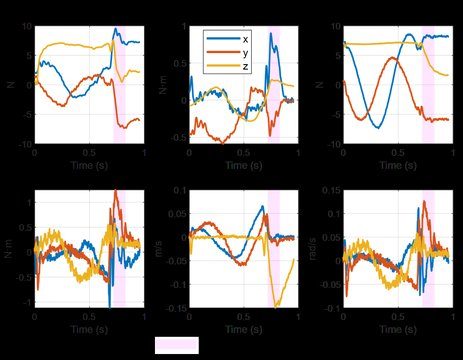
SI-Diff: A Framework for Learning Search and High-Precision Insertion with a Force-Domain Diffusion Policy
Yibo Liu, Stanko Oparnica, Simon Shewchun-Jakaitis et al. · arXiv · May 2026
Contact-rich manipulation is fundamental in robotics but poses significant challenges due to uncertainties in relative poses, such as misalignments and small clearances in peg-in-hole tasks. Existing approaches typically address search and...
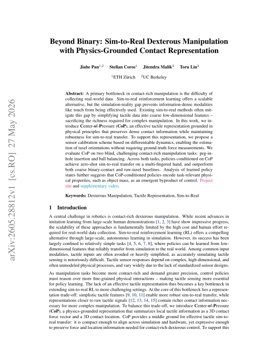
Beyond Binary: Sim-to-Real Dexterous Manipulation with Physics-Grounded Contact Representation
Jiahe Pan, Stelian Coros, Jitendra Malik et al. · arXiv preprint · May 2026
A primary bottleneck in contact-rich manipulation is the difficulty of collecting real-world data. Sim-to-real reinforcement learning offers a scalable alternative, but the simulation-reality gap prev
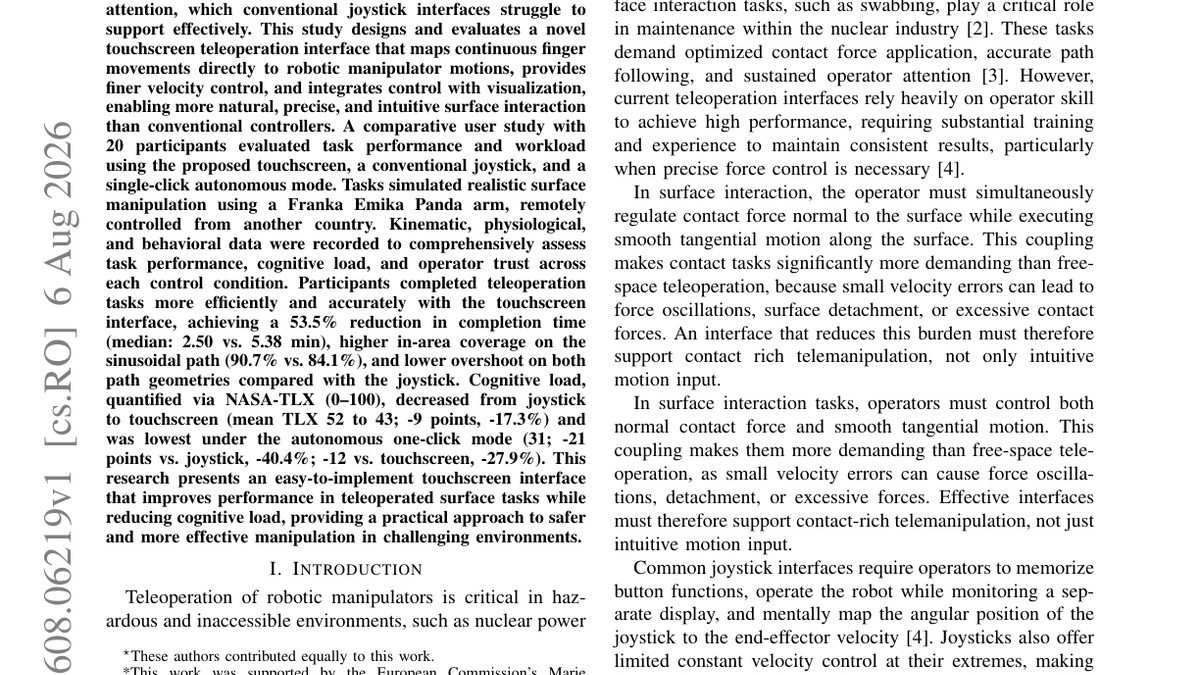
Design and Evaluation of a Touchscreen-Based Teleoperation Interface for Robotic Manipulators
Juan José García Cárdenas, Alperen Kenan, Hamidreza Raei et al. · arXiv preprint · Aug 2026
Intuitive teleoperation interfaces are crucial for the safe and effective operation of robotic manipulators in challenging environments. In the nuclear industry, surface contact tasks such as swab sampling require precise path and force tracking, obstacle avoidance, and sustained operator attenti...
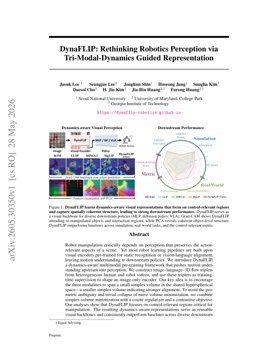
DynaFLIP: Rethinking Robotics Perception via Tri-Modal-Dynamics Guided Representation
Jusuk Lee, Seungjae Lee, Jonghun Shin et al. · arXiv preprint · May 2026
Robot manipulation critically depends on perception that preserves the action-relevant aspects of a scene. Yet most robot learning pipelines are built upon visual encoders pre-trained for static recog