
At a glance
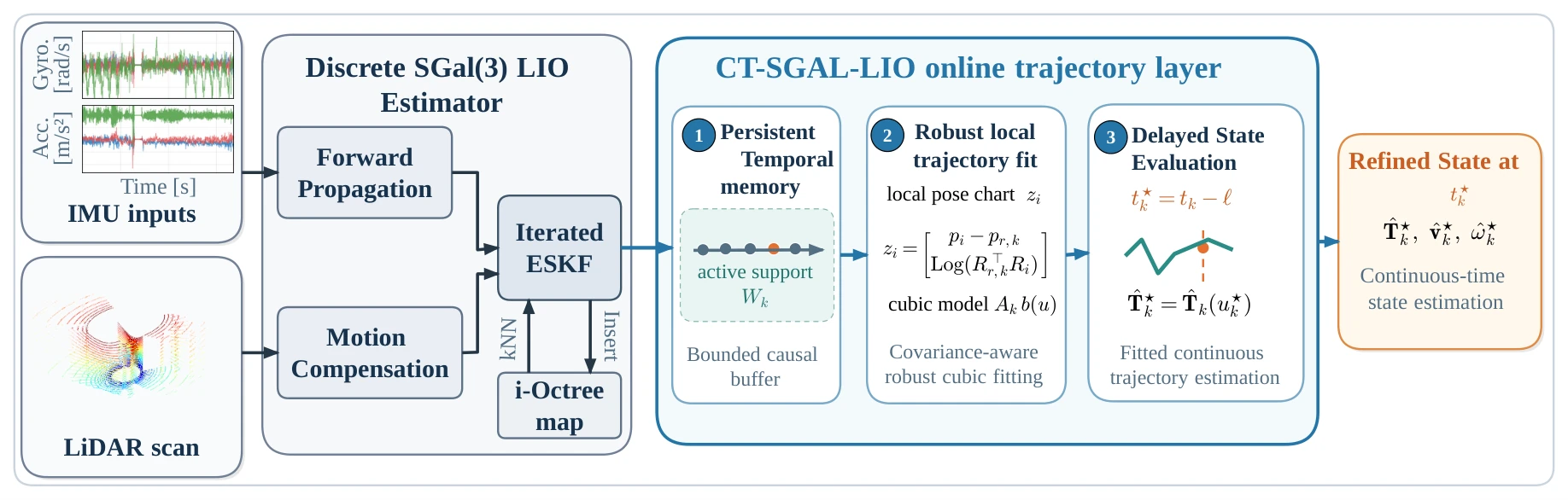
- A separate layer consumes posterior poses. Source
- Cubic fitting supports delayed interpolation. Source
- Benefits vary across sequences. Source
Evaluation scope Evaluation covers 17 sequences across GRAND-TOUR, MCD and GEODE. Source
How it works
- Fit a robust cubic trajectory in a local pose chart. Source
- Query inside the observed interval; causal does not mean zero output lag. Source
Evidence & results
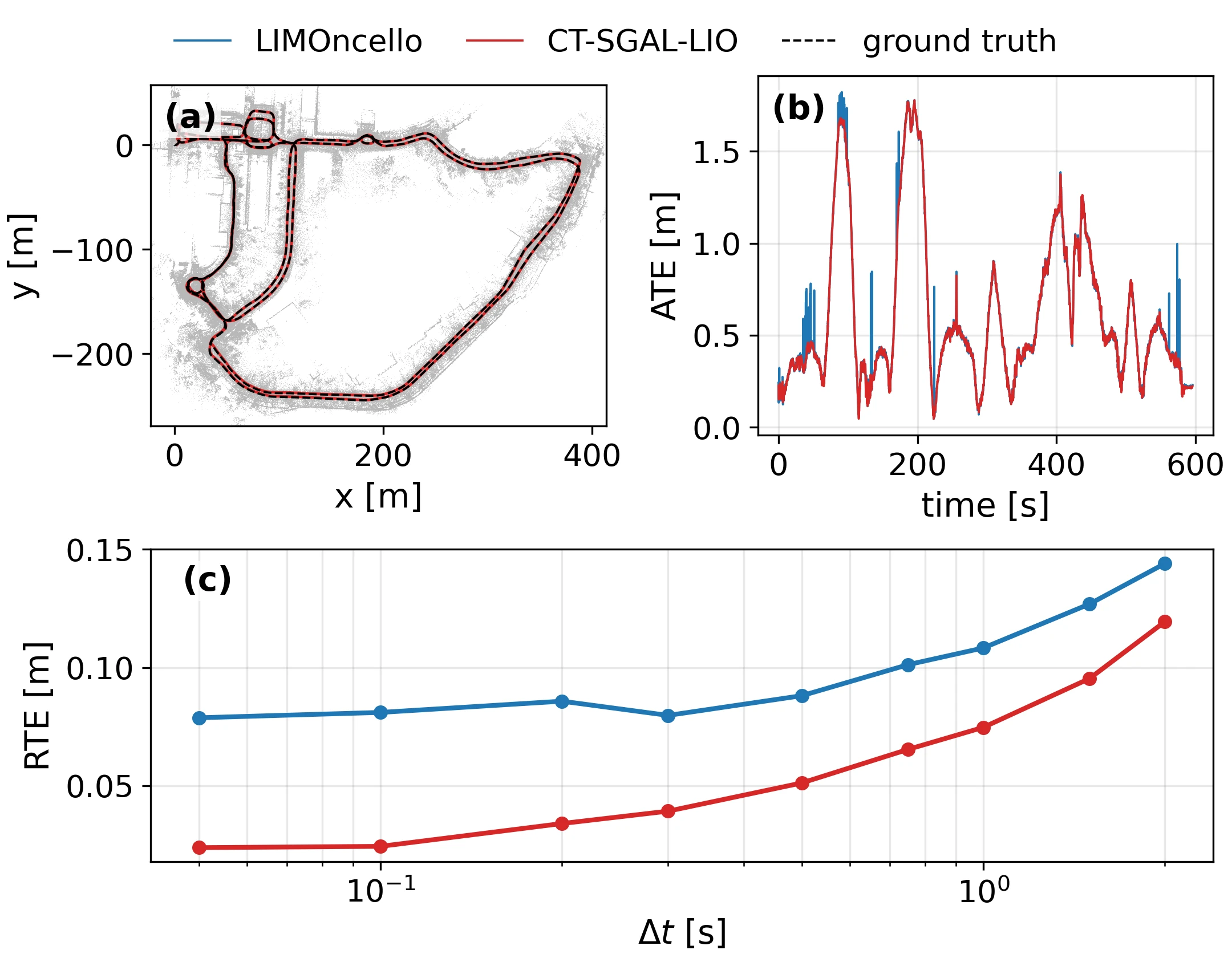
- On MCD day01, RTE RMSE at 0.1 s changes from 0.0810 to 0.0244 m versus LIMOncello; ATE changes from 0.7416 to 0.7389 m. Evidence
Limitations & boundaries
- Gains are uneven; testing other underlying estimators remains future work. Source
Takeaway
Refine the pose stream while leaving the estimator and map unchanged. Source
Resources
Figures: the paper's authors. Editorial source and image review: 2026-11-16. Findings are author-reported, not independently reproduced by Robotics Research Hub.
Original abstract
State-of-the-art LiDAR-inertial odometry methods, including those on richer state manifolds, achieve strong global accuracy, yet their pose stream alternates between propagation and correction and can oscillate over short horizons even when globally accurate. Most existing methods follow these approaches: they either modify the filter to enable faster updates or estimate a continuous-time trajectory from raw LiDAR and inertial data. The latter involves extra optimization, delaying state updates and becoming less robust during rapid rotations or accelerations. We propose CT-SGAL-LIO, a continuous-time refinement module that smooths the posterior pose stream of a discrete SGal(3) estimator without modifying the estimator itself. The key novelty is to perform continuous-time trajectory refinement directly on the projected SGal(3) posterior: we fit a cubic trajectory over a bounded window of recent poses and evaluate it at a small fixed lag. This places the query time within the observed interval, so the refined pose is obtained by interpolation rather than extrapolation, while preserving causal operation. CT-SGAL-LIO improves relative trajectory accuracy on 17 sequences from three public benchmarks. Across 17 sequences from GRAND-TOUR, MCD, and GEODE, CT-SGAL-LIO improves short-term motion accuracy while largely preserving global accuracy. RTE improves by up to 70% on GRAND-TOUR and on all seven GEODE sequences, with 9.9-51.1% reductions. A 19.5-min R-Campus run also reduces posterior jumps by 85.4% with only a 4.7 mm change in the end-to-start gap. We plan to release our source code and results to support community validation and reproducibility.
Citation
@article{Tran2026_261116918v1,
  title     = {CT-SGAL-LIO: Causal Continuous Time Refinement of Discrete LiDAR Inertial Odometry},
  author    = {Nam Tran and Thu Tran and Toan Nguyen and William J Beksi and Tuan Dang},
  year      = {2026},
  eprint    = {2611.16918v1},
  archivePrefix = {arXiv},
  primaryClass  = {cs.RO},
  url       = {https://arxiv.org/abs/2611.16918v1}
}