
At a glance
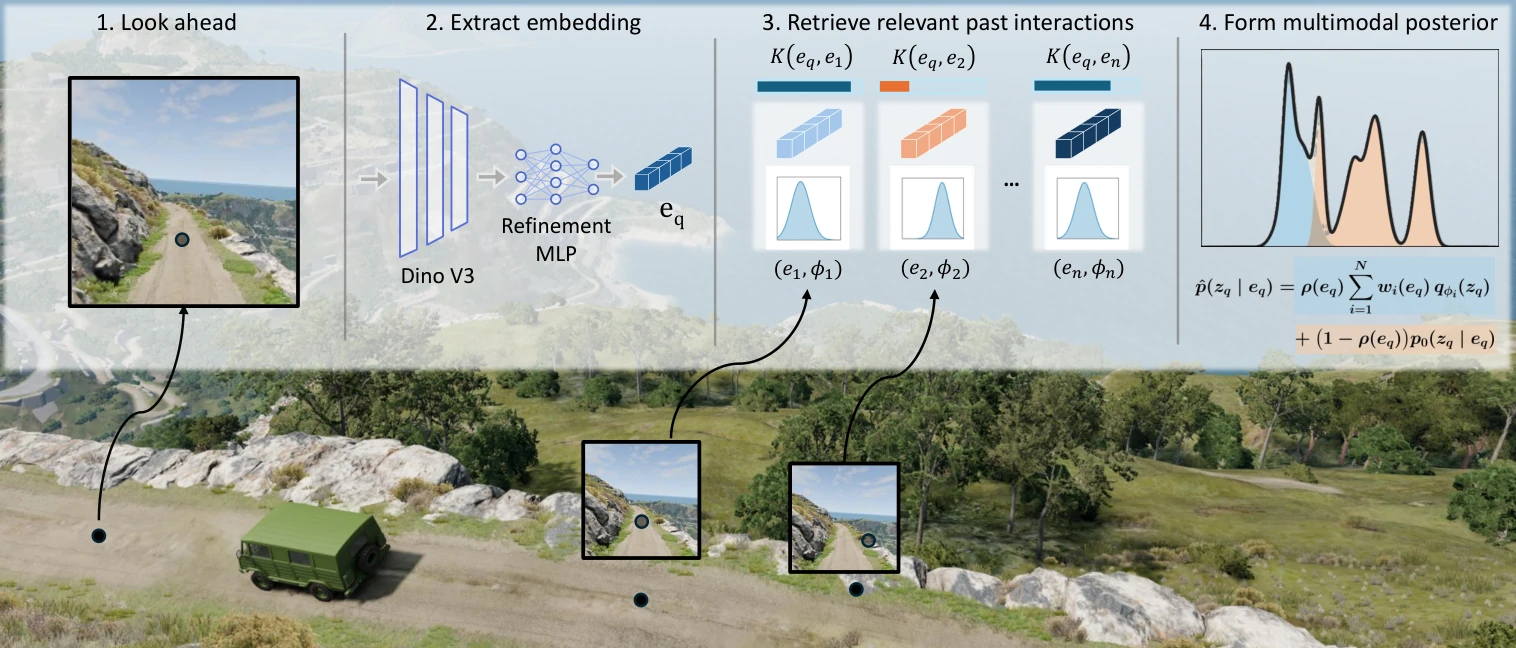
- Each interaction contributes a Gaussian physical-parameter belief paired with the visual embedding of the traversed region. Source
- Kernel retrieval forms a mixture whose components remain separate rather than being averaged into one estimate. Source
- A support coefficient interpolates between retrieved history and a conditional prior when evidence is sparse. Source
Evaluation scope The estimator predicts a latent interaction-relevant physical parameter from a continuous visual embedding and an interaction history. Source
How it works
- Historical embeddings are weighted with a similarity kernel to transfer interaction evidence to a query region. Source
- The final belief combines the history posterior and a conditional prior using the support coefficient rho. Source
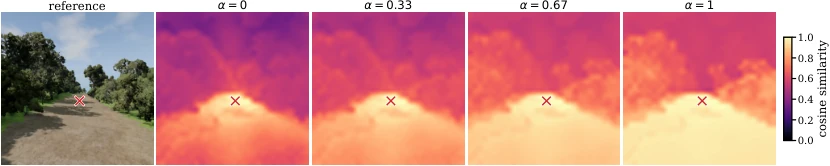
- A retrieval-space refinement is learned over frozen visual features to reduce nuisance sensitivity without discretizing the representation. Source
- The runtime pipeline uses frozen DINOv3 ViT-B/16 patch embeddings. Source
- In the closed-loop racing stack, the vision estimator runs at 0.5 Hz, the trajectory optimizer at 2-5 Hz, and MPC at 20-50 Hz. Source
Evidence & results
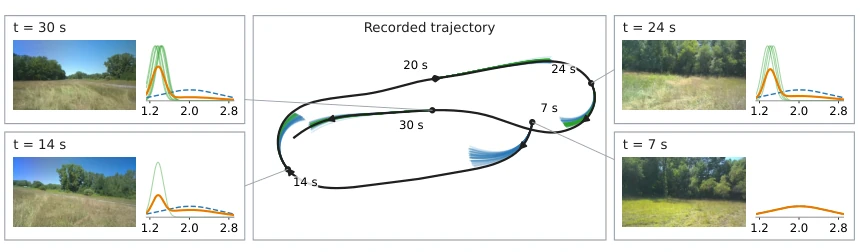
- The fused posterior remains an explicit Gaussian mixture when the prior is represented in Gaussian-belief space. Evidence
- In a collision-risk comparison, more than 40% of bimodal-belief rollouts collide, versus fewer than 1% for a moment-matched Gaussian with the same mean and variance. The cited evidence block does not specify the rollout denominator. Evidence
- The closed-loop controller uses posterior means of preview tune vectors to generate a surface-aware reference for MPC. Evidence
Limitations & boundaries
- The estimator depends on an embedding geometry in which similarity reflects physical-parameter relevance rather than nuisance visual variation. Source
- The main closed-loop evaluation is in BeamNG.tech with a forward-facing 512 by 512 camera. Source
- The simulator supplies local Gaussian interaction beliefs directly rather than fitting them from raw trajectories. Source
- The study evaluates vehicle-terrain dynamics; applicability to manipulation or contact-rich robot tasks is not established by these experiments. Source
Takeaway
Embedding-conditioned Gaussian mixtures retrieve interaction-derived beliefs and fuse them with a support-aware visual prior. Source
Resources
Figures: the paper's authors. Editorial source and image review: 2026-11-12. Findings are author-reported, not independently reproduced by Robotics Research Hub.
Original abstract
Enabling robots to infer interaction-relevant physical properties from vision before contact would improve planning and control in unstructured environments. Vision provides useful pre-contact information, but appearance alone is often ambiguous: visually similar regions can induce different friction, stiffness, or sinkage responses upon contact. Existing approaches often collapse this ambiguity to a point estimate or aggregate experience through fixed semantic classes, limiting their ability to preserve distinct physical regimes. Instead, we propose a real-time estimator that replaces semantic class indexing with an interaction-grounded Gaussian-mixture posterior over latent physical parameters, conditioned directly on continuous visual embeddings. Our approach maintains interaction-derived Gaussian parameter estimates, typically from inverse modeling, as mixture components while using embedding similarity to retrieve and weight relevant past interactions for each new query region. A support-aware fusion mechanism incorporates a conditional generative prior model when interaction history is sparse, while a learned embedding refinement improves retrieval relevance without discretizing the representation. Our experiments show that the estimator recovers multimodal physical beliefs, rejects unrelated interaction history, avoids spatial map discretization, and evaluates at controller rates. In a high-fidelity autonomous racing simulation with unknown low- and high-friction surface regions, the posterior enables the controller to adapt over repeated laps as interaction evidence accumulates, improving performance while maintaining friction-aware behavior.
Citation
@article{Borca-Tasciuc2026_261110107,
  title     = {Beyond Semantic Classes: Online Physical Parameter Estimation via Embedding-Conditioned Gaussian Mixtures},
  author    = {Alexander Borca-Tasciuc and Prayag Sharma and Franck Djeumou},
  year      = {2026},
  eprint    = {2611.10107},
  archivePrefix = {arXiv},
  primaryClass  = {cs.RO},
  url       = {https://arxiv.org/abs/2611.10107}
}