
At a glance
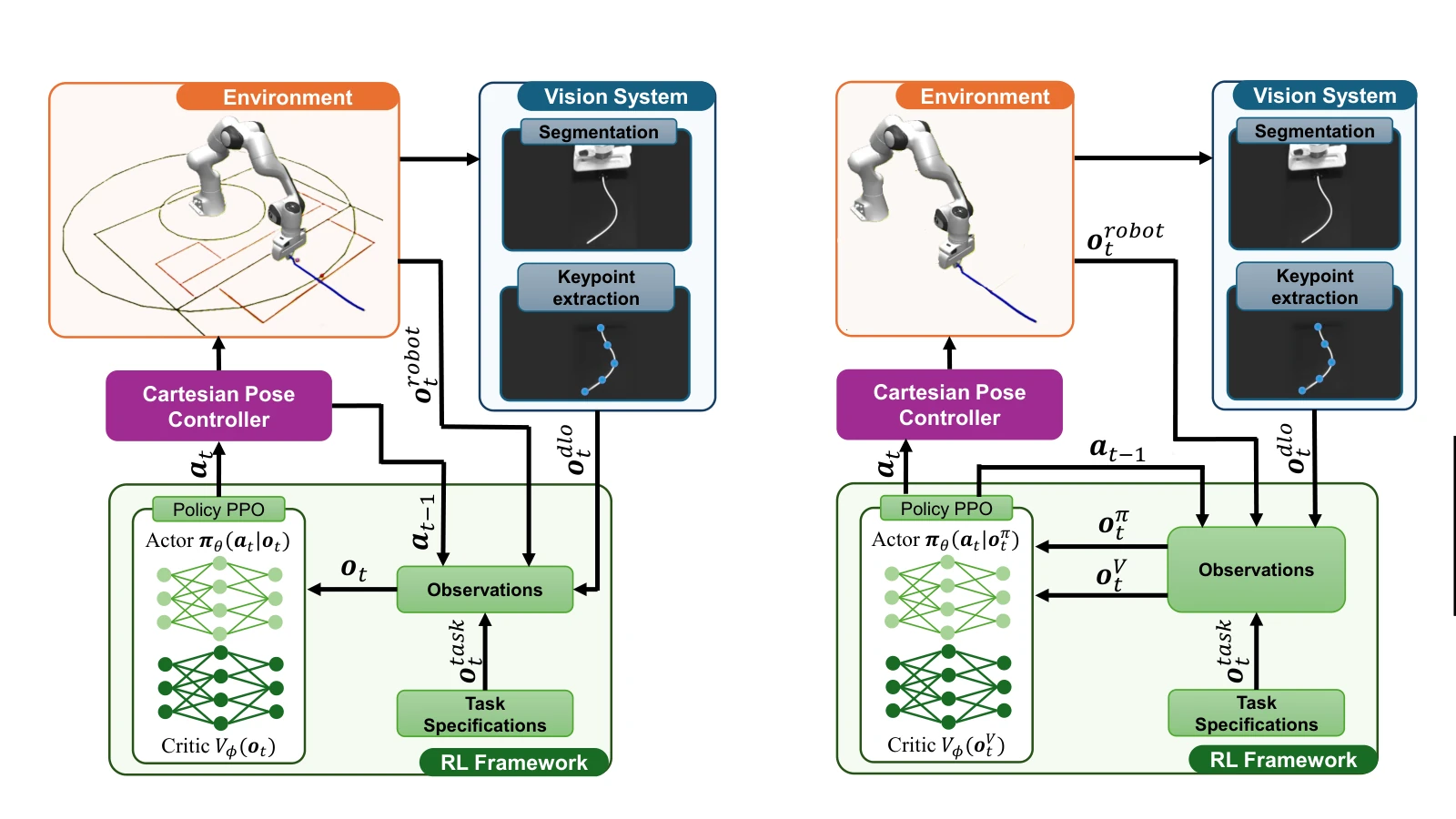
- The policy maps robot proprioception, DLO state, and target-relative information to Cartesian end-effector increments. Source
- The three complete PPO stacks are SB3 with CPU MuJoCo, SBX with CPU MuJoCo, and MuJoCo Playground with integrated JAX training. Source
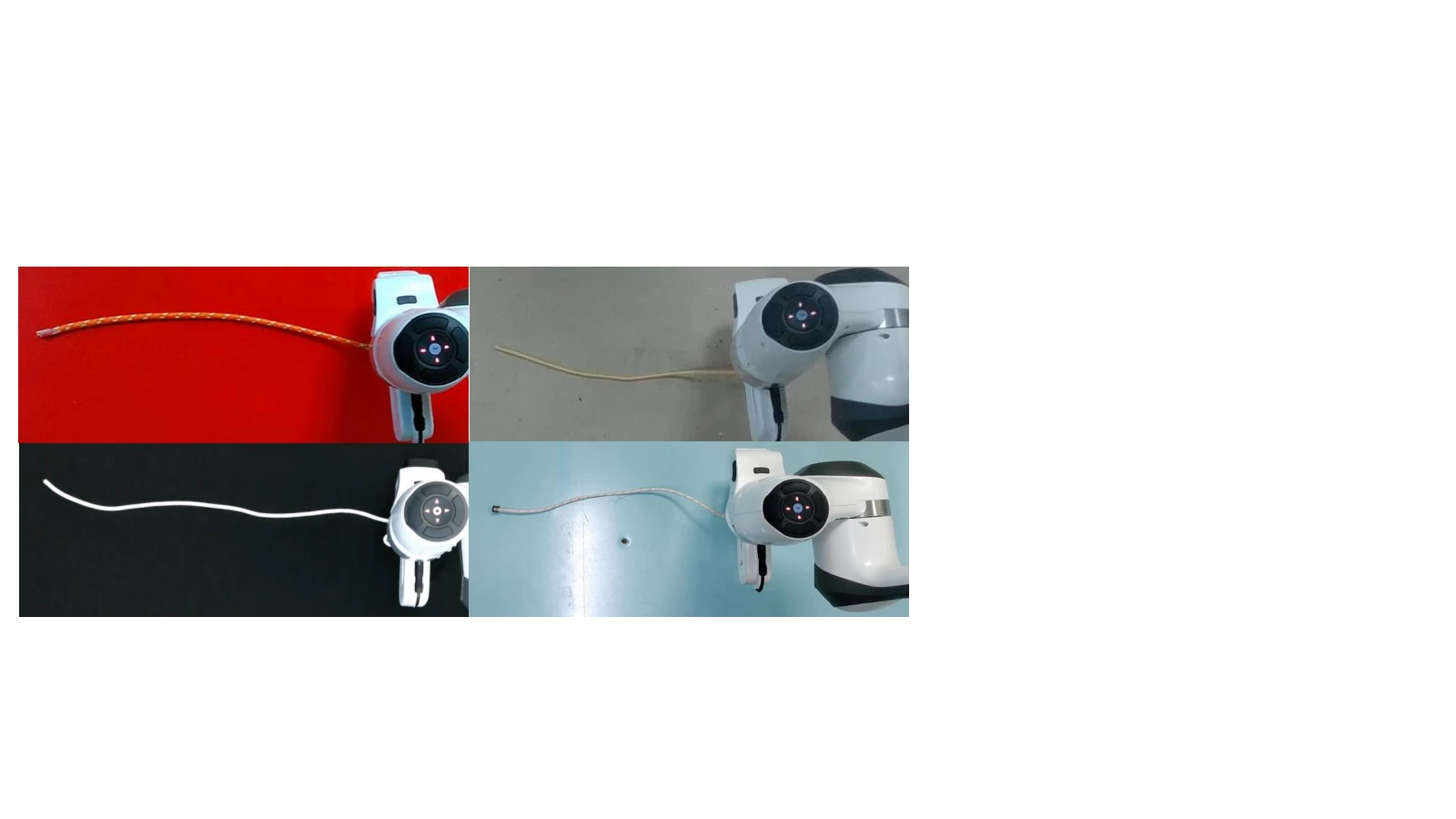
- A markerless RGB-D pipeline segments the rope, skeletonizes its mask, and extracts approximately equally spaced centerline keypoints. Source
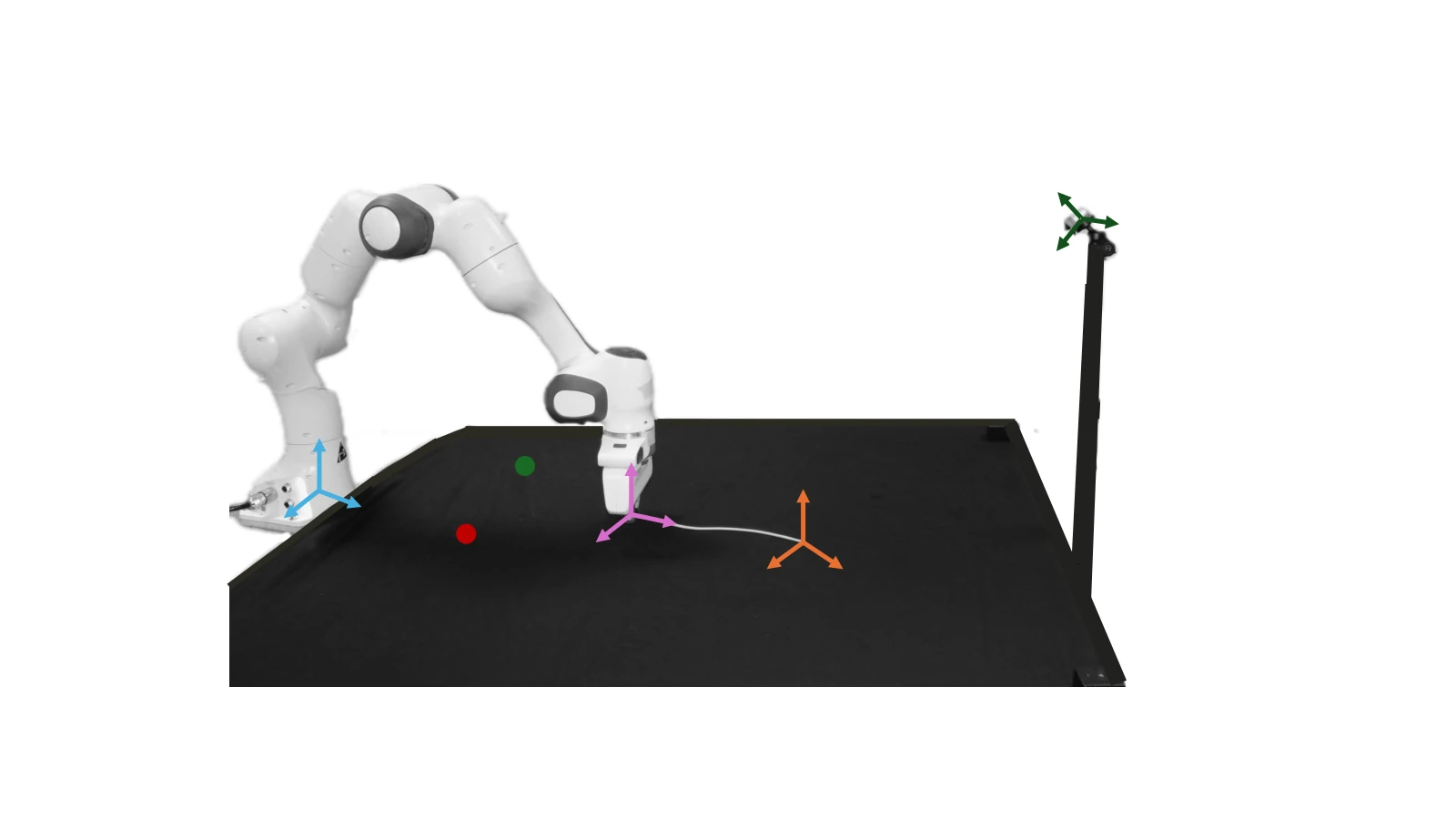
Evaluation scope The work studies planar Cartesian control of a one-end-grasped deformable linear object represented by task-relevant keypoints. Source
How it works
- The actor uses deployable observations while the critic receives additional privileged simulator information in an asymmetric actor-critic formulation. Source
- Policies use PPO with multilayer perceptrons and SiLU activations; robustness training randomizes friction and robot dynamics parameters per episode. Source
- The benchmark uses separate hyperparameter sweeps and five held-out training seeds, reporting final success rate, success-rate AUC, final reward, and reward AUC. Source
- The real-world platform is a Franka Emika Panda with a fixed Intel RealSense D435i camera operating at 30 Hz. Source
Evidence & results
- Within approximately 240 minutes, the GPU-parallel MuJoCo Playground stack converged faster and reached higher mean success than the CPU-based stacks. Evidence
- A two-point evaluation used five random seeds and 50 episodes per seed, for 250 episodes per condition. Evidence
- The jointly trained policy achieved success rates of 84.4%, 86.0%, and 86.4% for DLO lengths of 0.300 m, 0.375 m, and 0.450 m. Evidence
- The fine-tuned rope segmentation model achieved 98.81% precision, 99.13% recall, 98.97% F1, and 29.8 FPS inference in the reported evaluation. Evidence

Limitations & boundaries
- Two-point hardware evaluation succeeded in 8/10 trials, with failures associated mainly with perception loss, material effects, and latency. Source
- The demonstrated task is planar and task-specific; future work is needed for more complex shape control, three-dimensional manipulation, and broader generalization. Source
Takeaway
With five held-out seeds, MuJoCo Playground reached mean final success 0.950 plus or minus 0.032, compared with 0.860 plus or minus 0.108 for SB3 plus MuJoCo and 0.880 plus or minus 0.110 for SBX plus MuJoCo. Source
Resources
Figures: the paper's authors. Editorial source and image review: 2026-11-07. Findings are author-reported, not independently reproduced by Robotics Research Hub.
Original abstract
Deformable linear object (DLO) manipulation is challenging because high-dimensional configurations, nonlinear contact dynamics, and diverse material and geometric properties produce a broad range of object responses that are both difficult to model and data-intensive to learn. This work studies reinforcement learning for planar manipulation of a one-end-grasped DLO, focusing on training efficiency, observation design, robustness, and zero-shot sim-to-real transfer. We compare three Proximal Policy Optimization training stacks and find that the GPU-parallel MuJoCo Playground stack enables faster convergence and more consistent performance than CPU-based alternatives under the same wall-clock budget. Relative keypoint observations and an asymmetric actor-critic formulation further improve learning efficiency. Policies trained with observation noise, delay, domain randomization, and disturbances achieve simulation success rates of 96.4% for single-point tracking, 98.0% for disturbance recovery, and 88.8% for two-point tracking. Using markerless RGB-D keypoint estimation, the policies transfer without real-world fine-tuning, succeeding in 9/10, 10/10, and 8/10 physical trials, respectively.
Citation
@article{Rodrigues2026_261107261,
  title     = {An Empirical Study of Reinforcement Learning for Keypoint Positioning of Deformable Linear Objects},
  author    = {Vinay Rodrigues and Sara Zeynalpour and Gokhan Solak and Sebastian Hjorth and Arash Ajoudani},
  year      = {2026},
  eprint    = {2611.07261},
  archivePrefix = {arXiv},
  primaryClass  = {cs.RO},
  url       = {https://arxiv.org/abs/2611.07261}
}