
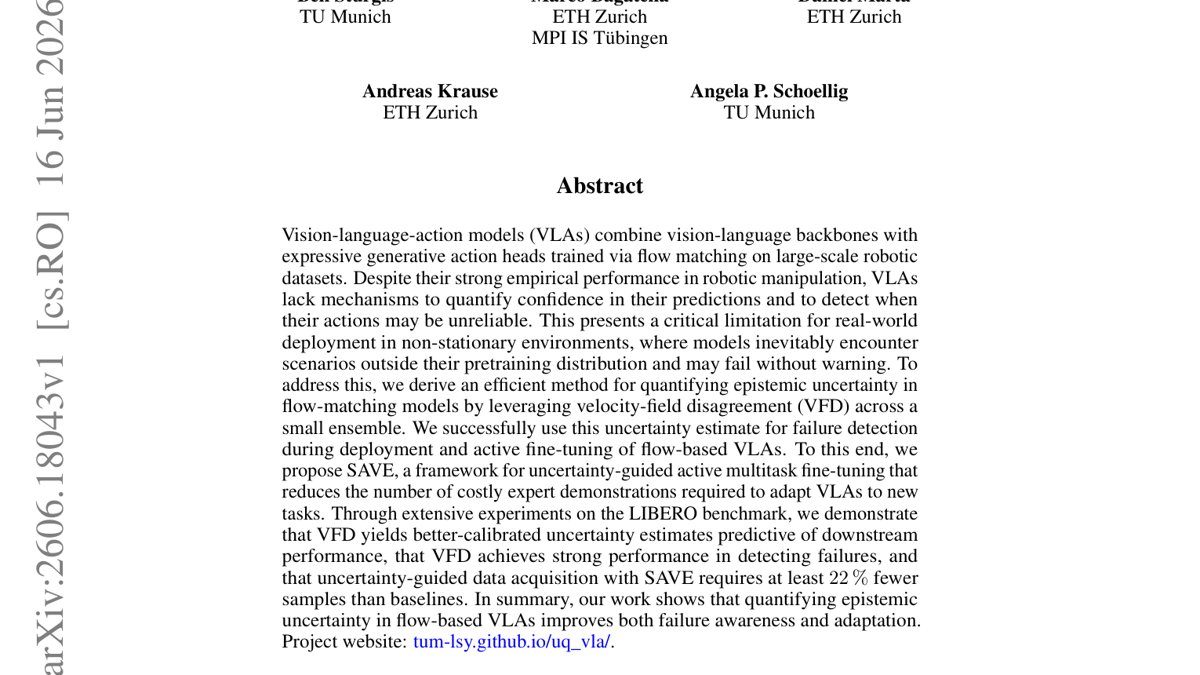
Uncertainty Quantification for Flow-Based Vision-Language-Action Models
FeaturedRalf Römer, Maximilian Seeliger, Saida Liu, Ben Sturgis, Marco Bagatella, Daniel Marta, Andreas Krause, Angela P. Schoellig · ETH Zürich / University of Toronto (Learning Systems & Robotics Lab) · 2026
Framework
PyTorch
License
N/A
Stars
N/A
Summary
Quantifies epistemic uncertainty in flow-matching VLAs using velocity-field disagreement (VFD) across a small ensemble, enabling failure detection at deployment and sample-efficient active fine-tuning (SAVE).
Abstract Summary
Key Points
- Introduces velocity-field disagreement (VFD) for epistemic uncertainty quantification in flow-matching VLAs
- Uses uncertainty for failure detection during deployment
- Proposes SAVE: uncertainty-guided active multitask fine-tuning requiring ≥22% fewer expert demonstrations
- Validated on LIBERO benchmark with better-calibrated uncertainty than baselines
- RSS 2026 Best Paper Award
Uncertainty Quantification for Flow-Based Vision-Language-Action Models
Authors: Ralf Römer, Maximilian Seeliger, Saida Liu, Ben Sturgis, Marco Bagatella, Daniel Marta, Andreas Krause, Angela P. Schoellig
Venue: RSS 2026 — Best Paper Award | Year: 2026
arXiv: 2606.18043 | PDF: link
Summary
Vision-language-action models (VLAs) combine vision-language backbones with expressive generative action heads trained via flow matching. While powerful, they lack any mechanism to quantify confidence or detect unreliable predictions — a critical gap for real-world deployment where out-of-distribution scenarios cause silent failures.
This paper introduces velocity-field disagreement (VFD), an efficient epistemic uncertainty estimate for flow-matching models. By measuring disagreement across a small ensemble of velocity fields, VFD provides calibrated uncertainty without significant computational overhead.
Key Contributions
-
VFD — Velocity-Field Disagreement: A scalable epistemic uncertainty quantification method specifically designed for flow-matching action heads in VLAs.
-
Failure Detection: VFD uncertainty scores effectively flag unreliable actions at deployment time, enabling safe intervention or fallback.
-
SAVE — Sample-efficient Active VLA finE-tuning: An uncertainty-guided active learning framework that selects which demonstrations to collect, reducing expert demonstration requirements by at least 22% compared to baselines on the LIBERO benchmark.
Why It Matters
- Safety: Flow-based VLAs can now express “I don’t know” — essential for non-stationary real-world deployment.
- Data Efficiency: Active fine-tuning with SAVE directly reduces the cost of adapting VLAs to new tasks.
- Award: RSS 2026 Best Paper — signals high-impact recognition from the robotics community.
Code & Data
| Resource | Link |
|---|---|
| Project page | https://tum-lsy.github.io/uq_vla/ |
| Code | https://github.com/learnsyslab/uq_vla |
| arXiv | https://arxiv.org/abs/2606.18043 |
| Benchmark | LIBERO |
Related Papers
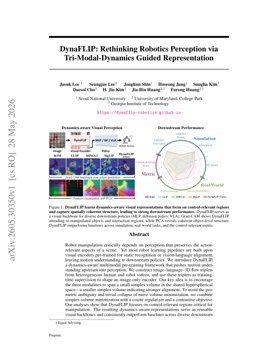
DynaFLIP: Rethinking Robotics Perception via Tri-Modal-Dynamics Guided Representation
Jusuk Lee, Seungjae Lee, Jonghun Shin et al. · arXiv preprint · May 2026
Robot manipulation critically depends on perception that preserves the action-relevant aspects of a scene. Yet most robot learning pipelines are built upon visual encoders pre-trained for static recog
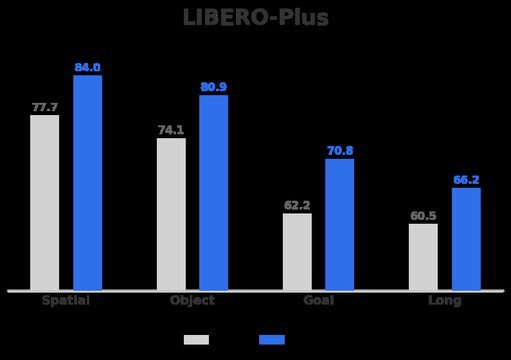
GuidedVLA: Specifying Task-Relevant Factors via Plug-and-Play Action Attention Specialization
Xiaosong Jia, Bowen Yang, Zuhao Ge et al. · RSS 2026 · May 2026
Vision-Language-Action (VLA) models aim for general robot learning by aligning action as a modality within powerful Vision-Language Models (VLMs). Existing VLAs rely on end-to-end supervision to implicitly enable the action decoding process to learn...
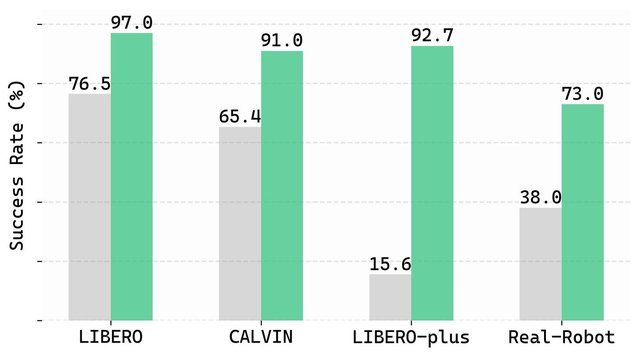
From Imagined Futures to Executable Actions: Mixture of Latent Actions for Robot Manipulation
Yajie Li, Bozhou Zhang, Chun Gu et al. · ICML 2026 · May 2026
Video foundation-models models offer a promising imagination mechanism for robot manipulation by predicting long-horizon future observations, but effectively exploiting these imagined futures for action execution remains challenging. Existing approaches...

Pre-VLA: Preemptive Runtime Verification for Reliable Vision-Language-Action and World-Model Rollouts
Zhen Sun, Yongjian Guo, Haoran Sun et al. · arXiv preprint · May 2026
A lightweight runtime verification layer that preemptively prunes unsafe VLA and world-model actions before they reach robot hardware, eliminating collision and droppage failures.