
At a glance
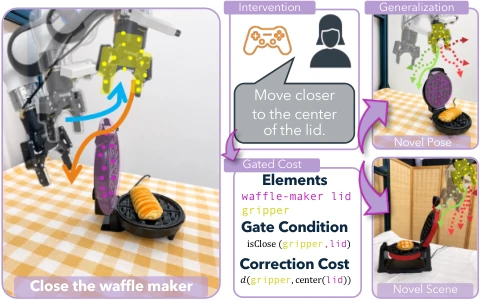
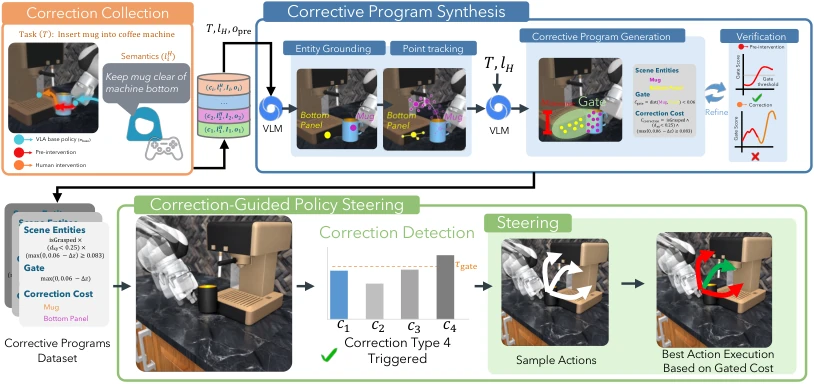
- Human intervention provides a corrective trajectory plus a semantic description, while the VLA controls the robot before the intervention and, when the episode continues, after the human returns control. Source
- A correction program contains entity labels, a gate, a correction term, and a task term. Source
- At deployment, candidate action chunks are predicted, ranked by their gated costs, and the lowest-cost candidate is executed. Source
Evaluation scope The method represents corrections as gated costs over semantically grounded scene entities and uses them to steer a frozen VLA. Source
How it works
- For each correction type, synthesis grounds relevant scene entities, proposes a gated cost, calibrates its threshold, and verifies and refines the proposal against intervention evidence. Source
- The gate threshold is calibrated from the minimum gate score observed in pre-intervention windows across the correction episodes. Source
- The ranking check tests whether the gate score rates the human correction as an improvement over pre-intervention behavior. Source
- During steering, candidate action chunks are ranked by their predicted gated costs, and the lowest-cost candidate is selected for execution. Source
Evidence & results
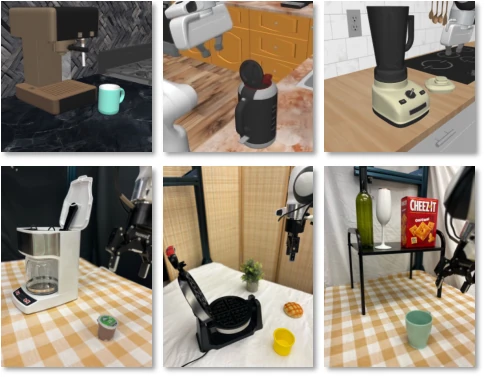
- In simulation, each method is evaluated over 50 episodes across three tasks, using 5–8 collected corrections per task. Evidence
- In real-world experiments, the evaluation uses DROID hardware and three tasks, with 3–6 semantic corrections per task. Evidence
- The abstract reports that real-world task progress improves from 35.1% to 61.0% and that corrections transfer to unseen poses, objects, and scenes. Evidence
- On CoffeeMug, the figure caption reports 84% success with 8 corrections for OopsieRecover versus 28% for HG-DAgger with three times as many corrections. Evidence
Limitations & boundaries
Takeaway
The reported results suggest that context-gated correction programs can improve execution and transfer corrections across object-pose and scene variations from a handful of interventions. Source
Resources
Figures: the paper's authors. Editorial source and image review: 2026-11-10. Findings are author-reported, not independently reproduced by Robotics Research Hub.
Original abstract
Vision-Language-Action (VLA) models can perform a wide range of robotic manipulation tasks, but often fail during deployment. Teaching them to recover from these failures requires substantial corrective data: existing approaches learn to recover from failures by directly associating corrective actions with the observations in which they were demonstrated. For instance, DAgger-like fine-tuning can require tens to hundreds of interactions, yet the resulting policy may still fail to generalize the learned corrections beyond the demonstrated scenarios. We hypothesize that semantics can capture the underlying reasons for failures and their corrections, enabling policies to learn from only a handful of corrective demonstrations and generalize those corrections to novel objects, and scene variations. We propose OopsieRecover, a framework that uses abduction to infer the intent behind a small set of corrective demonstrations and encodes the inferred knowledge as dense spatial representations and conditional costs. These costs capture when a behavior is undesirable and steer the policy toward more desirable action regions. We experiment across 6 tasks and variations in object poses, scenes, and related tasks, and find that only a handful of corrective demonstrations can enable a VLA to overcome failures across a broad range of novel situations, without requiring new corrective data for each variation. Please refer to https://robin-lab.cs.utexas.edu/oopsierecover for videos.
Citation
@article{Bahety2026_261108462v1,
  title     = {OopsieRecover: Learning Transferable VLA Corrections from Semantic Interventions},
  author    = {Arpit Bahety and Skand Peri and Sriniket Ambatipudi and Chen Xu and Haruki Nishimura and Masha Itkina and Roberto Martín-Martín},
  year      = {2026},
  eprint    = {2611.08462v1},
  archivePrefix = {arXiv},
  primaryClass  = {cs.RO},
  url       = {https://arxiv.org/abs/2611.08462v1}
}