
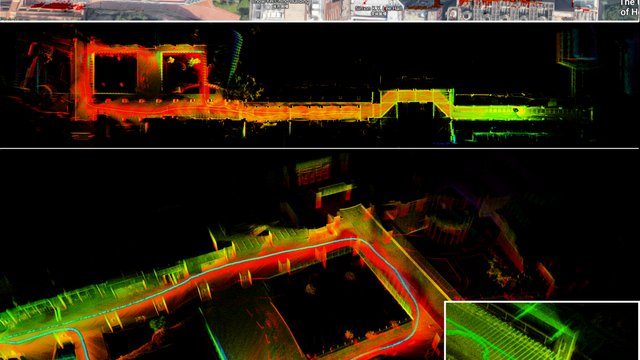
FAST-LIO2: Fast Direct LiDAR-Inertial Odometry
Wei Xu, Yixi Cai, Dongjiao He, Jiarong Lin, Fu Zhang · The University of Hong Kong · 2022
Framework
ROS / C++
License
MIT
Stars
4,707
Summary
A tightly-coupled LiDAR-inertial odometry system with incremental kd-tree mapping, enabling real-time state estimation for UAVs and mobile robots.
Abstract Summary
Key Points
- Tightly-coupled iterated Kalman filter fusing LiDAR and IMU at high frequency.
- Novel incremental ikd-Tree enables fast direct point registration without feature extraction.
- Runs at over 100 Hz onboard UAVs; tested on Livox, Ouster, and Velodyne sensors.
- Open-source ROS package with modular C++ backend and standalone ikd-Tree library.
- Widely adopted as odometry core in aerial, legged, and mobile manipulation platforms.
Additional Notes
Setup Tips
- For Livox sensors, use the official Livox ROS driver and check LiDAR firmware compatibility.
- Increase CPU governor to performance mode for consistent real-time performance.
- When mapping very large environments, tune mapping buffer size to avoid memory growth.
Related Papers
- FAST-LIO (Xu et al., ICRA 2022)
- R3LIVE (Lin et al., ICRA 2022)
- ikd-Tree (Cai et al., RAL 2021)
Related Papers
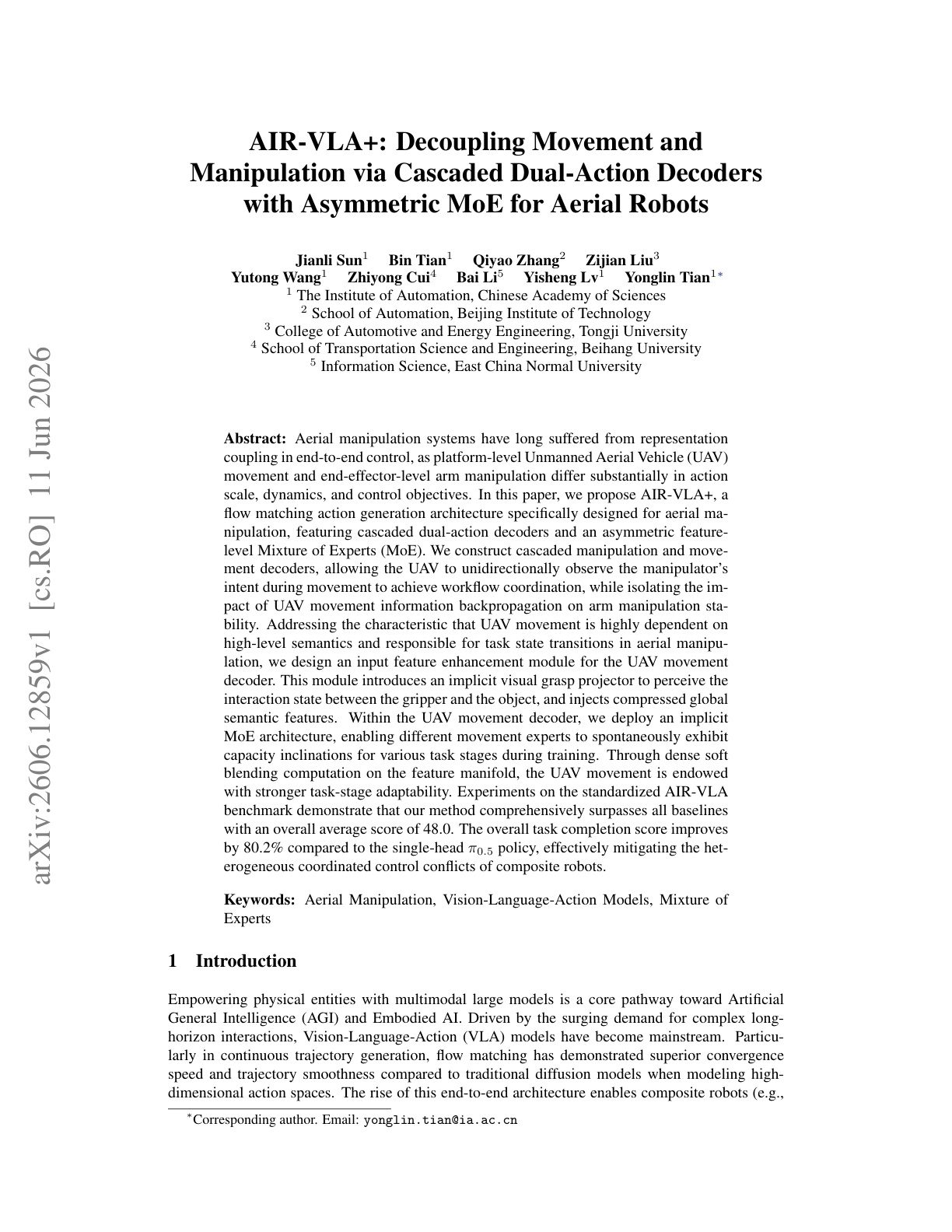
AIR-VLA+: Decoupling Movement and Manipulation via Cascaded Dual-Action Decoders with Asymmetric MoE for Aerial Robots
Jianli Sun, Bin Tian, Qiyao Zhang et al. · arXiv preprint · Jun 2026
Aerial manipulation systems have long suffered from representation coupling in end-to-end control, as platform-level Unmanned Aerial Vehicle (UAV) movement and end-effector-level arm manipulation differ substantially in action scale, dynamics, and control objectives. In this paper, we propose AIR-VL...

ALAM: Algebraically Consistent Latent Transitions for Vision-Language-Action Models
Zuojin Tang, Haoyun Liu, Xinyuan Chang et al. · arXiv · May 2026
Vision-Language-Action (VLA) models map visual observations and language instructions to robot actions through learned l...

AwareVLN: Reasoning with Self-awareness for Vision-Language Navigation
Wenxuan Guo, Xiuwei Xu, Yichen Liu et al. · arXiv preprint · May 2026
AwareVLN introduces selective self-aware reasoning for VLN agents, triggering explicit spatial and progress analysis only at uncertain waypoints to improve robustness and explainability.
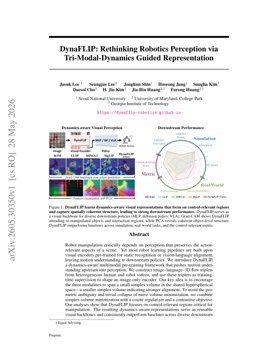
DynaFLIP: Rethinking Robotics Perception via Tri-Modal-Dynamics Guided Representation
Jusuk Lee, Seungjae Lee, Jonghun Shin et al. · arXiv preprint · May 2026
Robot manipulation critically depends on perception that preserves the action-relevant aspects of a scene. Yet most robot learning pipelines are built upon visual encoders pre-trained for static recog