DROID: A Large-Scale In-the-Wild Robot Manipulation Dataset

DROID: A Large-Scale In-the-Wild Robot Manipulation Dataset

Featured

Alexander Khazatsky, Karl Pertsch, Suraj Nair, Ashwin Balakrishna, Sudeep Dasari, Siddharth Karamcheti, Chelsea Finn, Sergey Levine · Stanford, UC Berkeley · 2024

Framework

PyTorch

License

Apache-2.0

Stars

362

Summary

A 350-hour dataset of diverse real-world robot manipulation across 22 robots in 71 scenes, designed to train scalable and generalist imitation learning policies.

Abstract Summary

DROID is arguably the largest and most diverse open-source robot manipulation dataset available to date. Released by researchers at Stanford and UC Berkeley for RSS 2024, it aggregates over 350 hours of teleoperated robot demonstrations collected across 22 different robot platforms operating in 71 distinct real-world households and laboratories. Each trajectory includes high-resolution stereo RGB video, proprioceptive joint states, end-effector poses, gripper forces, and text task descriptions. The dataset is intentionally designed for diversity rather than scale on any single task. It covers a wide variety of everyday manipulation primitives: opening drawers, picking fruits, pouring liquids, tying knots, and repositioning household objects. By collecting across many different robot morphologies (single-arm, dual-arm, mobile manipulators, gripper types) and many different environments, DROID provides the kind of breadth needed to train generalist policies rather than narrow task-specific ones. The authors benchmark several imitation learning methods on DROID, showing that policies pretrained on the full dataset and then fine-tuned on a small target task outperform policies trained from scratch. The dataset includes standardized train/validation splits, preprocessed observation sequences, and an evaluation server. A PyTorch dataloader and dataset viewer are provided, making it straightforward to integrate DROID into existing training pipelines. DROID fills a critical gap in robot learning: while simulation datasets can scale to billions of samples, they lack the visual and physical diversity of the real world. DROID provides a real-world counterpart at a scale large enough to train meaningful generalist models. It has become a standard benchmark for imitation learning and VLA pretraining, alongside Open X-Embodiment. For researchers building the next generation of generalist robot policies, DROID is an essential starting point.

Key Points

  • 350+ hours of real-world manipulation across 22 robots and 71 diverse environments.
  • Designed for diversity: many tasks, many scenes, many robot embodiments.
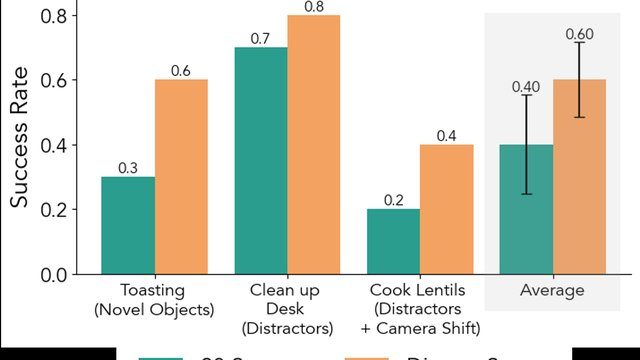
  • Pretraining on DROID then fine-tuning outperforms training from scratch.
  • Standard train/val splits, PyTorch dataloader, and evaluation server provided.
  • Became a standard benchmark alongside Open X-Embodiment for VLA training.
Share

Related Papers

X-Imitator: Spatial-Aware Imitation Learning via Bidirectional Action-Pose Interaction

X-Imitator: Spatial-Aware Imitation Learning via Bidirectional Action-Pose Interaction

Kai Xiong, Hongjie Fang, Lixin Yang et al. · arXiv · May 2026

Effectively handling the interplay between spatial perception and action generation remains a critical bottleneck in robotic manipulation. Existing methods typically treat spatial perception and action execution as decoupled or strictly...
imitation-learning manipulation foundation-models
PDF Intermediate
No code repo May 2026
LeRobot: A Library for Real-World Robot Learning

LeRobot: A Library for Real-World Robot Learning

Remi Cadene, Simon Alibert, Alexander Soare et al. · NeurIPS 2024 Workshop · Jun 2024

Hugging Face's LeRobot is an open-source PyTorch framework providing pretrained models, datasets, and training scripts for imitation and reinforcement learning on real robots, lowering the entry barrier to robot learning.
imitation-learning rl foundation-models manipulation
Code PDF Beginner
GitHub ★ 24,333 Code updated: May 2026
Octo: An Open-Source Generalist Robot Policy

Octo: An Open-Source Generalist Robot Policy

Dibya Ghosh, Homer Walke, Karl Pertsch et al. · RSS 2024 · Jul 2024

Octo is a large open-source transformer-based generalist robot policy trained on 800k trajectories, supporting language-conditioned and goal-image-conditioned control across 9 robotic platforms with efficient fine-tuning on consumer GPUs.
foundation-models manipulation imitation-learning open-source
Code PDF Intermediate
GitHub ★ 1,652 Code updated: May 2026
Open X-Embodiment: Robotic Learning Datasets and RT-X Models

Open X-Embodiment: Robotic Learning Datasets and RT-X Models

Open X-Embodiment Collaboration · arXiv · Oct 2023

The largest collaborative robot learning dataset ever assembled, spanning 22 robots from 21 institutions, enabling training of generalist RT-X policies that exhibit positive cross-embodiment transfer.

imitation-learning foundation-models manipulation dataset
Code PDF Intermediate
GitHub ★ 1,853 Code updated: May 2026